Complete Guide to Wakizashi Construction Variations: Hira-zukuri, Shinogi-zukuri, Kiribe-zukuri, and Unokubi-zukuri
 * Image is for illustrative purposes only.
Table of Contents
Wakizashi and Tsukurikomi
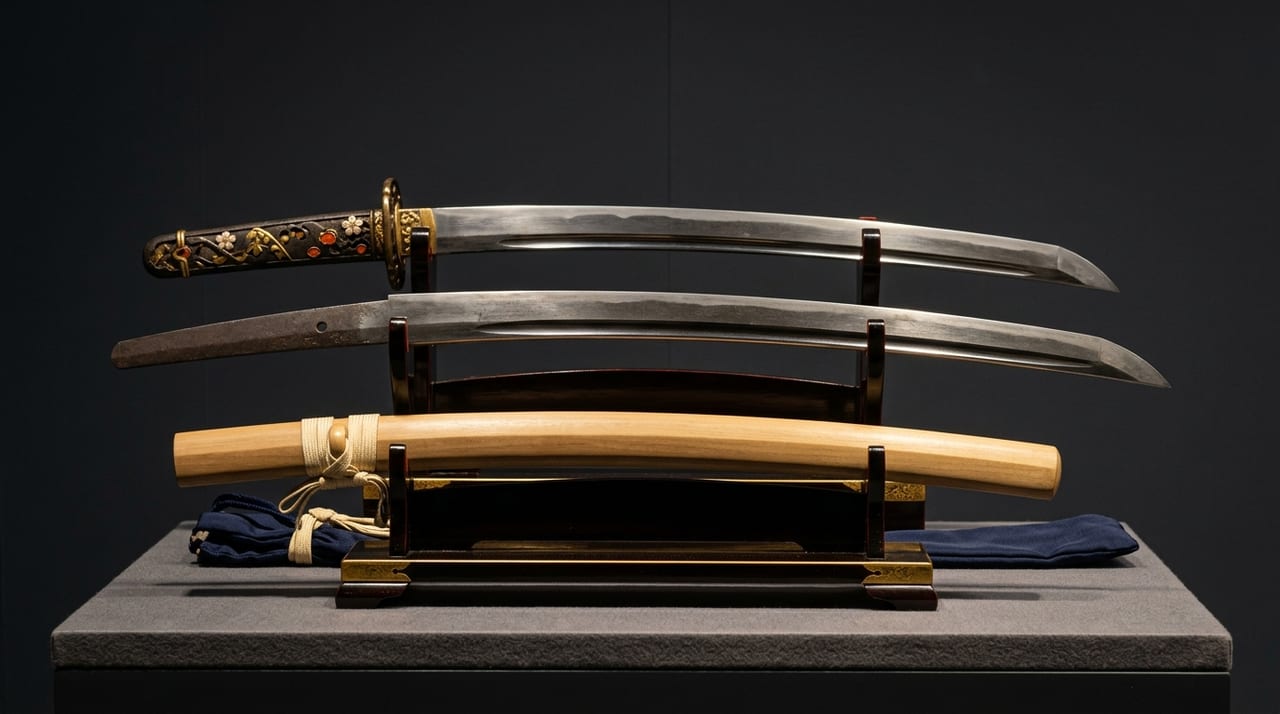
Wakizashi are swords with blade lengths of 1 shaku or longer and less than 2 shaku (approximately 30-60 cm), representing the shorter of the "daishō" pair that samurai wore alongside the large sword (uchigatana or tachi). Wakizashi employ diverse tsukurikomi due to their wide range of blade lengths, making the classification of blade shape an important perspective in authentication.
The definition of wakizashi blade length, "1 shaku or longer and less than 2 shaku," has become established as a formal classification (with tantō = less than 1 shaku, and uchigatana/tachi = 2 shaku or longer being the general boundaries).
Hirazukuri
Hirazukuri is a tsukurikomi with a flat cross-section lacking the shinogi (ridge line) on the blade surface. It is most common in tantō but is also widely used in wakizashi.
Characteristics:
- The hamon can be observed broadly, and the jigane (steel texture) grain is also clearly visible
- The blade is lightweight and suitable for carrying
- A basic form manufactured widely across all periods from the Kamakura to Edo periods
- Has no yokote, with blade width tapering continuously to the point
Hirazukuri wakizashi often have longer blade lengths, and those exceeding 1 shaku 5 sun are prized as "sun-nobi wakizashi" (elongated wakizashi). Key viewing points are the flow of the hamon and the grain of the jigane; since the grain is exposed broadly, visibility is excellent.
Craftsmen of the Kamakura period, such as those from the Awataguchi and Rai lineages, were known masters of hirazukuri wakizashi and tantō, and Yoshimitsu's hirazukuri works are regarded as among the finest tantō and wakizashi in Japanese sword history.
Shinogizukuri
Shinogizukuri is the standard cross-sectional shape with the shinogi line running along the blade surface, similar to tachi and uchigatana, and is also widely adopted in wakizashi.
- Greater rigidity and strength than hirazukuri, capable of withstanding use in combat
- When curvature is present, the form closely resembles uchigatana, and cases where it is difficult to distinguish from "sun-tsumari" (shortened uchigatana) can occur
- In Edo period wakizashi, shinogizukuri was standard
The blade length is the criterion for distinguishing shinogizukuri wakizashi from uchigatana. A shinogizukuri blade that does not reach 2 shaku (approximately 60 cm) is classified as wakizashi. In authentication, the shape of the nakago (tang), the direction of the mei (signature), and actual measurement of blade length are the axes of judgment.
Kiriha-zukuri
Kiriha-zukuri is a special cross-sectional shape where a flat surface remains on the "mune" (spine) side of the blade, while the shinogi is raised only on the "ha" (edge) side.
- The blade edge cross-section is wedge-shaped (kusabi-gata), providing enhanced cutting penetration
- Primarily seen in classic-form large wakizashi and swords from the Nanboku-chō to Muromachi periods
- Numerous representative examples exist among swords by Sōshū-den and Yamato-den craftsmen
- Less common after the Shintō period, though there are examples made in a revivalist manner during the late Edo period
Kiriha-zukuri is said to have developed during the tumultuous Nanboku-chō period (14th century) from a perspective emphasizing practical combat use. The wedge-shaped cross-section on the edge side increases penetrating power when cutting.
Unokubi-zukuri
Unokubi-zukuri is a special tsukurikomi where the mune and shinogi near the kissaki (point) and the lower half are retained, with the shinogi-ji (side metal) in the middle section shaved away to thin the mune side. Viewed from the side, the outline tapers like a cormorant's neck, which is the origin of its name.
Specific cross-sectional structure:
- The upper portion's shinogi is high and thin near the mune
- Near the kissaki the shinogi becomes thick again
- As a result, the overall blade outline exhibits a "taper-then-broaden" contour
- A classic form seen in tachi and large wakizashi
- The beautiful curved lines of the blade are points of appreciation
- Representative examples are numerous from the Kamakura to Nanboku-chō periods, with masterpieces by craftsmen of the Awataguchi and Rai lineages
- The unokubi works by renowned late Kamakura masters such as Rai Kunitoshi and Shintōgo Kunimitsu receive high evaluation
Kanmuri-otoshi-zukuri
Kanmuri-otoshi-zukuri is a tsukurikomi characterized by a cross-section where the mune side near the kissaki has been shaved away, designed to enhance thrusting power.
- The blade tip becomes nearly triangular in cross-section, increasing penetrating power
- Common in tantō and wakizashi
- The name "kanmuri-otoshi" derives from the shape as if the "crown" of the mune has been removed
Correspondence Between Tsukurikomi and Lineage/Swordsmith
Each tsukurikomi often corresponds to specific lineages and periods:
| Tsukurikomi | Typical Lineage/Period |
|---|---|
| Hirazukuri | Kamakura to Edo period generally, Awataguchi and Bizen-den lineages |
| Shinogizukuri | Edo period Yamato, Mino, and Sōshū lineages |
| Kiriha-zukuri | Nanboku-chō to Muromachi, Sōshū and Yamato lineages |
| Unokubi-zukuri | Late Heian to Kamakura period classical works, Rai and Awataguchi lineages |
| Kanmuri-otoshi-zukuri | Nanboku-chō period and late Edo revivalist works |
Appreciation Points: Wakizashi Tsukurikomi
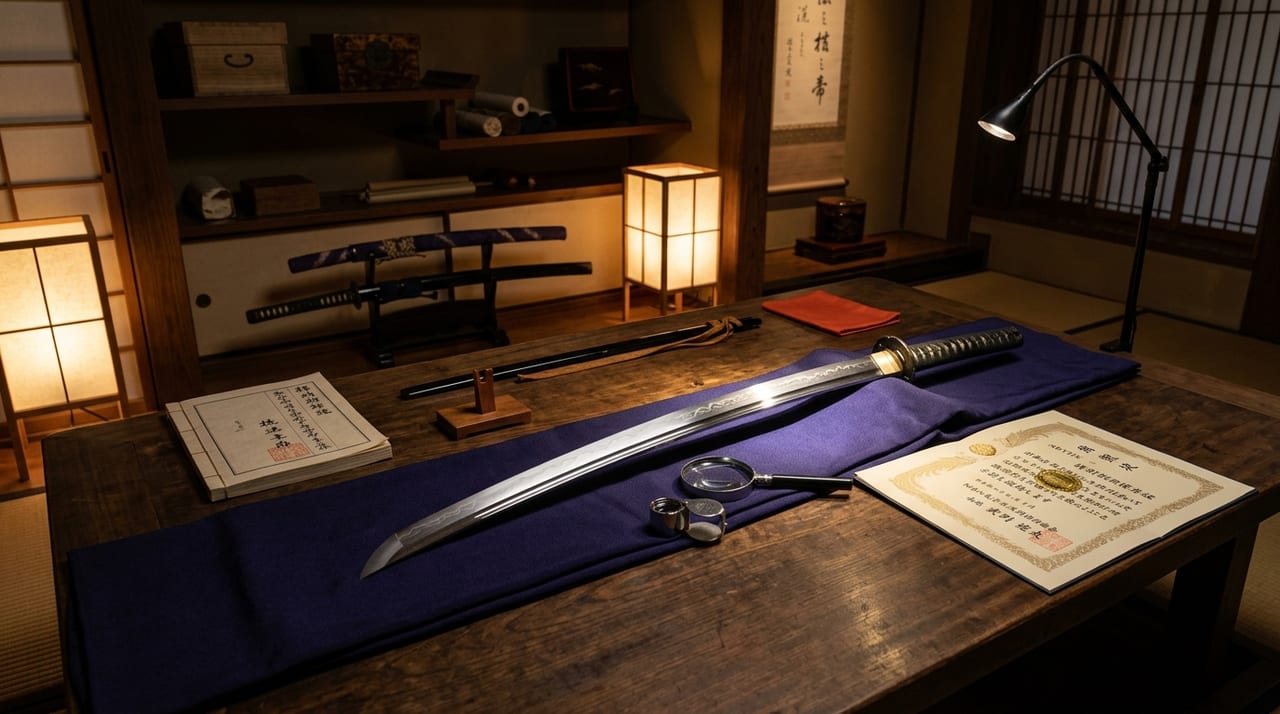
When appreciating and evaluating wakizashi, tsukurikomi is checked first as a "first impression." The actual procedure in authentication is as follows:
- Hold the blade in seigan stance: Confirm overall form, curvature, and proportions of blade length
- Determine tsukurikomi: From the presence or absence of shinogi, presence or absence of yokote, and cross-sectional shape, determine whether the blade is hirazukuri, shinogizukuri, kiriha-zukuri, etc.
- Observe the hamon: Under light, confirm the quality of the edge and jigane. Hamon observation is easiest with hirazukuri
- Examine the nakago: Check the patina color, shape, presence or absence of mei, and number of mekugi holes
Tsukurikomi Evaluation in NBTHK Authentication
In NBTHK examinations (Hozon, Tokubetsu Hozon, Jūyō Tōken, etc.), whether the tsukurikomi is consistent with the period and lineage is an important evaluation criterion. For example, if a wakizashi attributed to "late Heian Bizen" exhibits Edo period shinogizukuri, there is a contradiction in period determination. Tsukurikomi is always confirmed as the "first impression" in sword authentication.
A wakizashi where period, lineage, and tsukurikomi are all consistent is described as having "well-proportioned form," which itself becomes a significant positive in appreciation and evaluation. Conversely, when tsukurikomi is inconsistent with the period, the possibility of later modification (suriage shortening, reworking, etc.) is suspected.