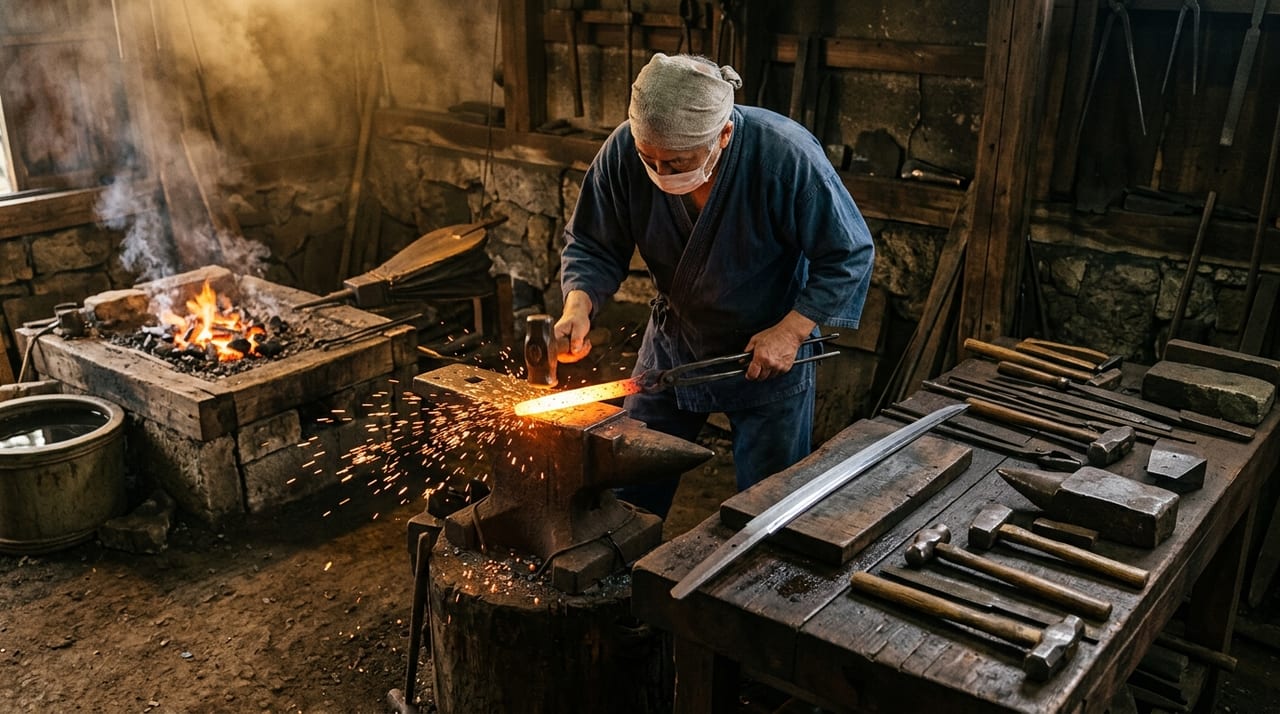
 * Image is for illustrative purposes only.
Hizen Tadayoshi
肥前忠吉
Description
Hizen Tadayoshi (1st generation) was a swordsmith active in Hizen Province, Saga, from the late Azuchi-Momoyama period through the early Edo period, and is known as the founder of the Hizen sword school (Hizen Tadayoshi lineage). His personal name was Hashimoto Shinzaemon, and he was born around Genki era (c. 1571–72) in Nagase, Takagise Village, Saga District. The Hashimoto family was a household that served the Sengoku daimyo Ryūzōji, but during the Battle of Okita-Nawa in Tenshō 12 (1584), Tadayoshi lost his grandfather and father. The young Tadayoshi then entered the path of sword forging. Later, he was recognized by Nabeshima Katsushige, the first daimyo of Saga domain, traveled to Kyoto in Keichō 1 (1596) to study under Umetada Myōju, a celebrated master of Yamashiro Province, and returned home in Keichō 3 (1598). He established himself below Saga Castle and was retained by the domain as a swordsmith, thus founding the Hizen sword lineage. In his later years, in Genna 10 (1624), he received the title Musashi-no-Daijō and changed his name to Tadahiro, signing his blades as "Musashi-no-Daijō Fujiwara Tadahiro." He died in Kanei 9 (1632). His signatures evolved over time through various forms—five-character signatures featuring the character Tada, "resident" signatures, and others—and the boldly distinctive cutting style seen in his early to middle period is known as the "Shūgan signature."
His style is characterized by taking the Yamashiro school tradition, which he learned under Kyoto's Umetada Myōju, and refining and fully assimilating it. The jigane is finely and densely packed, displaying the dense and uniform grain pattern known as ko-nuka-hada, which would later be transmitted through his lineage as the distinctive Hizen-hada characteristic of Hizen swords. His hamon is most skillfully expressed in bright, elegant straight edges with clear nioi, though he also undertook splendid compositions interspersing gunome-chōji patterns. His style—dignified and graceful, representing the assimilation of Yamashiro elegance—is highly regarded as an exemplary refinement of the Shintō period.
The lineage founded by Tadayoshi produced numerous branches, beginning with the 2nd generation Ōmi-no-Daijō Tadahiro and the 3rd generation Mutsu-no-Kami Tadayoshi, as well as offshoots such as Kawachi-no-Daijō Masahiro. Under the generous protection of Saga domain, the school flourished throughout the Edo period. The domain protected sword manufacture as one of its major industries, and the lineage continued through nine generations until the end of the shogunate, producing over one hundred swordsmiths—an unparalleled scale among provincial swordsmith lineages of the Shintō period.
In terms of evaluation, the 1st generation Tadayoshi is ranked among the highest-quality masters of the Shintō period, and his skill is considered befitting the founder of one of the period's most prestigious schools. He also excelled in practical application: in the Edo-period text Kaihō Kenshaku, which records sword cutting ability, Hizen swordsmiths were selected among the highest grade of wazamono, and the 1st generation Tadayoshi is counted among them. His combination of artistic elegance and practical effectiveness as a wazamono reveals the exceptional quality of Hizen Tadayoshi as a swordsmith.
Famous Works
- Katana, signed Hizen no kuni jū Fujiwara Tadahiro, dated Kan'ei 7, 8th month, auspicious day (Saga Prefectural Important Cultural Property)