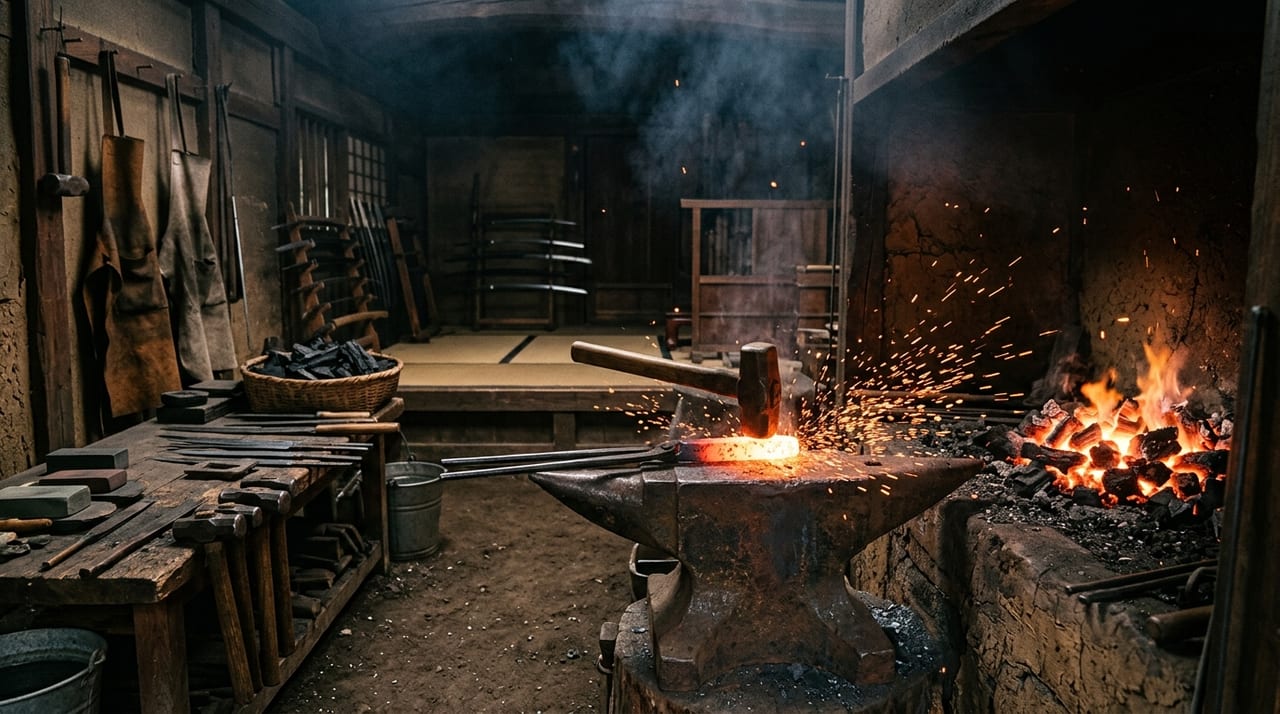
 * Image is for illustrative purposes only.
Mutsu-no-kami Yoshiyuki
陸奥守吉行
Description
Mutsu no Kami Yoshiyuki was a swordsmith of the shintō period who was active around the Genroku era in the mid-Edo period. His birthplace is said to be either Nakamura in Mutsu Province (present-day Sōma City, Fukushima Prefecture) or Sumiyoshi in Settsu Province (present-day Sumiyoshi Ward, Osaka City), and it is uncertain which. He first went to Osaka, where he entered the studio of the first-generation master Yamato no Kami Yoshimichi of the Mishina school and learned sword forging. Later, during the Genroku era, he was invited into the Tosa Domain, became a kaji bugyō (forge magistrate), and vigorously forged bantō (guard swords) for the domain's samurai, which is why he is also called “Tosa Yoshiyuki.” As his jūryōmei, he was granted the title Mutsu no Kami. In his later years he is said to have returned to Osaka and ended his life there. He was a swordsmith who left a considerable influence on the sword-making history of Tosa, in that he brought the forging techniques cultivated in Osaka to the southern province of Tosa.
His style followed the Osaka shintō manner of his teacher Yamato no Kami Yoshimichi, and he fired splendid midare-ba in which gunome were mixed with chōji. After moving to Tosa, he produced many practical swords for the domain, and he shows spirited work with gunome-chōji hamon with ashi. His skill is highly regarded, and he is positioned as a swordsmith of high-grade work (jōsaku).
What made the name of Mutsu no Kami Yoshiyuki widely known was that it was the sword worn by Sakamoto Ryōma, a patriot of the late Edo period. The sword was originally a family treasure passed down in the Sakamoto family. In Keiō 2 (1866), Ryōma requested it from his elder brother Gonpei, the head of the family, and he received it the following year, Keiō 3 (1867). Ryōma treasured the sword, and it is said that he kept it close at hand even during the Ōmi-ya Incident, in which he was assassinated at Ōmi-ya in Kyoto in Keiō 3 (1867). After Ryōma's death the sword remained in the Sakamoto family, but it was damaged in a fire during the Taishō period and was later re-polished. As a result, its original appearance and the cut marks from the assassination are said to have been lost.
Because the re-polishing made the original hamon no longer visible, it was debated for years whether this sword was truly the one Ryōma had worn. It was donated to the Onshi Kyoto Museum (present-day Kyoto National Museum) in Shōwa 6 (1931) and became part of its collection. However, in recent research a distinctive hamon characteristic of Yoshiyuki was confirmed on the re-polished blade, and together with an examination of letters passed down in the Sakamoto family, researchers including Miyagawa Teiichi judged it to be the Mutsu no Kami Yoshiyuki that Ryōma carried during the Ōmi-ya Incident. It is still held by the Kyoto National Museum and is cherished by many people both as a sword Ryōma loved and as a representative work of Yoshiyuki, linking Osaka shintō to Tosa.
Famous Works
- Mutsunokami Yoshiyuki (Kyoto National Museum)