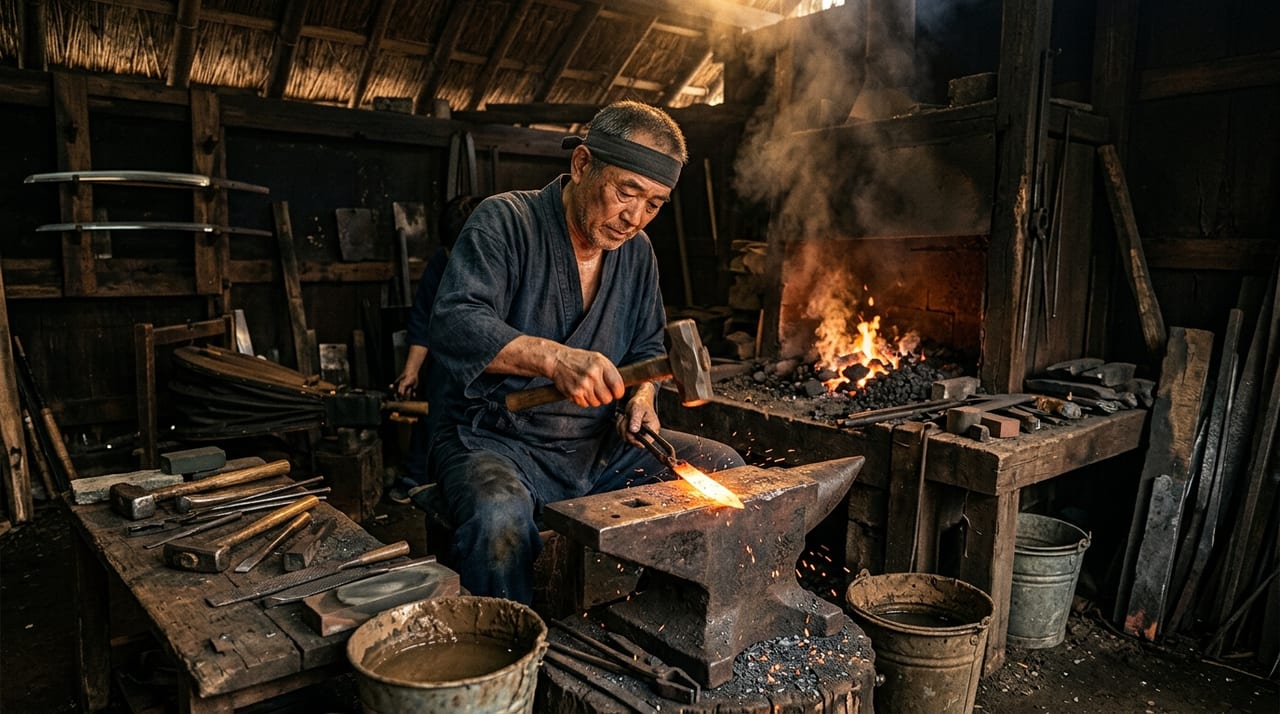
 * Image is for illustrative purposes only.
Suishinshi Masahide
水心子正秀
Description
Suishinshi Masahide was a swordsmith who flourished in the late Edo period. He was born in Kan'en 3 (1750) in Nakayama-mura Suwahara in the territory of Yonezawa Domain, Dewa Province (present-day Minami Yonezawa City, Yamagata Prefecture). His birth name was Kawabe Gihasshirō, and his childhood name was Sanjirō. After losing his father at an early age and being raised by his principal branch family, he entered a blacksmith's workshop as an apprentice around age eighteen, and in Meiwa 8 (1771) apprenticed himself to a swordsmith of the Shimohara school in Hachiōji, Musashi Province, where he learned the techniques of sword-making. In An'ei 3 (1774), his skill was recognized and he was employed by Akimoto Nagatoyo, the daimyo of Yamagata Domain; around this time he began using the name "Suishinshi." In Temmei 1 (1781), he went to Edo and continued sword-making from a forge within the inner residence of the Akimoto household in Nihonbashi Hamachō.
Masahide's greatest achievement was the proposal of what is called the "fukkotō-ron" (revival sword theory). In the context of a prolonged period of peace, swords increasingly inclined toward ornamental elaboration and lost their practical martial function; he criticized the style of contemporary shintetsu (new swords) and argued that the Japanese sword should return to the ways of the kotō (old swords), particularly of the Kamakura period and earlier. He conducted repeated research on ancient works and pursued his ideal by delving even into ancient forging methods and iron-smelting practices. Moreover, what deserves special mention is that he generously disclosed sword-making techniques that had traditionally been kept secret, publishing more than a dozen written works, including the Kenkō Hiden Shi, Tōken Jitsuyōron, and Tōken Bengi. Over his lifetime, he forged more than 360 swords and his disciples numbered more than one hundred, ranging from Dewa in the north to Satsuma in the south. As a leader of the shinshintetsu period, he came to be called in later generations the "founder of shinshintetsu."
His style underwent major changes throughout his lifetime. Shortly after going to Edo, he studied the Sōshū and Bizen school traditions, and excelled at copying works by such master smiths of Osaka shintetsu as Tsuda Sukehiro and Inoue Shinkai. From around the Temmei period onward, he actively forged brilliant hamon featuring tōran-midare (wave pattern) in the Sukehiro style. However, in his later years, after advocating the fukkotō-ron, he shifted his style to follow ancient works of the Bizen and Sōshū traditions, putting his theory into practice. He forged gunome-chōji and chōji-midare with a nioi-dekite quality, as well as suguha patterns. His jigane featured well-refined itame-hada with thick jinie. The deeply curved, practically-oriented sugata characteristic of his work reflected his philosophy of restoring the Japanese sword to its original martial purpose.
Many notable smiths emerged from his workshop. Among them were Taikei Naokane, Hosokawa Masayoshi, and Chōunsai Tsunatoshi, who were versed in all Five Schools and excelled particularly in the Bizen and Sōshū traditions; his school exercised tremendous influence over the shinshintetsu sword-forging world. Suishinshi Masahide, together with Taikei Naokane and Minamoto Kiyomaro, is ranked among the "Edo Sansaku" (Three Masters of Edo), representing the foremost smiths of the shinshintetsu period. In addition to his excellent sword-forging skill, he is classified as jōsaku (upper grade) and accorded high esteem as a rare educator who trained many disciples and transmitted his theory to posterity.
Famous Works
- 刀(復古刀)