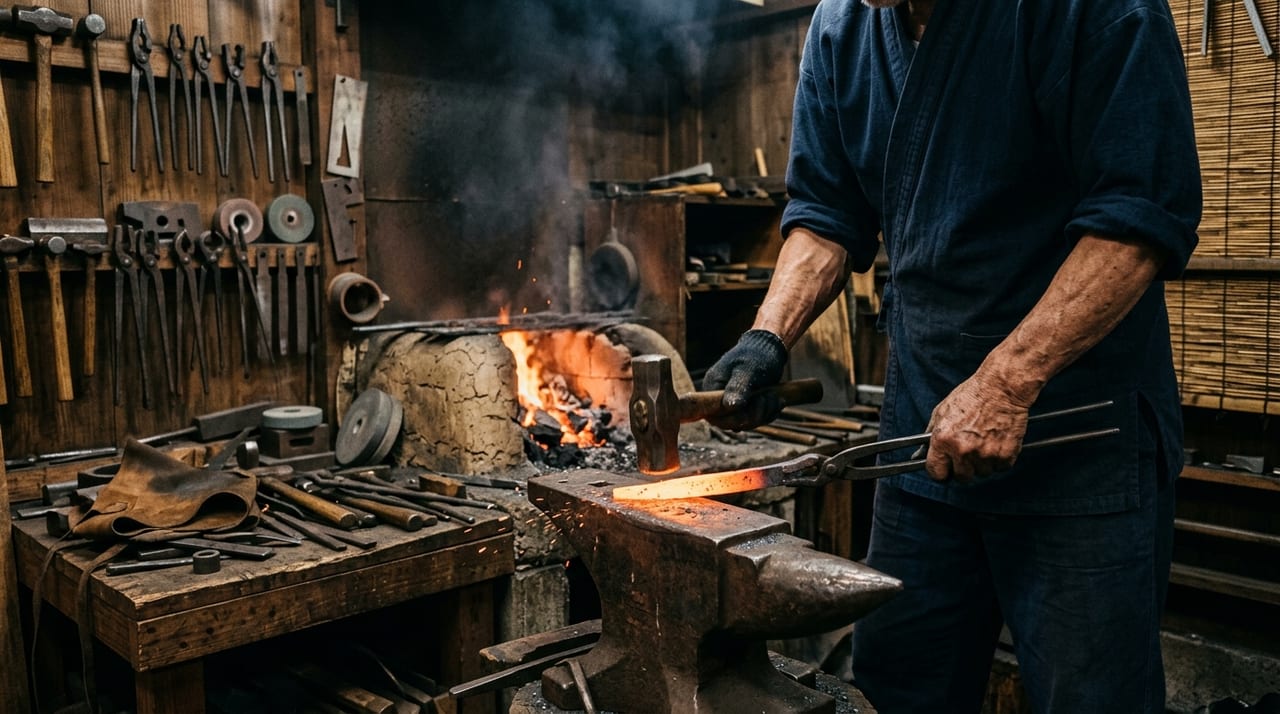
 * Image is for illustrative purposes only.
Yoshihara Yoshindo
吉原義人
Description
Ambassador of the Sword Across Borders—Yoshihara Yoshindo
Yoshihara Yoshindo is a contemporary swordsmith who has been active across three eras: Shōwa, Heisei, and Reiwa. In terms of international recognition, he is one of the most widely known living swordsmiths. He is based in Katsushika Ward, Tokyo, and his contributions to spreading Japanese sword-making techniques and culture overseas are immeasurable.
One of the works that spread Yoshihara's name overseas is THE CRAFT OF THE JAPANESE SWORD, an English-language book published in 1987 and co-authored with Leon Kapp and Hiroko Kapp. As an English-language book that explains the Japanese sword-making process in detail, it was widely read by sword enthusiasts, researchers, and museum professionals in Europe and the United States.
From Tokyo's Shitamachi to the World—The History of the Yoshihara School
The Yoshihara family's sword-making begins with the grandfather, Yoshihara Kuniie I (1893–1970), who studied under Kurihara Hikosaburō and became a representative swordsmith of the early Shōwa period. Yoshindo was born in 1943 in Setagaya, Tokyo, as the eldest son of Yoshihara Kuniie II (Yoshihara Masahiro). From an early age, he helped with sword-making under his grandfather and father. He currently operates a forge in Takasago, Katsushika Ward, Tokyo.
After sword-making resumed in postwar Japan, the Yoshihara family functioned as an important base for contemporary swords in Tokyo. In 1972, Yoshindo received the Tokushō (Special Prize) and the Commissioner for Cultural Affairs Prize at the Shinsaku Meitō-ten (New Sword Exhibition). The following year, he became the first recipient of the newly established Prince Takamatsu Prize. In 1982, he was certified as Mukansa by the NBTHK (Society for the Preservation of Japanese Art Swords).
Characteristics of His Work—Reproducing the Bizen Tradition
Yoshihara Yoshindo's works aim to reproduce ancient famous blades of the Bizen tradition. By vividly reproducing utsuri, which is considered the most difficult aspect of the Bizen tradition, he pioneered the boom in Bizen-tradition Japanese swords.
In the hamon, he excels at gorgeous chōji-midare (Yoshihara chōji), characterized by large differences in wave height that resemble petals arranged in a row. His refined carving skill is also highly praised.
In works intended for international exhibitions and collections, he clearly shows the stylistic characteristics of Japanese swords while achieving a universal beauty that appeals to foreign aesthetic sensibilities. This forms the technical foundation of Yoshihara Yoshindo's high international reputation.
The International Spread of Japanese Sword Culture—Yoshihara's Mission
The most notable aspect of Yoshihara Yoshindo's activities is the role he has played in the international spread of Japanese sword culture as a whole, not just sword-making technique. In addition to the English-language book mentioned above, his activities include providing works to overseas museums and cultural institutions, cooperating with exhibitions, and accepting visits from foreigners to his workshop. These have greatly contributed to positioning Japanese swords not merely as weapons but as art objects and cultural properties recognized by the world.
In the contemporary sword world, many swordsmiths known in Japan as master swordsmiths are barely known overseas. The name Yoshihara Yoshindo, however, is known to Japanese sword enthusiasts and researchers around the world, and his international brand has become something that raises the value of Japan's sword culture as a whole.
The Next Generation of the Yoshihara School—Continuing Tradition
Yoshihara Shōji, Yoshindo's younger brother, is also known as an excellent swordsmith. The Yoshihara school functions as an important family of swordsmiths in the present day. Yoshihara Yoshikazu (1967–2018), Yoshindo's eldest son, was certified as Mukansa at the youngest age in history. Many master swordsmiths have also emerged from disciples who trained under Yoshindo, including Ōno Yoshimitsu. In this way, the Yoshihara techniques and spirit are being passed on to the next generation.
TOUKENZA and Yoshihara Yoshindo
TOUKENZA introduces Yoshihara Yoshindo as a contemporary "ambassador of the sword" who continues to communicate the value of Japanese swords to the world. As a swordsmith of the highest technical level and a bridge for Japanese sword culture internationally, Yoshihara continues to demonstrate that Japanese swords are works of art that deserve recognition as cultural properties of the world. Yoshindo's achievements in conveying the spirit of the living Japanese sword to the world are also becoming an important foundation for the future of Japanese swords.
Famous Works
- Tachi, sacred treasure for the Ise Grand Shrine Shikinen Sengū (chosen as maker 3 times)
- Wakizashi (donated to the Museo Nazionale del Bargello in 2005)