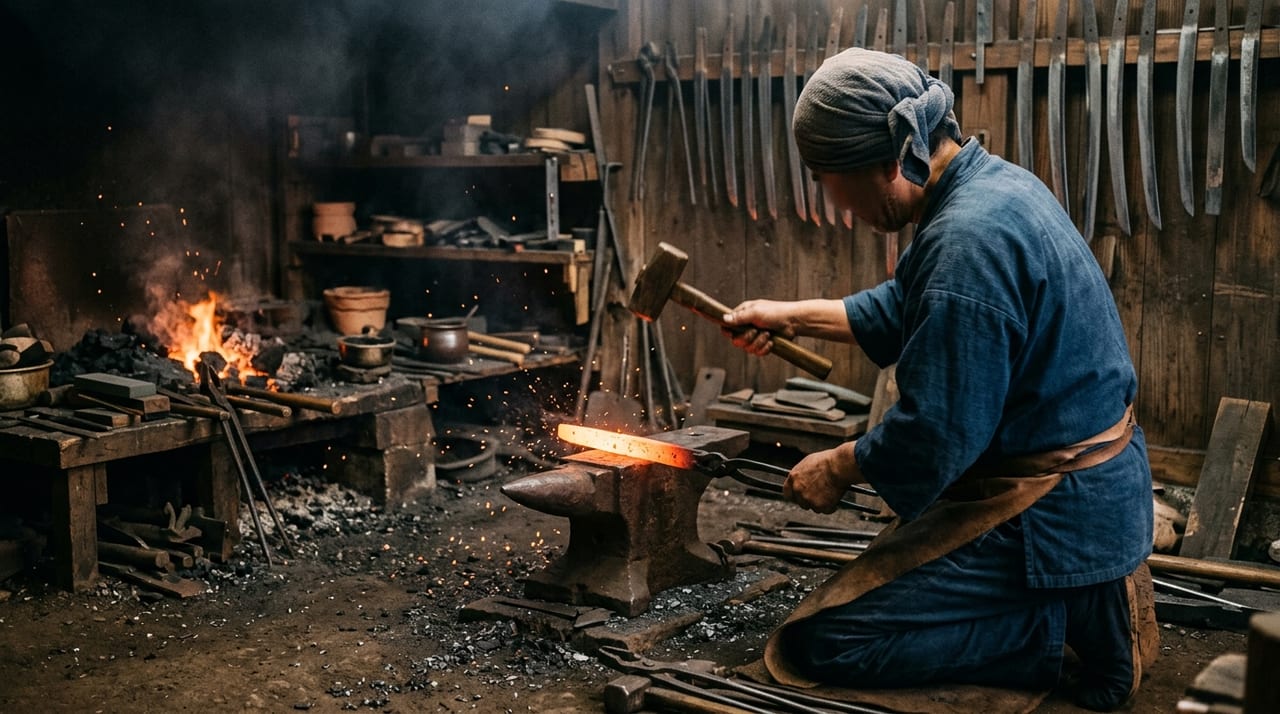
 * Image is for illustrative purposes only.
Dōtanuki Masakuni
同田貫正国
Description
Dōtanuki Masakuni and the Swords of Higo
Dōtanuki Masakuni was a swordsmith who was active in Higo Province (present-day Kumamoto Prefecture) from the late Sengoku period through the Azuchi-Momoyama period, during the Tenshō to Keichō years (c. 1573–1615). He is a master smith of the Dōtanuki school who shines in the history of Kyushu swordmaking. The name "Dōtanuki" is said to derive from a place name in Higo Province (around present-day Kikuchi City, Kumamoto Prefecture), and smiths born in this area formed the Dōtanuki school as a sword school unique to Kyushu.
The Dōtanuki school is known for making swords that met the practical demands of the Sengoku period. It is said to be a later branch of the Enju school, whose smiths had been retained by the Kikuchi clan. In fact, Dōtanuki blades were highly rated in cutting tests (tameshigiri), and the legend that Katō Kiyomasa favored Dōtanuki blades is still widely told today.
Masakuni's Style: The Pinnacle of Practical Beauty
Dōtanuki Masakuni's swords are known for a style that pursued thorough practicality. A design philosophy that gave top priority to use on the battlefield runs through every aspect of them: blade shape, steel, and hamon. The blade shape is characterized by a broad body and a small difference in width between the base and the tip, which gives it a "robust form," with solid heft and a sturdy structure. Unlike the great swords (ōtachi) of the Nanbokuchō period, this imposing form reflects the result of pursuing the most practical format for a Sengoku-period uchigatana.
The steel is itame with a tendency toward mokume and a raised grain, and it has a whitish (shirake) tendency. The hamon is suguha or ko-midare. The blade inscribed "Kyūshū Higo Dōtanuki Kōzuke-no-suke" in the Kyushu National Museum is suguha with nioi-deki. These are works of practicality with restrained decoration. Their character differs from the flashy Kyō-mono and Bizen-mono, but they are known for being sturdy and sharp.
Besides the inscription "Kyūshū Higo Dōtanuki Fujiwara Masakuni," after receiving the provincial title the smith inscribed "Kōzuke-no-suke," "Kyūshū Higo Dōtanuki Kōzuke-no-suke," "Hishū Kikuchi-jū Dōtanuki Kōzuke-no-suke," and similar. Works signed Kōzuke-no-suke have been confirmed mainly from the Bunroku through the Keichō years.
Katō Kiyomasa and the Dōtanuki Legend
What greatly raised Dōtanuki Masakuni's reputation was his relationship with Katō Kiyomasa, the daimyō of Higo Province. Kiyomasa is known as a warlord who distinguished himself in the Bunroku and Keichō campaigns (the invasions of Korea). The fact that Dōtanuki blades are passed down as his favorite swords established the image of Dōtanuki as "the strongest blade in actual combat." It is said that Masakuni received the character "Masa" from Kiyomasa. Dōtanuki is also said to have been the standing swords of Kumamoto Castle, as smiths retained by Kiyomasa.
However, Dōtanuki declined after the attainder of the Katō family. From the early to middle Edo period, smiths of the same name continued, but they did not flourish. In the late Edo period, the shinshintō era, Munehiro appeared and became known to the world again as "shinshintō Dōtanuki."
The Aesthetics of Practical Swords and Modern Appraisal
Dōtanuki blades remain strongly supported today as a typical example of the "martial aesthetic," which values practicality and toughness over delicacy. On an axis of evaluation different from that of the Kyō-mono and Bizen-mono, which boast refined steel and intricate hamon (sturdiness, honesty, and strength), Dōtanuki represents another aesthetic peak of Japanese swords.
In the grading of swords based on Yamada Asaemon Yoshimutsu's Kaihō Kenjaku and other sources, Dōtanuki Masakuni is listed among smiths whose works fall into a mix of ō-wazamono, yoki-wazamono, and wazamono. The school is also known for the anecdote that at the helmet-cutting test before the Emperor (tenran kabuto-wari) in Meiji 19 (1886), Sakakibara Kenkichi cut into a helmet with a Dōtanuki blade. Toukenza introduces Dōtanuki Masakuni as the pinnacle of practical swords produced in the turbulent Sengoku and Azuchi-Momoyama periods, and it aims to convey to modern enthusiasts the "martial beauty" aspect of Japanese swords.
Famous Works
- Katana, signed Kyūshū Higo Dōtanuki Kōzuke no suke (Kyushu National Museum)
- Katana (Kumamoto Prefectural Important Cultural Property, Honmyōji)