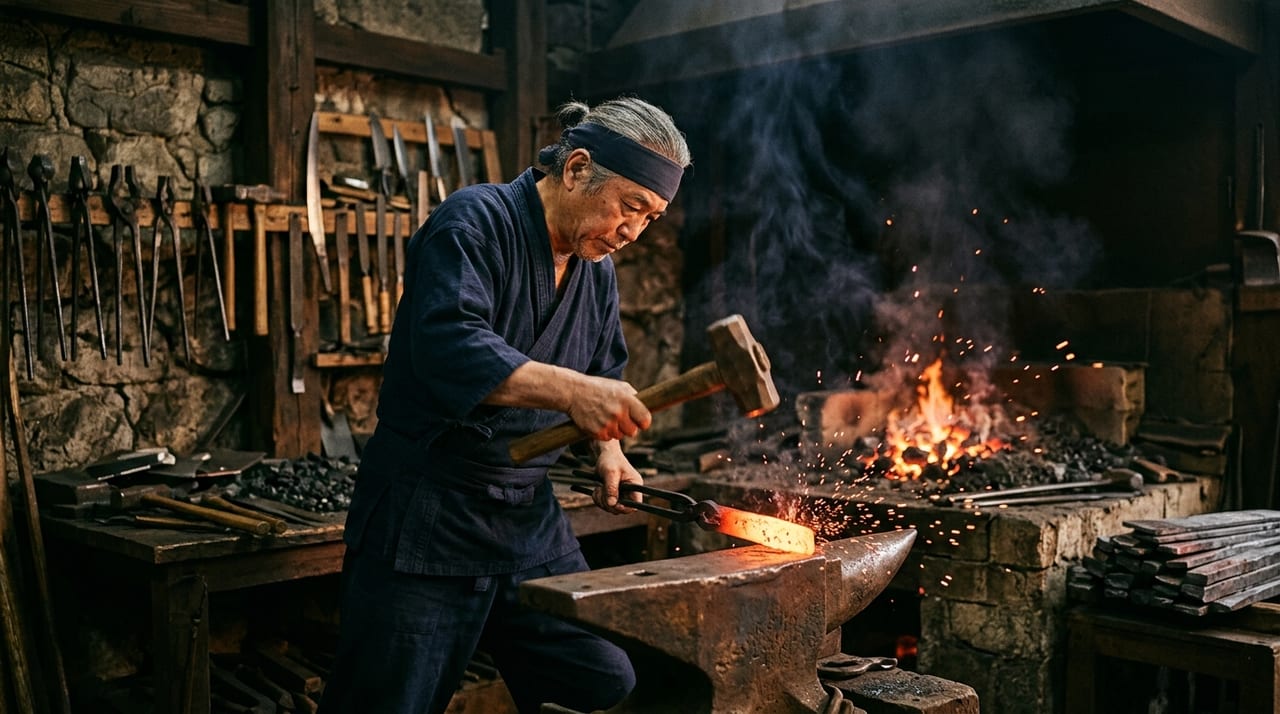
 * Image is for illustrative purposes only.
Hizen Masahiro
肥前正廣
Description
Masahiro, a Master Who Revived Hizen-tō
Hizen Masahiro was an active swordsmith of the middle Edo period, from the late 17th to the early 18th century, in Hizen Province (present-day Saga and Nagasaki Prefectures). He is one of the important master smiths who carried on the lineage of Hizen-tō that began with Tadayoshi and Tadahiro. Hizen-tō is known for a distinctive style marked by “konuka-hada” and beautiful straight hamon. This style was established by the first Tadayoshi (Hashimoto Shinzaemon, later Musashi Daijō Tadahiro), and it was favored by samurai across western Japan throughout the Edo period. Masahiro inherited the Hizen-tō tradition at a high level while producing works of his own distinct refinement.
Hizen Province has been known since ancient times as a sword-producing region. From the start of the Edo period, after the first Tadayoshi (Hashimoto Shinzaemon) established the Hizen-tō style, its techniques were handed down across several generations. Several smiths of this lineage used the name Masahiro, and the name was passed down from the first generation through later ones. Works of each generation can be identified by tracking changes in style, and the generation that produced works of particularly high technical accomplishment among the smiths bearing the name Masahiro is especially prized as “Hizen Masahiro.”
Konuka-hada and suguha: The Aesthetic Ideal of Hizen-tō
The greatest feature of Hizen-tō, and the most important element even in Masahiro’s works, is the distinctive texture of the jigane known as “konuka-hada.” Konuka-hada refers to a fine, uniform granular surface resembling rice bran (komenuka), that is, a jigane densely packed with fine grain. This jigane is extremely uniform and clear in appearance, and when light strikes it, it gives off a delicate luster. It is a jigane with a serene beauty unique to Hizen, entirely different from the disordered reflections (midare-utsuri) of Bizen or the large-grained hada (ōhada) of Sōshū.
As for the hamon, the main form is suguha. The straight, uniform hamon, so straight that it is called “bō-suguha,” has become Masahiro’s signature. Though this hamon appears monotonous at first glance, the depth of the niekuchi and the fineness of the nie demonstrate Masahiro’s high technical ability. Fine sunagashi and kinsuji appear within the hamon, and rich activity is concealed within a hamon that seems simple. Masahiro’s suguha is technically very difficult. To complete a uniform suguha, one must perfectly control many elements, including the adjustment of blade thickness, the temperature management of quenching, and the precision of the clay application (tsuchi-oki).
Hizen-tō Industry in the Mid-Edo Period and Masahiro’s Place
In the Edo period, Hizen Province was one of Japan’s leading sword-producing regions, and many smiths were active under the patronage of the Saga domain (the Nabeshima family). Hizen-tō circulated widely among samurai in western Japan because of its stable quality and high aesthetic appeal, and the “Hizen-tō” brand enjoyed nationwide renown. Masahiro’s era coincided with the flourishing of the Genroku culture (late 17th to early 18th century), a time when demand for swords extended beyond practical use to a growing role as artworks and collectibles.
Against this historical backdrop, Masahiro further refined the precise jigane and beautiful suguha that are the hallmarks of Hizen-tō, and produced works that stand at the highest level of mid-Edo sword standards. Masahiro’s swords were prized by a broad range of customers, from Saga domain retainers to samurai of other domains. Some were treasured as gifts to daimyō households.
Evaluation and Appraisal of Extant Works
Masahiro’s extant works convey the essence of Hizen-tō beauty to the present day. In appraisal, the main criteria are the degree of perfection of the konuka-hada, the uniformity of the suguha, and the texture of the nie and the depth of the niekuchi. Masahiro’s works are evaluated as having a degree of perfection a step above those of other Hizen smiths of the same period, and this is what leads to the high rating of “jōjōsaku.”
The tang (nakago) is finished with care, and the signature is inscribed as “Masahiro” or “Hizen-jū Masahiro.” When one appreciates a Masahiro sword revived through polishing, one feels drawn into the world of precise beauty that Edo-period craftsmen pursued to its limit.
Hizen Masahiro at Tōken-za
At Tōken-za, Masahiro is introduced as a master of the mid-Edo period who carried on the Hizen-tō tradition after Tadayoshi and Tadahiro at a high level. Masahiro’s works, which embody the aesthetic ideal of Hizen-tō (konuka-hada and beautiful suguha), show one of the high points of Edo-period sword art. They are an indispensable presence in discussing the sword culture of the shintō period. Through Masahiro’s works, one can experience the world of Hizen-tō, which pursued a precise and well-balanced beauty different from the grandeur of kotō.
Technical Background of Hizen-tō and Masahiro’s Legacy
What supported the high quality of Hizen-tō was the systematic sword production system of the Saga Nabeshima domain. By the time Masahiro was active, about a hundred years had passed since this system was established, and its technical accumulation and quality-control mechanisms had matured. Smiths who, generation after generation, took the name “Masahiro” passed on their techniques through master–apprentice and parent–child relationships. They maintained and raised the quality of Hizen-tō not as mere individual skill but as a “family craft.”
Hizen-tō also consistently prevailed in quality competition with shintō swords from other production centers (Echizen, Echigo, Owari and others of the Edo period). The basis of its superiority lay in combining uniform quality with high artistry. Even in Masahiro’s era, the reputation that “Hizen swords have no hit-and-miss quality” remained intact. This was nothing other than the result of Hizen smiths, including Masahiro, striving with pride for quality control. Today, anyone who holds a Hizen Masahiro sword can sense both the weight of the technical heritage built up by Edo-period swordsmiths and the depth of craftsman’s spirit behind its beauty.