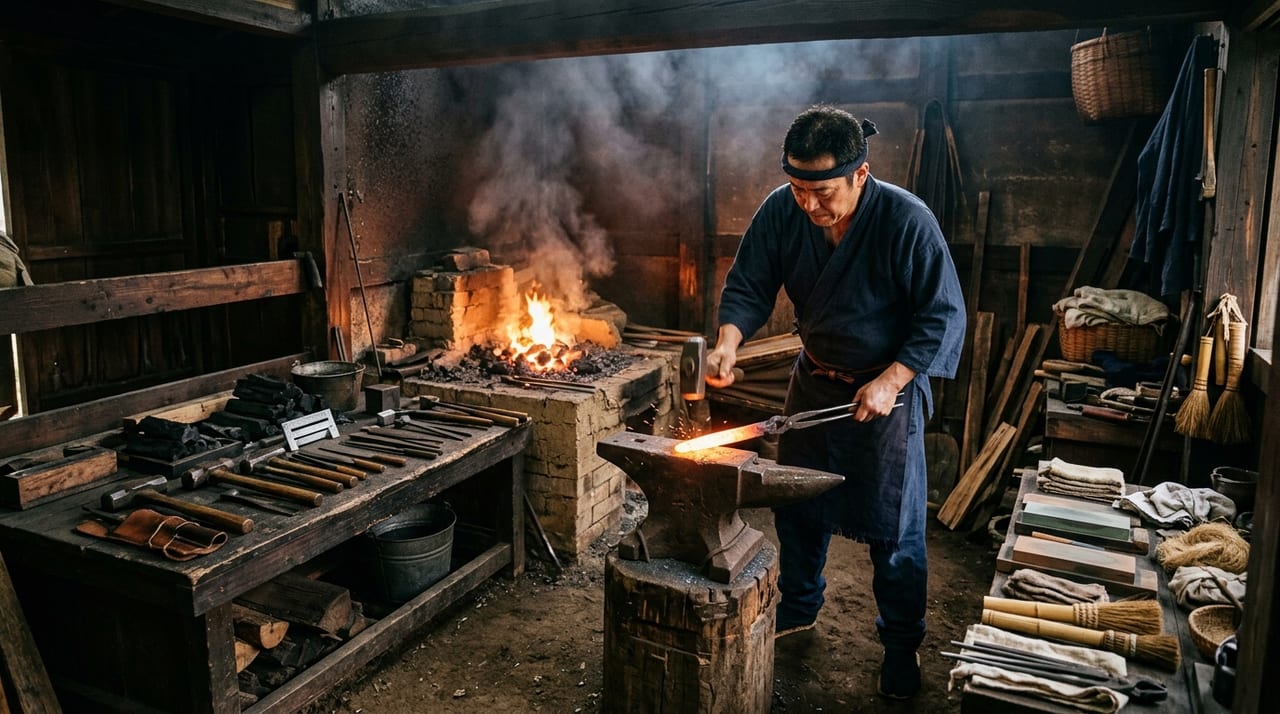
 * Image is for illustrative purposes only.
Izumi no Kami Kunisada
和泉守国貞
Description
Izumi no Kami Kunisada (first generation) was a swordsmith of the early Edo period who represented Settsu Province (present-day Osaka Prefecture), and was a master of the highest rank within the Osaka shintō school. Born in Hyūga Province, he studied under Horikawa Kunihiro, went to Osaka, and laid the foundations of Osaka shintō. His son, the second-generation Kunisada, later became Inoue Shinkai.
The most distinctive feature of Kunisada's blades is the fineness of their jigane. The ko-itame hada is well packed and ji-nie is thickly distributed; the overall firm and clear jigane is exceptionally beautiful even among Osaka shintō. The hamon is based on gunome-midare and shows varied workmanship with togariba, ko-ashi and yō. The yakihaba is medium to wide, and complex midare mixed with notare is finished with superb accomplishment.
In form, the blade shows the style of the early Edo period: the difference between motogasane and sakigasane is somewhat small, and the basic form is elegant, with shallow sori and a tip spreading outward. The nakago often retains its ubu surface, and the yasurime is mostly sujichigai. The representative signature is a long signature (nagamei) reading “Izumi no Kami Fujiwara Kunisada,” and the carefully executed signature characters further enhance the dignity of the work.
Kunisada's active period falls in the early Edo period. In warrior society the sword was still revered as the soul of the samurai, but as the age of peace continued, demand grew for artistic perfection over practical function. Kunisada responded skillfully to the requirements of the age, leaving many works that combined practicality and artistry at a high level.
Beyond the technical foundation inherited from his teacher, Kunisada made full use of the cultural soil of Osaka, a commercial city. Wealthy merchants gathered there from across the country, and demand for fine swords was strong. Kunisada's blades were sought eagerly not only by the warrior class but also by affluent townspeople (chōnin), and his renown spread throughout the country.
Kunisada's works are now held by the Tokyo National Museum, the Fukuoka City Museum and others. His refined technique and beauty that transcends its age are still highly valued today as the progenitor of Osaka shintō.
Famous Works
- Wakizashi, signed Izumi no Kami Fujiwara Kunisada (Tokyo National Museum)
- Katana, signed Izumi no Kami Fujiwara Kunisada (Fukuoka City Museum)