Sword Culture in the Keicho, Genna, and Kan'ei Periods (1596–1651): The Social Foundations Behind the Birth of Shinto Swords After Sekigahara
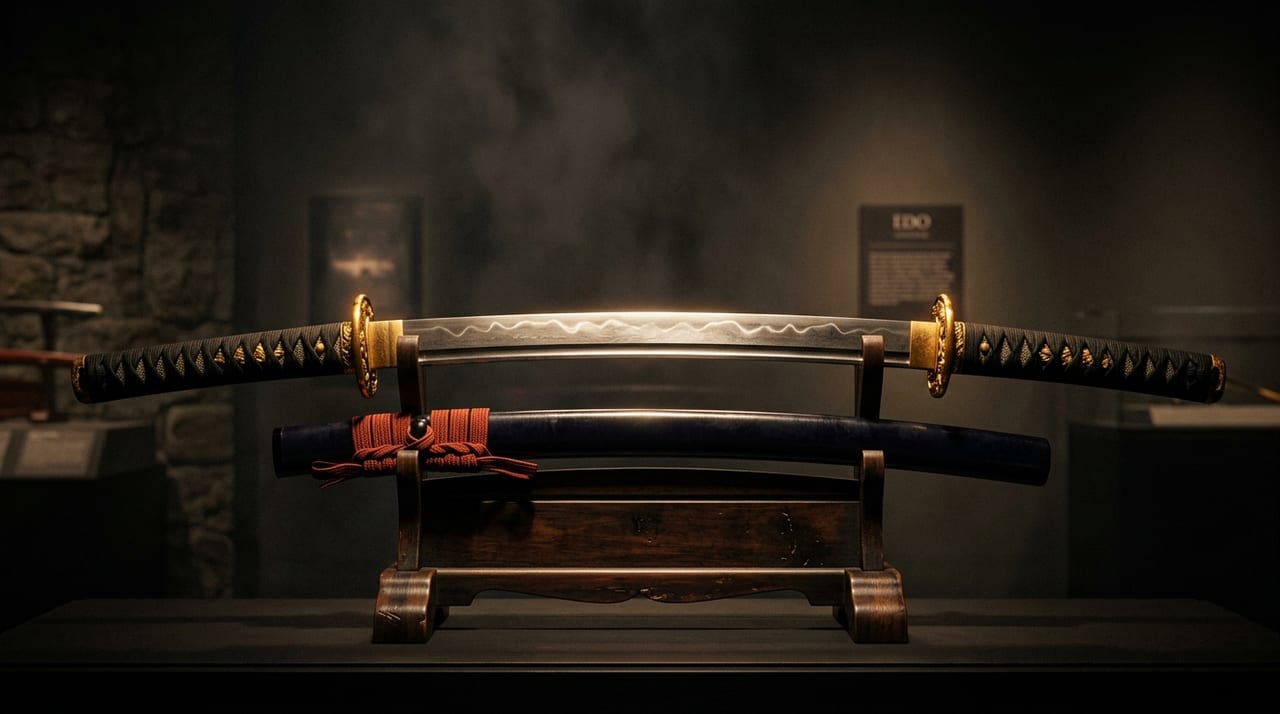 * Image is for illustrative purposes only.
Table of Contents
The Keicho, Genna, and Kan'ei Periods: An Era of Transformation
The Battle of Sekigahara in 1600 (Keicho 5) effectively ended over a century of the Sengoku period of civil wars. When Tokugawa Ieyasu assumed the position of Seii Taishogun in 1603 (Keicho 8), and the Toyotomi clan was destroyed in the Summer Campaign of Osaka in 1615 (Genna 1), the age of military struggle for political power came to a close. The reigns of the third shogun, Tokugawa Iemitsu, spanning the Genna (1615–1624) and Kan'ei (1624–1644) periods, marked the establishment of the bakuhan system and represented a fundamental turning point in sword culture.
This half-century is positioned in sword history as a transitional period from "koto" (old swords) to "shinto" (new swords). While definitions of shinto vary, generally swords made from the Keicho period (1596–1615) onward are classified as shinto.
War's End and the "Change in Sword Purpose"
Swords of the Sengoku period were required above all to be practical for actual combat. Durability to withstand field use, blade geometry suited to hand-to-hand combat with spear-wielding ashigaru, and manufacturing efficiency to enable mass production—these were the paramount concerns of swordsmiths.
After Sekigahara, the use of swords changed dramatically.
Transformation into an instrument of samurai etiquette: In the peaceful early Edo period, the occasions for samurai to actually use their swords diminished drastically. Swords came to function as a "mark of status" and "instrument of ceremony" for samurai, with the beauty of their form and the elegance of their hamon taking precedence over practical combat qualities.
Increased opulence of koshirae (fittings): Demand shifted from battlefield-functional mounts to ornate koshirae suited for audiences with daimyo and ceremonial occasions. It was during this era that the techniques of metalworkers, lacquerers, and scabbard makers and other sword-furniture artisans advanced significantly.
Presentation swords to daimyo: Supreme-quality swords began to be created as gifts to the shogun and daimyo who had unified the realm, establishing a new value standard for swords as "masterpieces crafted by renowned smiths using the finest materials and techniques."
Master Smiths of the Keicho and Genna Periods—Horikawa Kunihiro and His Students
The swordsmith "Horikawa Kunihiro" exemplifies the opening of the shinto era. Kunihiro, originally from Satsuma (present-day Kagoshima Prefecture), established his forge in Horikawa, Kyoto, and while studying the forms of koto, established his own distinctive shinto style.
Kunihiro's swords are characterized by deep curvature and graceful form, with a style conscious of the jihada and hamon of koto, particularly those of the Kamakura-period Soshu tradition. From Kunihiro's workshop emerged numerous exceptional swordsmiths, and the "Horikawa school" formed the core of Kyoto sword-making during the shinto era.
Notable students:
- Dewa Daijō Kunimichi: known as one of Kunihiro's leading disciples
- Izumi no Kami Kunisada: a representative smith of Osaka shintō
- Kawachi no Kami Kunisuke: a disciple active in Settsu Province
Note that Iga no Kami Kinmichi, Tanba no Kami Yoshimichi, and Etchū no Kami Masatoshi were sons of Kanemichi, a smith of Seki in Mino, and formed their own lineage as the Mishina school, one of the Kyō Go-kaji (five Kyoto smith families). They belong to a lineage separate from the Horikawa school.
Sword Culture of the Kan'ei Period—Official Swordsmiths of the Various Domains
The Kan'ei period (1624–1644) was an era when the bakuhan system had become stable and daimyo households established the goyou-toko (official swordsmith) system. Various daimyo families invited excellent swordsmiths as "live-in swordsmiths" and had them forge blades under their clans' financial patronage.
While this patronage system stabilized the livelihoods of swordsmiths, it also had the effect of fixing their activity to specific regions. As a result, "han-smiths" were established throughout the country, laying the foundation for regional stylistic variations.
Characteristics of Sword Forms from the Keicho to Kan'ei Periods
The following are the morphological characteristics of swords produced during this era.
Changes in blade length: During the Sengoku period, longer swords (2 shaku 5 sun to 2 shaku 8 sun) were predominant for combat use, but from the Keicho period onward, a contraction to approximately 2 shaku 3 sun—called "josun" (standard length)—is evident. This reflects the shift in use from battlefield combat to wearing swords in urban Edo.
Changes in curvature: In shinto, a transition from the "koshi-zori" (curvature peak in the lower third of the blade) of koto to "naka-zori" (peak near the center of the blade) progressed. This was a design change predicated on wearing and using the sword while traveling on foot.
Changes in kissaki: A tendency toward reversion from the "ko-kissaki" (short point) that had become common in the Sengoku period, back to the "chu-kissaki" (medium point) is evident by the Keicho period.
Technical Challenges in Early Shinto Metallurgy
Major changes in the technical foundation of swordsmiths occurred during the early shinto period.
The technique of "shitaji-kitae" (base forging)—particularly the precise temperature control of fold-forging using tamahagane as the base material—passed down by koto smiths of the Kamakura and Muromachi periods was partially lost through Sengoku-period mass production. As the shinshintō period (late Edo) swordsmith Suishinshi Masahide later raised the issue, some shinto swords from the Keicho period onward lack the "fine jihada" characteristic of koto.
On the other hand, celebrated Keicho smiths such as Horikawa Kunihiro and Echizen Yasutsugu consciously attempted "technical revival based on koto research," which became the driving force behind the production of superior shinto swords.
The Legacy of the Keicho, Genna, and Kan'ei Periods in Sword History
The role this half-century played in the history of Japanese swords can be summed up as "the transformation from a tool of war to a cultural treasure." By ceasing to assume actual combat use, swordsmiths were given a new mission: "to create beautiful swords."
Swords of this era possess a transitional beauty, positioned midway between the robust practical aesthetics of koto and the ornamental hamon beauty that would flourish in the later Edo period. Collecting and appreciating shinto swords from the Keicho through Kan'ei periods is also to experience, through the medium of the blade, the end of the tumultuous Sengoku period and the dawn of a peaceful age.