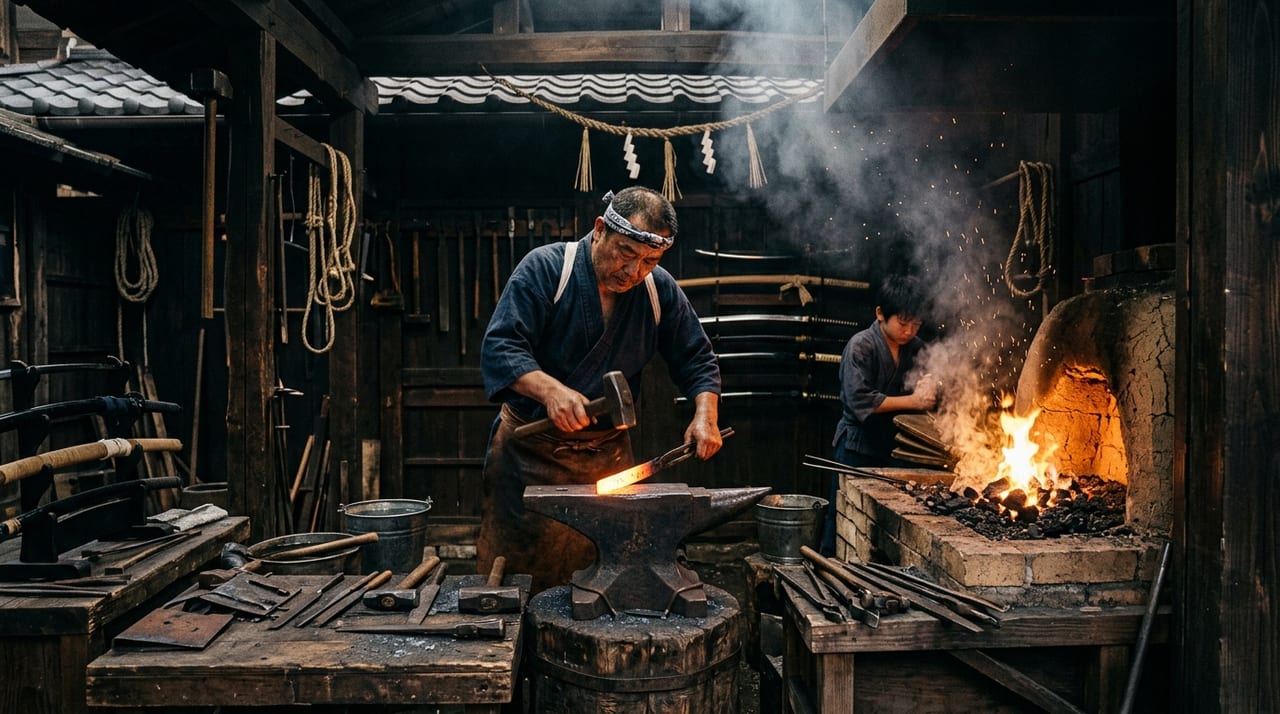
 * Image is for illustrative purposes only.
Inoue Shinkai
井上真改
Description
Inoue Shinkai (1630–1682) was a master smith of the shintō (new sword) tradition who worked in Osaka in the early Edo period. Together with Tsuda Sukehiro he is celebrated as one of the twin pillars of Osaka shintō. In Yamada Asaemon's Kaihō Kenshaku he is ranked as wazamono, and his jigane and hamon are still highly valued today as among the finest of the shintō period. He was the son of the first Izumi no kami Kunisada. After his father's death in Keian 5 (1652), he succeeded as the second Kunisada and took the title Izumi no kami. In Kanbun 12 (1672), he changed his name and signature to Shinkai.
The most distinctive feature of Shinkai's blades lies in their hamon, which consists mainly of suguha with deep nie and ō-notare, and in a precise, bright jigane typical of Osaka. The jigane shows a fine, dense ko-itame with thick ji-nie, giving a clear and brilliant surface that embodies the refined, urban sensibility of Osaka shintō. The hamon is mainly suguha, and gunome-midare and ō-notare are also formed. The nioiguchi is extremely deep, bright and clear, and the hanaka is richly covered with nie. He is said to have revered Gō Yoshihiro, and his works are therefore also called "Osaka Masamune."
While Sukehiro pursued the dynamic beauty of waves in his tōranba, Shinkai showed his mastery mainly in suguha with deep nie and in ō-notare. In the second half of the seventeenth century, these two masters competed with each other and raised the aesthetic standard of Osaka shintō to its peak. This period is regarded in the history of the Japanese sword as the "golden age of shintō."
The signature is cut as "Izumi no kami Kunisada" or "Inoue Izumi no kami Kunisada," and from Kanbun 12 (1672) onward as "Inoue Shinkai." In Kanbun 1 (1661), after presenting a work to the imperial court, he was permitted to cut a chrysanthemum crest on the nakago. Today, a sword dated Enpō 4 and a tachi dated Enpō 5 are designated Important Cultural Property.
Famous Works
- katana signed Inoue Shinkai, dated Enpō 4, 8th month (Important Cultural Property)
- tachi signed (chrysanthemum crest) Inoue Shinkai, dated Enpō 5, 8th month (Important Cultural Property)
- wakizashi signed Inoue Izumi no Kami Kunisada, dated Kanbun 2, 2nd month (Fukuoka City Museum collection)