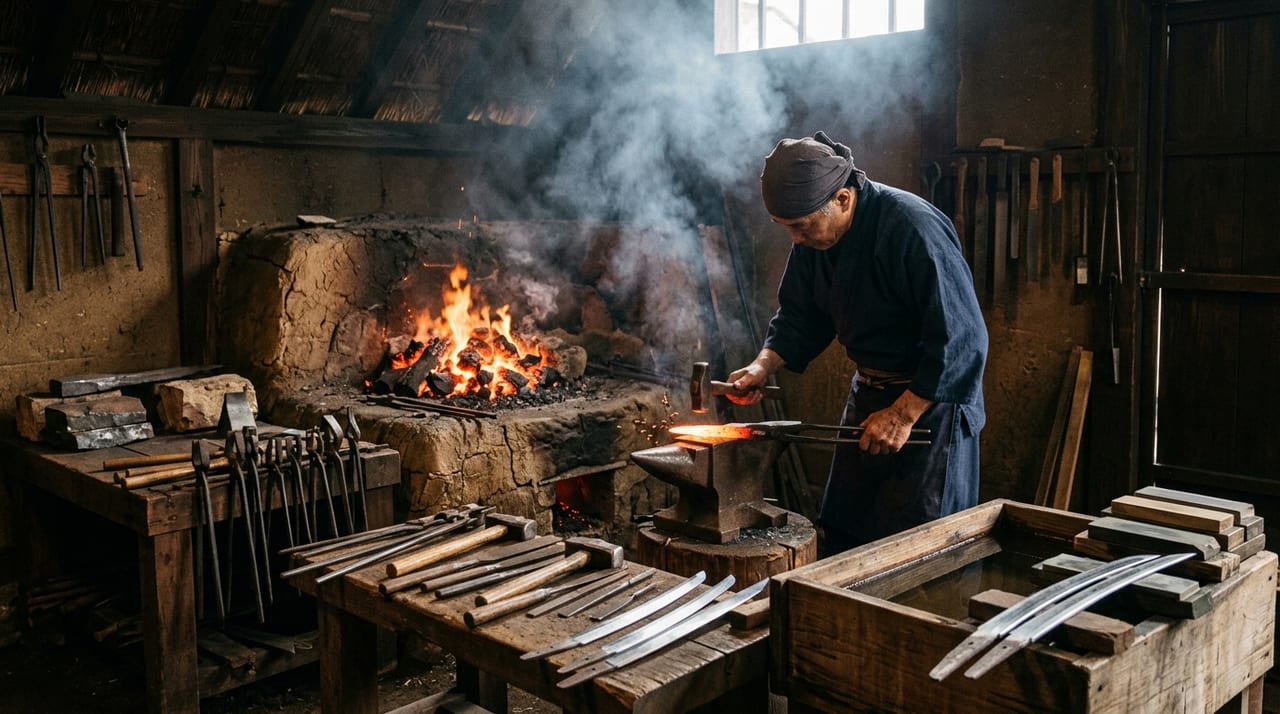
 * Image is for illustrative purposes only.
Echizen Yasutsugu
越前康継
Description
Protective Swordsmiths of the Tokugawa House — The Arrival of Echizen Yasutsugu
Echizen Yasutsugu moved to Echizen Province (present-day Fukui Prefecture) during the Keichō era (1596–1615). With the establishment of the Edo shogunate, he received the highest honor as a swordsmith serving the Tokugawa shogunal house, making him a representative swordsmith of the shintō period. His greatest distinction lies in the extremely rare honor, in the history of Japanese swordsmithing, of being specially permitted by the shogunal house to cut the Tokugawa family crest, the mitsuba aoi, into the nakago (tang). This hollyhock crest was not mere decoration. It symbolized the authority of the Tokugawa shogunal house, the ruler of the realm itself, and the fact that Yasutsugu was granted permission to carve it into his swords clearly shows how highly his skill and character were regarded.
There are various theories about Yasutsugu's origins. He is said to be connected to the Shimosaka family of Sakata District, Ōmi Province, and is also called 'Shimosaka Yasutsugu.' After moving to Echizen, he served Yūki Hideyasu, lord of Fukui domain (the second son of Tokugawa Ieyasu), and this service was the beginning of his rise. Hideyasu's father, Ieyasu, highly valued Yasutsugu's swordforging skill, and it is said that around Keichō 11 (1606) he granted Yasutsugu the name 'Yasutsugu' and permission to stamp the aoi-mon. From then on, Yasutsugu's blades bore the aoi-mon as proof of official recognition by the Tokugawa shogunal house, and he served the shogunal house through a two-center system in Edo and Echizen.
The Weight of the Aoi-mon — A Swordsmith of the Ruler of the Realm
The weight of what permission to carve the aoi-mon meant is hard to imagine from a modern sense, but in the samurai society of the Edo period it carried enormous significance. The hollyhock crest of the Tokugawa family was an emblem symbolizing the absolute authority of the shogunal house, and unauthorized use of it was a grave crime. Yasutsugu was a swordsmith publicly permitted to cut this emblem into the nakago, and his swords were not merely weapons or art objects but also political symbols bearing the legitimacy of shogunal power.
The tradition of 'Aoi-mon Yasutsugu' established by the first Yasutsugu was passed down through successive generations. The second Yasutsugu had his talent recognized by Shogun Hidetada, settled in Edo, and served the shogunal house in a position close to the center of the shogunate. From the third generation onward, the Yasutsugu house split into an Edo house and an Echizen house. The Edo house continued the name to the twelfth generation around the Meiji period, and the Echizen house to the ninth generation at the end of the Bakumatsu, making it one of the most long-lived swordsmith lineages in the history of Japanese swordsmithing.
Technical Character — Shintō in the Sōshū-den Lineage
An essential point in discussing the technical character of Echizen Yasutsugu's blades is the adoption of techniques from the Sōshū-den lineage. Yasutsugu's original style featured itame-hada in the manner of the Seki smiths, mixed with notare and gunome. However, after being ordered in Genna 1 (1615) to re-temper a famous blade that had been fire-damaged in the fall of Osaka Castle, he also took up utsushi (copies) and adopted the nie-deki style of the Sōshū-den, led by Sōshū Sadamune. Yasutsugu's hamon are based on gunome-midare and ō-midare, and deep nie fills the blade, showing complex workings such as kinsuji, sunagashi, and inazuma. These bold, dynamic hamon were highly regarded as carrying forward the tradition of the Sōshū-den, including the works of Masamune and Sadamune, into the shintō period.
The jigane shows a distinctive hada pattern in which ō-itame-hada is mixed with nagare-hada, and thick ji-nie gives it a moist, lustrous atmosphere. For a shintō blade, the quality of the steel is high, and it shows the powerful forging shared by smiths of the Keichō period. The works of the first Yasutsugu carry the rough, raw vitality of the Keichō period, and comparing them with the works of later Yasutsugu allows one to trace changes in style.
The shape of the swords is typical of Keichō shintō, with many bold blades that are broad in the mihaba and thick in the kasane. The sori is somewhat shallow and tends toward sakiomori, showing the majestic form peculiar to Keichō shintō, which carries the lingering afterglow of the Sengoku period.
Historical Background of the Keichō Shintō — From Sekigahara to the Winter and Summer Campaigns of Osaka
The Keichō, Genna, and Kan'ei eras, in which Echizen Yasutsugu was active, were a turbulent period in which the Edo shogunate stabilized after the Battle of Sekigahara (1600) and the Winter and Summer Campaigns of Osaka (1614–1615). For samurai, the sword remained a weapon for actual combat, and Yasutsugu's swords, made at the shogunal house's command by its finest swordsmith, were also judged by their quality as practical objects. The bold form and large-scale hamon characteristic of Keichō shintō reflect the spirit of samurai of this era.
The background to Ieyasu's particular patronage of Yasutsugu is thought to have involved not only technical appraisal but also the relationship with Yūki Hideyasu, lord of Echizen. Hideyasu was Ieyasu's second son and a daimyō who was granted Echizen after the Battle of Sekigahara. Ieyasu's favoring of Yasutsugu, who was Hideyasu's own swordsmith, may also have held the political meaning of strengthening relations between the shogunal house and the Echizen domain. As witnesses to an age in which swords could not be separated from politics, the swords of Echizen Yasutsugu are also a mirror reflecting the power structure of the shintō period.
First Generation and Later Generations — Succession of the Name
An important point in evaluating Echizen Yasutsugu is the distinction between the first generation and later generations. The first Yasutsugu receives the highest evaluation for his active swordmaking during the Keichō era. Among first-generation works bearing the aoi-mon are some designated Important Cultural Property, such as a wakizashi with a dedicatory inscription to Atsuta Daimyōjin. Later Yasutsugu works also maintain a high technical standard, but compared with the bold style of the first generation, a tendency toward a gradually milder direction can be seen.
In sword appraisal, it is necessary to judge comprehensively the shape of the aoi-mon, the style of the signature, and the content of the appraisal certificate to determine whether a piece is by the first generation. Appraising Yasutsugu works is one of the fields requiring specialized knowledge.
The Spirit of Echizen Yasutsugu and TOUKENZA
The status of being 'a swordsmith granted permission by the shogunal house to carve the aoi-mon' is proof that the skill and dignity of Echizen Yasutsugu were publicly recognized. A swordsmith who, under the protection of the shogunal house, is given the finest materials and environment and faces his swords with full commitment embodied the ideal relationship between swordsmith and ruler in the shintō period.
TOUKENZA is a Japanese sword sales website based in Sendai, and there is also an indirect connection between Echizen Yasutsugu and the Sendai Date family. Date Masamune frequently traveled to Edo and Fushimi during the Keichō era through diplomatic relations with Tokugawa Ieyasu, and it is quite conceivable that he had the opportunity to know of the swords of Yasutsugu, who was in the employ of the Tokugawa house. The aoi-mon-bearing Yasutsugu swords made by the swordsmith of the shogunal house are the supreme crystallization of authority and aesthetics in Japan during the shintō period, and they stand as a symbol of one era in the history of Japanese swords.
Famous Works
- Katana, signed: Made from Nanban-tetsu at Edo, Bushū, by Echizen Yasutsugu / dated Keichō 19, 8th month, auspicious day (Important Cultural Property)
- Wakizashi (dedication inscription to Atsuta Daimyōjin, aoi crest) Echizen Yasutsugu (Important Cultural Property, Tokyo National Museum)