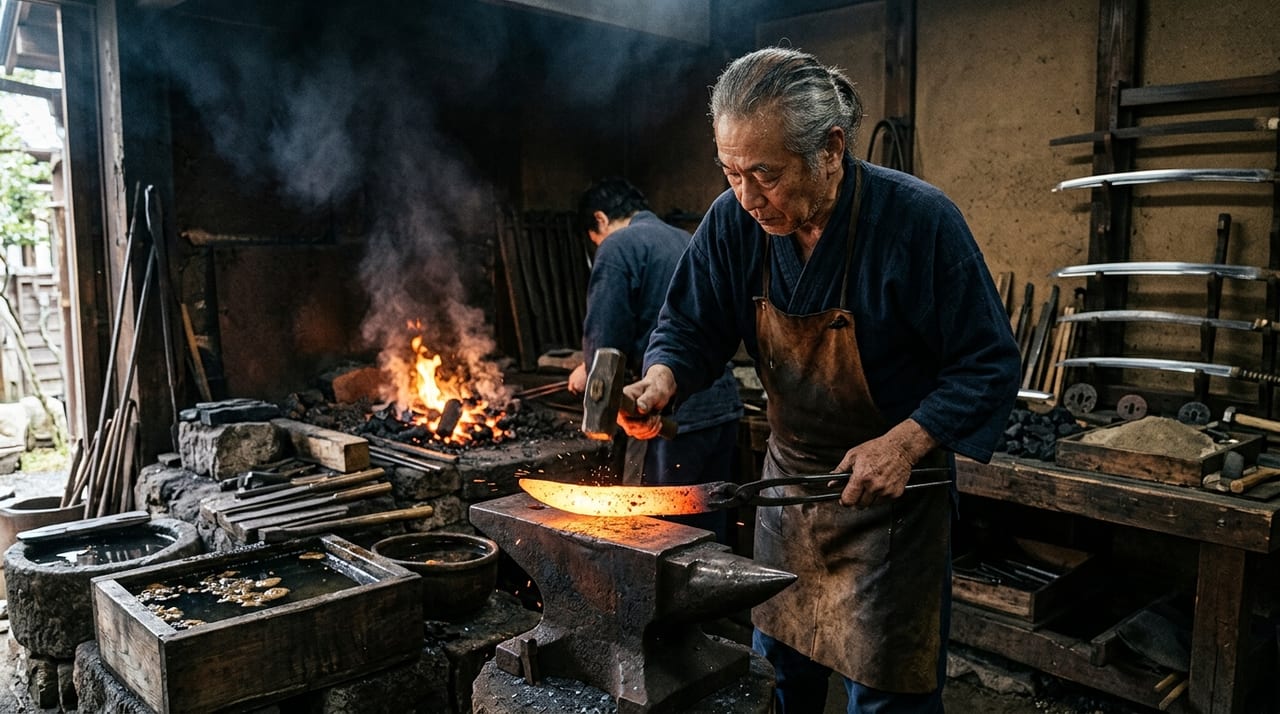
 * Image is for illustrative purposes only.
Dewa Daijō Kunimichi
出羽大掾国路
Description
Dewa Daijō Kunimichi was a master swordsmith active in Yamashiro Province (Kyoto) from the early to middle Edo period. He represents the shintō period and is a leading figure of the Kyō-mono (Kyoto works). He is known as a senior disciple (monjin) of Horikawa Kunihiro. He used the court title Dewa Daijō, and his technical level received very high evaluation in shintō-period Kyoto.
The most distinctive feature of Kunimichi's blades is an eclectic yet individual style that combines the spirit of the kotō with the technical innovations of the shintō period at a high level. The jigane is a beautiful surface with fine ko-itame packed closely and mokume mixed in here and there. In contrast to the whitish ground characteristic of the shintō period, Kunimichi's jigane has a kind of warmth and depth. The hamon is known above all for its rich variation. Depending on the work, he selectively used a range of techniques, including gunome, notare, and togari-ba, and although he worked in the shintō period, his expressive range recalls the diversity of the kotō. The nioiguchi is deep and clear, the nie is fine and orderly in its distribution, and a dignified elegance pervades the whole blade.
His mei include variations such as "Dewa Daijō Fujiwara Kunimichi" and "Kunimichi," and a relatively large number of signed works (zaimei-saku) survive.
Kunimichi has been praised by later generations as a senior disciple of Horikawa Kunihiro, and he received high regard as one of the leading figures of Kunihiro's school.
In the history of Japanese swords, Kunimichi embodied the transition from the kotō period to the shintō period with a high degree of artistry. His work receives universal appraisal that transcends the ages, and he remains one of the supreme objects of appreciation for today's sword enthusiasts.
Famous Works
- Katana signed Dewa Daijō Fujiwara Kunimichi