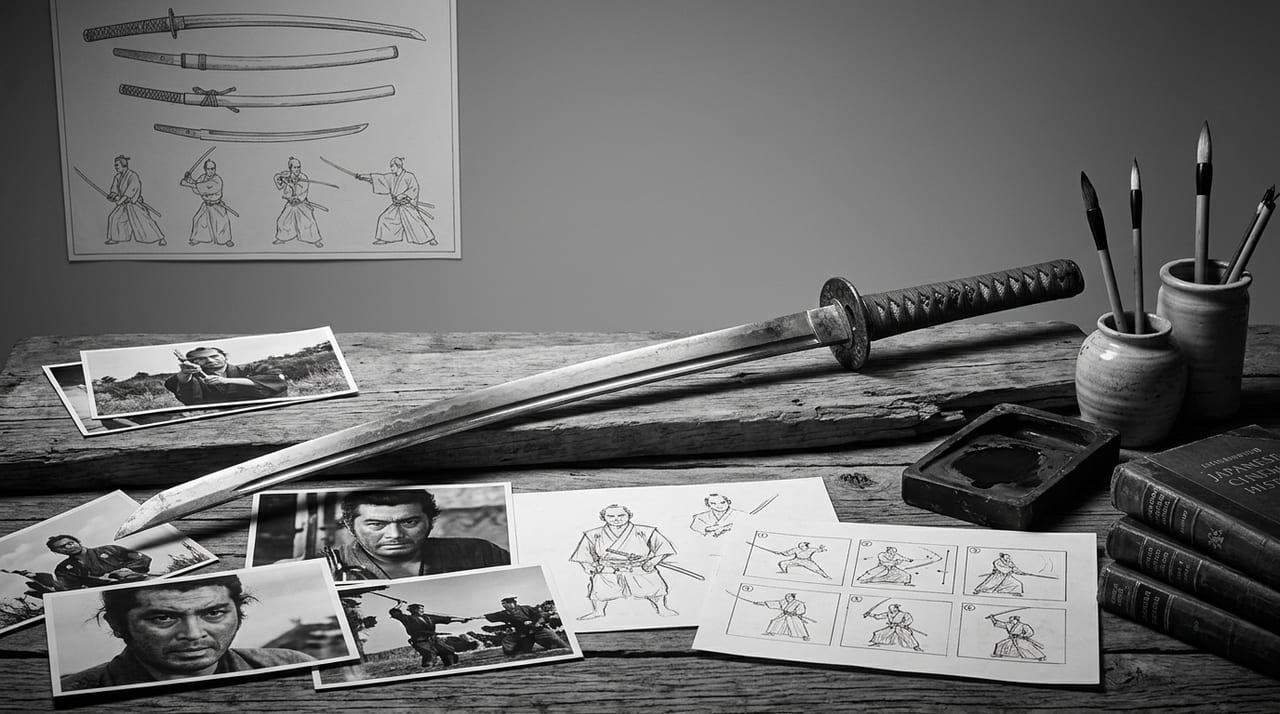
 * Image is for illustrative purposes only.
Yojimbo
用心棒
A 1961 Toho period film directed by Akira Kurosawa. A nameless rōnin (Toshirō Mifune) drifts into a post town where two yakuza gangs are locked in conflict, and skillfully plays both sides to destroy them. The climactic sword sequence — 'one man against six' — is among the most imitated in cinema history. Together with the sequel Sanjuro (1962), it exerted indelible influence on Japanese and world sword-action filmmaking.
Description
Yojimbo — Kurosawa Etches the Beauty and Function of the Japanese Sword into Cinema History
Yojimbo (Toho, 1961), directed by Akira Kurosawa and starring Toshirō Mifune, is among the most influential Japanese films ever made. The protagonist — who goes by the name Kuwabatake Sanjūrō but whose real identity remains concealed — is the archetype of the solitary, anonymous hero that would directly inspire Sergio Leone's A Fistful of Dollars and, through that, the entire tradition of the taciturn Western gunfighter and action hero.
### Sanjūrō and the Japanese Sword
The sword Sanjūrō carries is the most eloquent element of the film, spoken in action rather than words. He controls opponents by not drawing — and wins the moment he draws. The most famous sword sequence in the film — "one man against six" near the climax — transpires in a matter of seconds from draw to resheathing, a cinematic realization of the Japanese sword's essential qualities of speed and decisiveness that has never been surpassed.
Kurosawa put Mifune through intensive sword training, insisting especially on the visual contrast between the silence before the draw and the overwhelming speed after. This scene is still cited by film scholars and sword practitioners as one of the most perfect realizations of sword technique ever filmed.
### The Cinematic Expression of Ma — The Interval Between Fighters
Yojimbo's greatest innovation is its visual expression of ma (the interval) — the charged time before a fight. Sanjūrō's walk through town, his confrontations with opponents, his hand resting on his sword — all use time to translate the sword concept of maai (control of physical and psychological distance) into cinematic grammar. The duel with rival swordsman Unosuke (Nakadai Tatsuya) is designed as a pure sword encounter in which differences of school, stance, and combative distance are expressed in precise detail.
### Kurosawa's Sword Aesthetic
Across his period films — Rashomon, Seven Samurai, Yojimbo, Sanjuro, Red Beard, The Hidden Fortress — Kurosawa consistently depicted the Japanese sword as a practical tool rather than a decorative art object. Sanjūrō's blade is no famous masterwork; it is the worn tool of a man who fights, and that "used sword" quality gives the film its realism.
### Global Influence and the Sword-Film Tradition
Yojimbo's direct influence on A Fistful of Dollars (Leone, 1964) is well known, but the reach extends further: Hong Kong noir, Eastwood Westerns, and the John Wick franchise all carry its DNA. The rationality of the Japanese sword in one-against-many combat — speed, precision, control of distance — became the universal model for the cinematic lone hero. Together with Sanjuro (1962), Yojimbo can be considered the Japanese sword's greatest cultural ambassador to the world.
### For Sword Collectors
For sword enthusiasts, Yojimbo holds a special place as the purest cinematic expression of the sword's functional dimension — the sword as tool made to be used. To understand not only the "static beauty" of a blade behind museum glass but the "dynamic" nature of the Japanese sword as originally intended, this film and its sequel Sanjuro are essential viewing.
Real Swords Featured
The Rōnin's Sword in the Edo Period
Edo-period rōnin (masterless samurai) favored practical 'field blades' (nogatana) and proven cutting swords (wazamono) over ornate mounts. Long travel and combat readiness demanded function over aesthetics — scabbards tended toward durable, weatherproof 'martial mounts' rather than lacquered ceremonial finish. Sanjūrō's sword embodies this rōnin culture, emphasizing the sword as working tool.
Shin-shintō Practical Swords of the Late Edo Period
The swords actually used by rōnin and swordsmen in the late Edo period were typically workmanlike shin-shintō pieces — robust, sharp, and practical rather than famous masterworks. Blades by students of Katayama Munetsugu, Minamoto no Kiyomaro, and similar masters were prized as reliable fighting swords. The sword culture of 'the blade made to be used' that Sanjūrō embodies is grounded in this practical tradition.
See authentic Japanese swords
See authentic Japanese swordsThis page is intended to introduce Japanese sword culture and is not affiliated with any of the works mentioned.