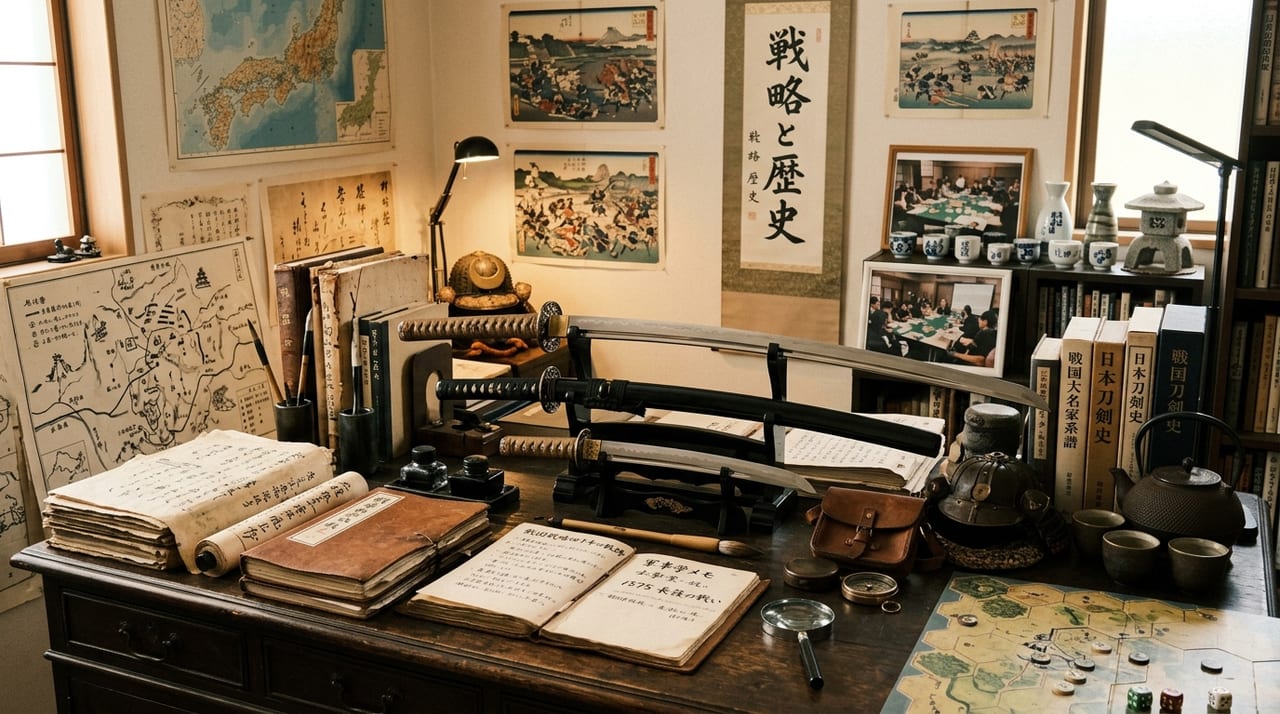
 * Image is for illustrative purposes only.
Nobunaga's Ambition
信長の野望
A historical simulation game series developed and sold by Koei Tecmo Games since 1983. It is a national-favorite series in which players control Sengoku daimyo, including Oda Nobunaga, in pursuit of unifying the country. Depending on the title, famous swords also appear as items, making it a historical game series that touches on the bond between Japanese swords and warlords.
Description
Nobunaga's Ambition — The Sword Culture Systematized by Japan's Greatest History Game
Beginning with the historical simulation game released by Koei (now Koei Tecmo Games) in 1983, Nobunaga's Ambition is a national game series that has continued to develop for more than 40 years. As of 2025, the series' cumulative worldwide shipments exceeded 11 million units, and it is a landmark work that established the historical simulation genre in Japan. It has made an immeasurable contribution, from both educational and entertainment perspectives, to the spread of Japanese swords and warrior culture.
Systematic Database of Sengoku Warlords and Japanese Swords
The greatest feature of the Nobunaga's Ambition series is that it recreates Sengoku-period warlords, daimyo, and retainers within the game based on historical research. Each warrior is given parameters such as 'Military Strength,' 'Strategy,' and 'Leadership.' In the higher-end series, the types of swords and weapons used by warriors and the famous swords they carry are also included. This 'warrior database' has served as the first systematic introduction to Japanese history, warrior culture, and sword culture for many players.
Oda Nobunaga is known as a innovative warlord who, along with his seal 'Tenka Fubu,' actively adopted weapons and firearms introduced from Nanban (Southern Barbarian) traders. In this series as well, Nobunaga's innovativeness, namely the shift from swords to matchlock guns, is reflected in the settings. Meanwhile, traditional mounted commanders such as Uesugi Kenshin and Takeda Shingen are portrayed as 'warlords of the sword,' depicting Japanese swords as embodying the cultural identity of Sengoku warlords.
Historical Connections Between Swords and Warlords
The Nobunaga's Ambition series introduces items such as 'famous swords' and 'treasure swords' in some titles, and is designed to let players experience the historical bonds between real famous swords and warlords. For example, the anecdotes surrounding Oda Nobunaga and 'Sōza Samonji,' the legend of a famous sword seized from Imagawa Yoshimoto, Toyotomi Hideyoshi and 'Ichigo Hitofuri,' and Tokugawa Ieyasu and Muramasa. By recreating these actual historical episodes in the game, players unknowingly learn the depth of sword culture.
Geographic Distribution of Japanese Sword Production Regions and Smiths
In Nobunaga's Ambition, castles, castle towns, and industries across the country are subject to management. As a result, the major sword-producing regions, namely Bizen Osafune (Okayama Prefecture), Mino (Gifu Prefecture), Yamashiro (Kyoto Prefecture), and Sōshū (Kanagawa Prefecture), are also included in each daimyo's domain, and the effect of sword production on economy and military strength is expressed within the context of the game. The fact that players have come to understand the 'geopolitical value of sword-producing regions' through the game is an important contribution to broadening the base of sword culture.
Latest Series and Continuation into the Modern Era
In the latest series, such as 'Nobunaga's Ambition: Shinsei with Power-Up Kit' released in 2023, more precise warlord data and historical research are incorporated, and the fidelity in reproducing warlords' weapons and fighting styles has increased. As a pioneer of historical simulation games, its role in the systematic spread of warrior culture, including Japanese swords, is unmatched by any other.
Perspective for Sword Collectors
For enthusiasts and researchers of Japanese swords, the Nobunaga's Ambition series functions as a reference for systematically grasping the historical connections between Japanese swords and warlords. Not a few sword fans learn the names of famous swords through the game and then seek out the actual objects at museums and archives. In particular, when swords designated as National Treasures and Important Cultural Properties are depicted as symbols of warlords, it deepens understanding of the value of swords as cultural properties.
Real Swords Featured
Sōza Samonji
A sword said to be the work of Samonji, a renowned smith of the Nanbokuchō period. It has a storied provenance: it is said to have passed from Miyoshi Sōzō (Masanaga) to Takeda Nobutora, then to Nobutora's son-in-law Imagawa Yoshimoto, and then to Oda Nobunaga, who defeated Yoshimoto at the Battle of Okehazama. It is said that after killing Yoshimoto, Nobunaga had this sword shortened (suriage), and had the gold-inlaid inscriptions "Eiroku 3, 5th month, 19th day: the sword Yoshimoto carried when he was struck down" and "Oda Owari-no-kami Nobunaga" added to the tang. It is designated as an Important Cultural Property. In the Nobunaga's Ambition series, it frequently appears as 'Sōza Samonji,' a representative famous sword.
Ichigo Hitofuri
A famous sword said to be the only tachi left by Awataguchi Yoshimitsu, a renowned smith of the Kamakura period. Toyotomi Hideyoshi treasured it. It is said that it was burned in the fire when Osaka Castle fell, and was re-tempered by the first-generation Echizen Yasutsugu. It is now held by the Imperial Household Agency as part of the Imperial Collection (gyobutsu). In Nobunaga's Ambition, it is depicted as a symbolic famous sword of the Toyotomi regime.
See authentic Japanese swords
See authentic Japanese swordsThis page is intended to introduce Japanese sword culture and is not affiliated with any of the works mentioned.