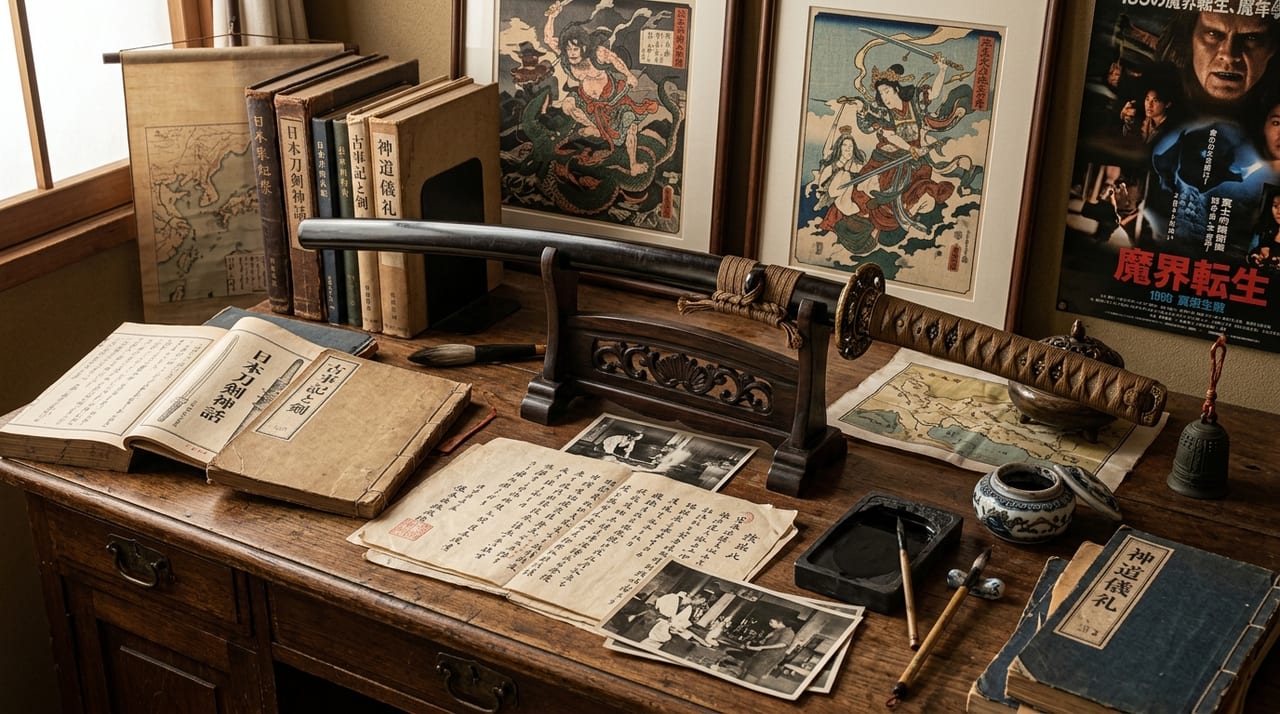
 * Image is for illustrative purposes only.
Yamato Takeru
ヤマトタケル
Tokusatsu film produced by Toho in 1994. Adapts the mythology of Yamato Takeru, the legendary hero appearing in the Kojiki and Nihon Shoki, into cinema. The divine sword Ame no Habakiri forms the narrative's core, embodying the ancient Japanese concept of 'the sword as sacred imperial regalia' through mass cinema. The divine sword Ame no Habakiri, used in the scene of subjugating the eight-headed serpent Yamata no Orochi, is repeatedly referenced in contemporary pop culture as the first 'legendary named sword' in Japanese mythology.
Description
Yamato Takeru — The Tokusatsu Film That Visualized Japan's Oldest 'Named-Sword Legend' from Mythology
Yamato Takeru (Toei Company, 1994) is a tokusatsu (special effects) film adaptation of the mythology of Yamato Takeru — the legendary divine hero Yamato Takeru no Mikoto recorded in the Kojiki and Nihon Shoki. Directed by Okawara Takao and starring Takashima Masanobu as Yamato Takeru and Sawaguchi Yasuko, the film marshaled Toei's accumulated special-effects expertise to present Japan's national hero myth at epic scale. Its primary cultural contribution is the popularization of the divine sword Ame no Habakiri as a widely recognized name in modern mass-audience cinema.
### Ame no Habakiri — Japan's Oldest 'Named Sword'
Ame no Habakiri (literally "Sword That Slashes Heaven's Feathers") is a divine sword appearing in the Kojiki and Nihon Shoki, and according to myth was used by Susanoo-no-Mikoto when he slew the eight-headed serpent Yamata no Orochi. As the name itself suggests — "ha-ha" signifying the cutting of the great serpent — it is held to possess mythological power and represents the archetype of the "sacred regalia as sword" concept in Japanese mythology.
In the Kojiki myth, Ame no Habakiri is wielded as Susanoo, inebriated with sake, successively severs the eight heads and tail of the Yamata no Orochi. During this slaying, a divine sword is discovered within the serpent's tail — the "Ame no Murakumo no Tsurugi" — later called the "Kusanagi no Tsurugi" (the "Grass-Cutting Sword"), which becomes one of the Three Sacred Treasures of the imperial line. Thus Ame no Habakiri is positioned as the "sword that led to the discovery of Japan's Three Sacred Treasures," occupying a place at the very origin of Japanese sword culture and the symbolism of imperial authority.
### The Divine Sword's Depiction in Film
In the Toei "Yamato Takeru," the mythological worldview centered on Ame no Habakiri is reconstructed through special effects. The depiction of the divine sword bestowed upon Yamato Takeru by his father, Emperor Keiko; the supernatural power it manifests — flashes of divine light, combat with mythological creatures (including the appearance of a fictional giant monster called "Grand Gloerdas") — visualizes the Japanese mythological concept that "the sword embodies the will of the gods" as an action film spectacle.
### The Penetration of "Ame no Habakiri" into Modern Pop Culture
The name "Ame no Habakiri" originates from the Yamato Takeru mythology and repeatedly appears in diverse modern pop-culture works. Representative examples include references in "Strangeia: The War of the Nameless Blade," personification in "Touken Ranbu," adoption as a special-technique name in the "Tales of" series, and implicit references in "Naruto" to the Yamato character. "Ame no Habakiri," alongside "Muramasa" and "Masamune," is one of the most widely penetrated Japanese sword-name proper nouns in pop culture.
### Connection to the Kusanagi Sword — The Three Sacred Treasures and Sword Culture
The Kusanagi no Tsurugi (Ame no Murakumo no Tsurugi) discovered through Ame no Habakiri is enshrined as one of the Three Sacred Treasures alongside the Yata-no-Kagami (Sacred Mirror) and Yasakani-no-Magatama (Sacred Jewel), and is currently venerated as a sacred object at Atsuta Shrine in Nagoya. The chain Ame no Habakiri → Kusanagi no Tsurugi → Three Sacred Treasures demonstrates the core of Japan's unique sword culture — "a mythological sword persisting into the present as a real sacred relic." The 1994 Toei film, by presenting this mythological chain through mass cinema, repositioned the divine sword legend from "a distant ancient tale" to "contemporary Japanese cultural DNA."
### Tokusatsu Film and the Popularization of Sword Culture
In the early 1990s, Toei's special-effects technology stood at Japan's highest standard, and this film is regarded as a fine tokusatsu work alongside the "Heisei Gamera" series and "Heisei Godzilla." The film's worldview, in which the sword is depicted as a being possessed of mythological and supernatural power, implanted a cultural program of "the relationship between the Japanese sword and mythology" in the children of that era, and may have been a contributing factor to the subsequent "Touken Ranbu" boom.
### A Perspective for Sword Collectors
Yamato Takeru serves as an essential cultural reference point for understanding the "mythological roots" of Japanese sword culture. To comprehend why the divine sword name Ame no Habakiri is so repeatedly invoked in modern pop culture, it is essential to grasp the mythological context from the Kojiki and Nihon Shoki — Susanoo's slaying of the great serpent, the discovery of the Kusanagi no Tsurugi, and the chain extending to the Three Sacred Treasures. The Toei film "Yamato Takeru" functions as a gateway to understanding the mythological roots of sword culture, being the work that most widely popularized this mythological context as mass cinema.
Real Swords Featured
Ame no Habakiri
Kusanagi no Tsurugi
See authentic Japanese swords
See authentic Japanese swordsThis page is intended to introduce Japanese sword culture and is not affiliated with any of the works mentioned.