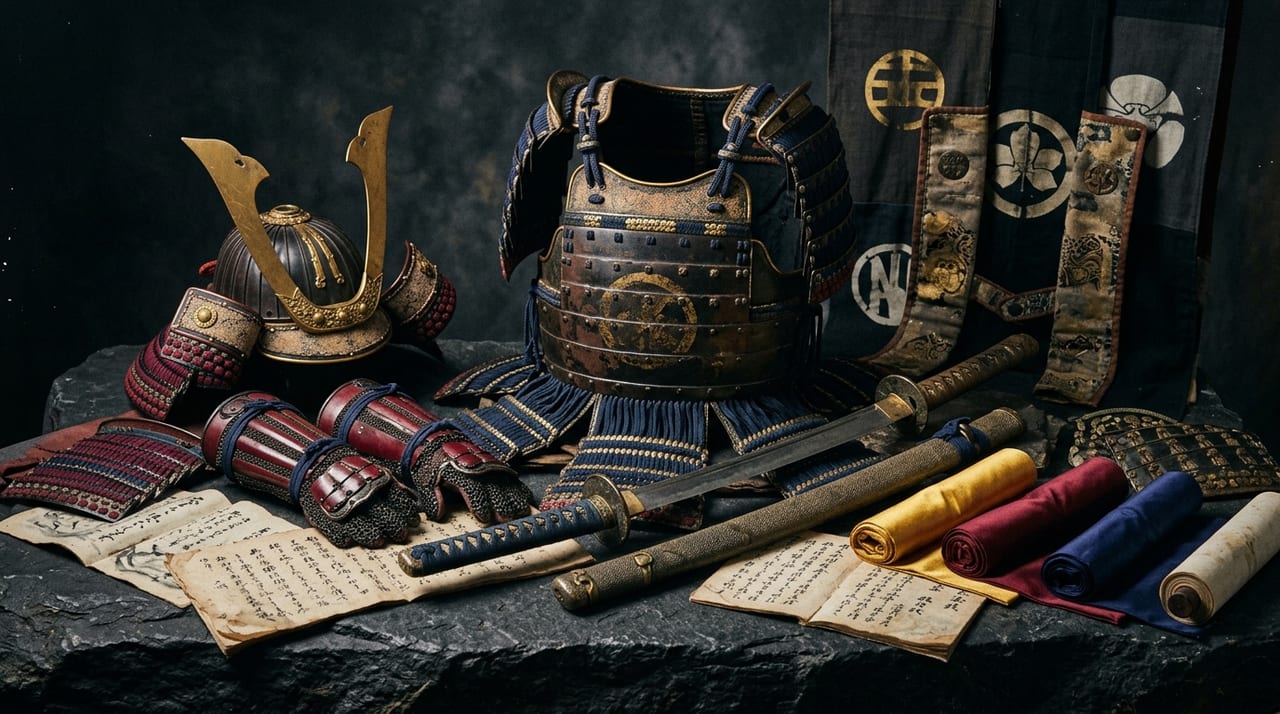
 * Image is for illustrative purposes only.
Ran
乱
A monumental 1985 film directed by Akira Kurosawa. An adaptation of Shakespeare's King Lear set in the Sengoku period, depicting a power struggle between the three sons of an aging daimyo, Ichimoji Hidetora, on a grand scale. The Battle of Sanno Castle is renowned as one of cinema's greatest depictions of warfare, with hundreds of mounted warriors and meticulously recreated Sengoku-period armor and swords of significant historical documentary value. Won the British Academy Film Award for Best Foreign Language Film.
Description
Ran — Akira Kurosawa's Final Masterwork Depicting the Twilight of the Sengoku Era and Japanese Swords
Ran (1985) is the final masterwork completed by Akira Kurosawa at age 75 and represents the culmination of his Sengoku historical dramas following Kagemusha (1980). This adaptation of Shakespeare's King Lear transplanted to the Sengoku period of Japan was made on an unprecedented scale, with a production budget of 2.6 billion yen (the highest in Japanese cinema history at the time) and a production period of 10 years. The costume design by Wada Emi won the Academy Award for Best Costume Design and is internationally recognized as the pinnacle of visual beauty.
### The Aesthetics of Color in Sengoku Armor and Swords
The defining visual characteristic of Ran is the rigorous execution of "color as visual code." The three sons of the Ichimoji clan—Taro (First Castle, yellow), Jiro (Second Castle, red), and Saburo (Third Castle, blue)—each command armies entirely unified in monochromatic armor, banners, and costumes. This color scheme elevates to cinematic expression the actual Sengoku tactical practice of army identification through unified livery—identification via battle flags (hatajirushi) and lance pennants (sashimono).
In the depiction of swords, the koshirae (fittings) of each warrior's blade are given chromatic unity, visually realizing the unified aesthetic of Sengoku warlords—where armor, banners, and sword fittings formed an integrated whole. The film's art direction embodies the historical practice of Sengoku daimyo applying distinctive designs to their military equipment—as when Uesugi Kenshin employed the banner of Bishamonten and Takeda Shingen displayed the "Wind, Forest, Fire, Mountain" battle standard—thereby demonstrating that sword fittings functioned as a complex medium of personal aesthetic taste and political allegiance.
### The Battle of Sanno Castle — The Beauty of Swords' Twilight
The film's greatest spectacle is the "assault on Sanno Castle." The approximately 15-minute sequence depicting the allied forces of Taro and Jiro assaulting the castle where Hidetora shelters is renowned for its avant-garde direction: all dialogue and sound effects are stripped away, with only Toru Takemitsu's string composition as accompaniment.
The swordsmanship depicted in this sequence is grounded in the actual "mass warfare tactics" of the Sengoku period. The katana is visually portrayed not in one-on-one duels but as a weapon employed in "charges" during melee combat (ranzen)—coordinated assaults that shattered enemy formations. The typical sequence of a Sengoku battle—massed musket volleys, followed by a wall of spear formations (yarhibusuma), cavalry charges, and finally hand-to-hand combat with swords—is recreated with hundreds of extras and authentic armor (some of museum quality).
### Hidetora's Madness and "The Meaning of Wielding a Sword"
The narrative of protagonist Ichimoji Hidetora's (played by Tatsuya Nakadai) psychological disintegration parallels the central question of "the authority and emptiness of wielding a sword." Once a warrior who claimed countless lives and conquered the realm through the sword's power, Hidetora loses his ability to wield a blade as he ages and is betrayed by his sons—a narrative that exposes the fundamental contradiction of Bushidō: that the authority conferred by the sword evaporates with physical decline.
"A sword amplifies the power of the one who wields it; should the wielder be weak, the sword becomes meaningless"—this truth offers profound insight into the essential nature of the blade. Ran presents this insight through the cinematic tragedy of an aging daimyo.
### Art Direction, Armor, and Weapons Authentication
Professional armor workshops participated in Ran's production, with approximately 1,500 suits of armor handcrafted. Most are faithful recreations of Sengoku mid-period (16th century) tosei-gusoku armor and possess archival value comparable to museum collections. A portion of the armor and weapons used in the film were subsequently donated to and preserved in museums—a rare instance of cinema functioning as historical documentation.
### A Perspective for Sword Collectors
Ran serves as "the largest-scale cinematic recreation of Sengoku-era sword and armor culture" and is an important reference point for sword enthusiasts and armor scholars. The Battle of Sanno Castle sequence in particular is a rare visual document for understanding the role of swords in actual Sengoku combat—where blades functioned as an auxiliary to firearms, bows, and spears. Kurosawa's "commitment to authenticity" in art direction and historical research preserves the reality of the Sengoku period as recreated through human effort and master craftsmanship in the pre-CGI era, a representation that remains unfaded in the digital age.
See authentic Japanese swords
See authentic Japanese swordsThis page is intended to introduce Japanese sword culture and is not affiliated with any of the works mentioned.