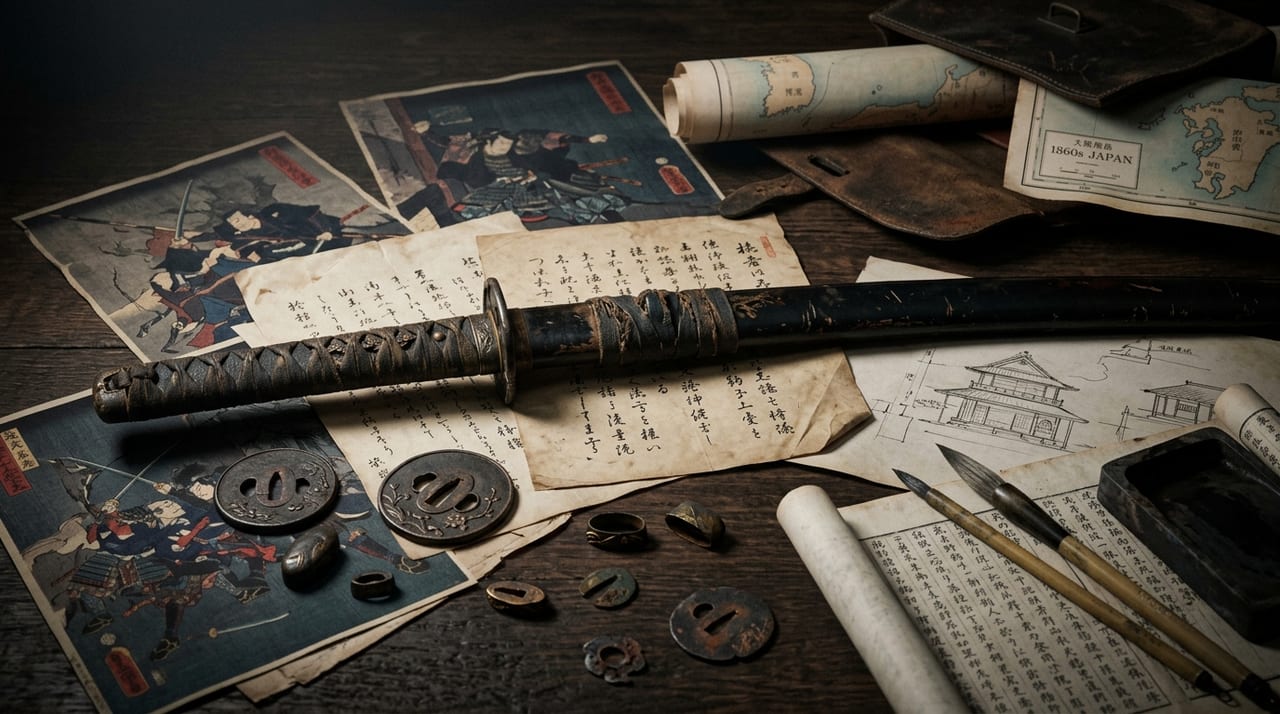
 * Image is for illustrative purposes only.
Assassin
人斬り
A late Edo period drama film released in 1969 by director Gosho Heinosuke (Daiei). It depicts the tragic life of Okada Izo (known as 'Izo the Assassin'), who carried out repeated assassinations under the orders of Takechi Zuisan of the Tosa Domain. An extraordinary star-studded ensemble film featuring Mishima Yukio, Katsu Shintaro, and Ishihara Yujiro, and a masterpiece period drama that vividly portrays the assassination culture and the true nature of sword-wielding in the late Edo period.
Description
Assassin (Heavenly Punishment)—The Harrowing Life of a Late Edo Period Assassin and the Karma of the Japanese Sword
Assassin is a late Edo period drama film (Daiei) released in 1969 by director Gosho Heinosuke. Through the life of Okada Izo (1838–1865), known by the name 'Izo the Assassin,' it is a work that unflinchingly portrays the sword culture of the late Edo period turmoil—assassination as a 'practical application of the sword.' Mishima Yukio is also known for his appearance in the role of Tanaka Shinbei, and as an authentic late Edo period drama with a stellar cast, the film remains a landmark in cinema history.
### Okada Izo—Historical 'Assassin' and the Japanese Sword
Okada Izo was a swordsman and assassin from the late Edo period from Tosa (present-day Kochi Prefecture) who bore the name 'Izo the Assassin.' He is reported to have carried out assassinations of Bakufu officials and political enemies under the orders of Takechi Zuisan, who led the Tosa Loyalist Party. The sword technique Okada Izo mastered was the Kyoshin Meichi School (Kyoshinmeichiryū), a formal school of swordsmanship he studied in Edo. Historically, after his capture, he confessed under torture and was executed by the Tosa Domain in 1865 (Keio 1). His harrowing life is remembered by posterity as 'the tragedy of a man whose exceptional sword skill was continually used for assassination, and who was ultimately discarded as a tool of the system.'
### Late Edo Period Assassination Culture and the Japanese Sword
The late Edo period (1853–1868) was an era of political turmoil following the opening of Japan prompted by Perry's arrival, during which assassination acts called 'Heavenly Punishment (Tenchū)' became rampant. Under the pretext of 'executing divine punishment in Heaven's stead,' royalist anti-foreign activists successively assassinated Bakufu officials and foreign-friendly daimyo with Japanese swords. These assassinations took place in various locations—streets, lodgings, and banquets—and were mainly carried out as nighttime surprise attacks. The sword's effectiveness in 'nighttime surprise attacks'—the speed of instant drawing from darkness and cutting down in a single stroke—was exploited to its fullest.
The swords of this period were in the golden age of Shinshintō (New-New Swords), and master smiths such as Katayama Munetsugu, Minamoto Kiyomaro, and Otafuji Naotane continued to forge masterpiece blades combining the aesthetic principles of ancient blades (kotō) with high practical effectiveness. The late Edo period activists and swordsmen carried these masterpiece swords as they navigated the turbulent waves of the era. The sword Okada Izo used is believed to have been a high-quality Shinshintō blade of this era.
### Authenticity of Sword Technique Depiction in Film
Director Gosho Heinosuke is known as a master of authentic period drama and pursued meticulous realism in his depiction of sword technique. The sword-fighting scenes in this film are based on consultation with practitioners of kendo and iaido, and coldly depict the speed, efficiency, and brutality of the 'assassination' that late Edo period swordsmen would have actually carried out. Particularly noteworthy among sword-fighting films is how it expresses the weight of the act of 'cutting'—the karma of taking a human life—through Izo's psychological collapse.
### Multi-faceted Depiction of Late Edo Period Swordsman Culture
By depicting Okada Izo's interactions with actual late Edo period figures such as Takechi Zuisan, Sakamoto Ryoma, and Katsura Kogoro, the film situates his life within the broader context of the late Edo period. Izo's life—repeatedly carrying out assassinations without ideological conviction despite his sword talent—embodies the universal theme of 'the meaning of wielding a sword' and 'the weight of cutting down a person with a blade.' While Kurosawa films depict 'samurai honor and aesthetics,' this film portrays 'the practicality and tragedy of the sword,' and is a rare work that sheds light on the dark side of Japanese sword culture.
### A Perspective for Sword Enthusiasts
Assassin is a rare film that portrays late Edo period sword culture from the perspective of 'practical combat, assassination, and politics.' Viewed from the modern era, in which the Japanese sword is appreciated as 'fine art and cultural property,' this film directly portrays the fact that in the late Edo period, the Japanese sword was also a 'lethal weapon' that actually claimed many human lives. In understanding this 'duality of the Japanese sword'—beauty and function, art and violence—Assassin can be said to be an essential work for modern sword enthusiasts.
Real Swords Featured
Late Edo Period Shinshintō (Activists' Swords)
The swords carried by late Edo period activists and swordsmen were often Shinshintō (New-New Swords) from their golden age. Blades forged by master smiths such as Katayama Munetsugu, Minamoto Kiyomaro, and Otafuji Naotane combined the aesthetic principles of ancient blades (kotō) with high practical effectiveness, and endured intense real combat during the late Edo period (assassinations, the Ikedaya Incident, the Kinmon Incident, and others). Famous examples include the Hotetsu of Kondo Isami and the Kikuichimonji of Okita Soji—the blades of the Shinsengumi are similarly renowned as symbols of late Edo period culture.
Kyoshin Meichi School (Kyoshinmeichiryū)
A school of swordsmanship that Okada Izo studied in Edo. Centered on the dojo 'Shigakukan' established by Momoi Shunzo, this school was counted among the 'Three Great Dojos of Edo' alongside Chiba Shusaku's Hokusin Ichi School and Saito Yakuro's Shinto Munen School. Technically renowned as a solid and practical form of swordsmanship, many late Edo period activists and swordsmen studied this school.
See authentic Japanese swords
See authentic Japanese swordsThis page is intended to introduce Japanese sword culture and is not affiliated with any of the works mentioned.