Guntō Quenching Techniques — Technical Differences Between Traditional Tsuchioki Yaki-ire and Industrial Uniform Quenching
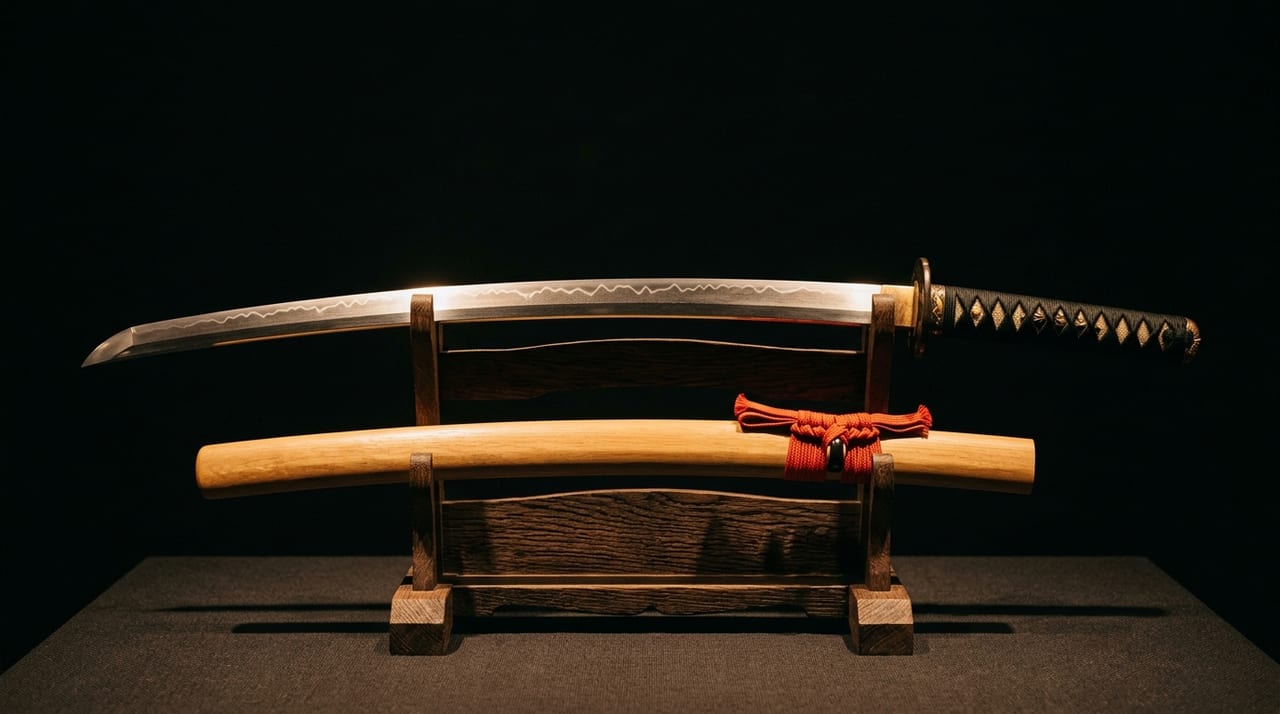 * Image is for illustrative purposes only.
Table of Contents
The Fundamental Principles of Yaki-ire — Structural Changes in Steel
The strength of all steel blades, including the Japanese sword, is largely determined by yaki-ire (quenching), a heat-treatment process. Yaki-ire is a technique in which red-hot steel is rapidly cooled to alter its internal structure and dramatically increase its hardness and strength.
The relationship between iron (Fe) and carbon (C), the principal constituents of steel, changes dramatically with temperature. When steel is heated to around 770°C or above, the crystal structure of iron transforms into a state called the "austenite phase," in which carbon atoms are distributed uniformly within the iron lattice. At this high temperature, steel is relatively soft and easy to work.
When rapidly cooled from this state, steel transforms into a different crystal structure called the "martensite phase." In this state, carbon atoms are locked within the iron lattice with nowhere to escape. The result is an abnormally distorted crystal structure, and this distortion causes hardness to rise dramatically. This is the essence of yaki-ire.
Quenching the Japanese Sword — Where Tradition Meets Science
Japanese tōkō understood the principles of yaki-ire through practice, long before the age of scientific language. Through centuries of trial and error, tōkō accumulated empirical knowledge of the optimal heating temperature, cooling rate, and quenching medium.
Control of heating temperature was judged by color. As the color of the red-hot blade shifts from dark red to bright red and then to yellow, the steel reaches different temperatures. Tōkō acquired this "reading of color" in the course of their training, and are believed to have judged temperature to an accuracy of approximately ±10°C.
The choice of quenching medium is also critically important. Different quenching media — water, oil, ash, salt — have a great influence on the cooling rate. Tōkō typically used a secret proprietary liquid called "yakimizu (quenching water)." This was not simple water but a complex formulation of lye, salt, plant ash, and other materials, and is believed to have precisely controlled both cooling speed and uneven cooling.
Tempering Back — The "Balance" of Hardness and Toughness
However, a sword immediately after yaki-ire is more brittle than one might imagine. A blade in the martensite phase is extremely hard but at the same time extremely prone to cracking, rendering it useless in actual combat. This makes "tempering back (yakimodoshi)" an indispensable process.
Tempering back is a process in which the sword is heated again after yaki-ire — though not to as high a temperature as during yaki-ire. It is typically heated in the range of 150°C to 300°C. At these temperatures, part of the distorted crystal structure of the martensite phase is relieved, transforming into a more stable "tempered structure." As a result, hardness decreases slightly, while "toughness (pliability, resistance to cracking)" improves substantially.
The choice of tempering-back temperature differs according to the intended use of the sword.
| Tempering-back temperature | Effect | Preferred application |
|---|---|---|
| Low-temperature tempering back (150°C–200°C) | Reduces brittleness while preserving hardness as much as possible | Swords prioritizing cutting sharpness, such as those intended for warriors in combat involving frequent sword-fighting |
| High-temperature tempering back (250°C–300°C and above) | Hardness decreases substantially, but toughness improves markedly | Often chosen for environments requiring flexibility and durability — for example, environments such as guntō where reliability as a weapon is the top priority |
This "balance of hardness and toughness" is the single most important factor that determines the true value of the Japanese sword.
The Practice of Quenching and Tempering Back in Guntō
The quenching and tempering back of Shōwa-era guntō — particularly the Type 98 guntō (established in 1938) — was designed with "reliability as a weapon" as the foremost priority.
Guntō blades were often tempered back to achieve greater toughness than typical art swords. This was because they needed to withstand repeated cuts in group combat. A blade cracking or chipping as a soldier struck multiple enemy soldiers in succession was unacceptable. Tempering-back temperatures were therefore set on the higher side, tuning the blade to "prioritize durability over cutting sharpness."
On the other hand, this balance varied greatly depending on the skill of the tōkō. Guntō made by renowned tōkō achieved tuning that "realized both hardness and toughness at a high level." Such swords were highly regarded on the battlefield, and it is said that they were sometimes prized by enemy forces as captured trophies.
The Microscope and the Science of Quenching — Modern Verification
Modern metallurgy provides the means to analyze the quenching and tempering-back traces of a sword in detail. When a blade is magnified more than 100 times under an optical microscope, the detailed structure of the martensite and tempered structures becomes visible.
Using hardness testing (Vickers hardness or micro-Vickers hardness), the hardness of very small areas of the blade can be measured in 0.1 mm increments. Examination of high-quality guntō confirms that while the entire blade falls within the range of HV 550–750 (Vickers hardness), intentional hardness differences are designed into each part.
Examples of hardness differences by part are as follows.
- Edge section: around HV 700
- Jihada (grain pattern of the steel) section: HV 550–600
From these differences, it can be inferred that tōkō "intentionally applied different cooling and heating conditions to each part." This is evidence that they had a complete understanding of "the science of quenching and tempering back," and it stands as an indicator of the tōkō's profound technical skill.
Although the iron-carbon phase diagram for steel was first drawn by chemists in the 19th century, Japanese tōkō had been practically controlling this phenomenon for hundreds of years before that.