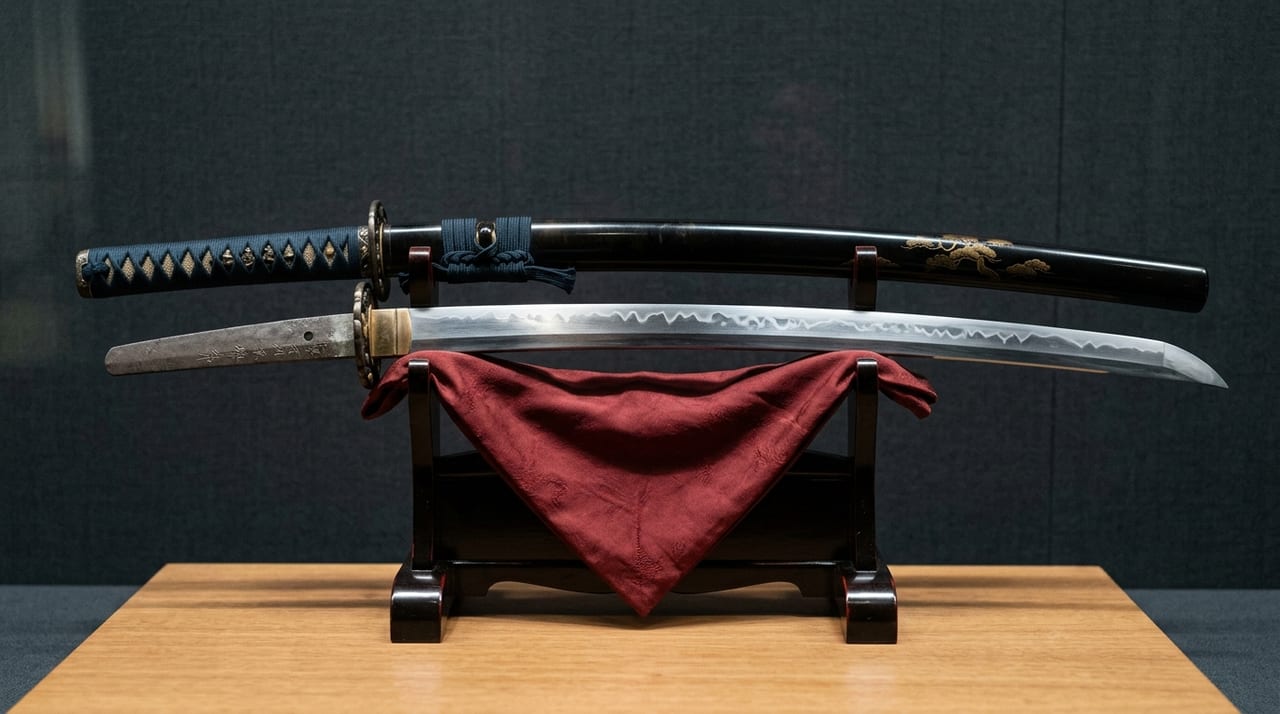
 * Image is for illustrative purposes only.
Yamanbagiri Kunihiro
山姥切国広
Also known as: Yamambagiri - Horikawa Kunihiro's Masterpiece - A Tachi Forged at Ashikaga School
Description
Sword Overview
Yamanbagiri Kunihiro is a long sword (tachi-style) forged by master craftsman Horikawa Kunihiro in Tenshō 18 (1590) during the Azuchi-Momoyama period, and is widely recognized as his supreme masterpiece. With an imposing blade length of approximately 70.6 cm, it was crafted in imitation of an older blade bearing the legend of having slain a "yamamba" (mountain hag). The blade's surface features distinctive cloth-like wear marks on the spine (mune), created through special finishing techniques that replicate characteristics of the original model. It has been designated an Important Cultural Property and is currently housed in Ashikaga City Museum of Art.
The Craftsman
Horikawa Kunihiro was a swordsmith active from the Tenshō through Keicho periods (approximately 1570s–1615) based in Horikawa, Yamashiro province (present-day Kyoto), and was the founder of the Horikawa school. Originally a swordsmith from Hyuga province (present-day Miyazaki Prefecture), he came to Kyoto in the wake of Toyotomi Hideyoshi's Kyushu Campaign and established his smithy in Horikawa. Kunihiro uniquely elevated the techniques of the Yamashiro tradition, demonstrating exceptional skill unmatched by his peers in the refinement of the blade's metal structure (jigane) and the rich variety of its edge patterns (hamon). He particularly excelled at dynamic hamon patterns such as "gunome," "choji-midare," and "nambari," whose vibrant character is highly appreciated by modern sword enthusiasts. His workshop produced many renowned masters including Dewa-dayu Kuniji, Izumi no Kami Kunisada, and Echigo no Kami Kunitomo, who formed the foundation of Kyoto's sword-forging tradition during the Edo period. Yamanbagiri Kunihiro stands among Kunihiro's works as the finest example of his craftsmanship, and its status as his "supreme masterpiece" remains unshaken.
Forging at Ashikaga School
One reason Yamanbagiri Kunihiro possesses such exceptional provenance lies in its place of creation. In Tenshō 18 (1590), Kunihiro forged this blade at Ashikaga School in Ashikaga, Shimono province (present-day Ashikaga, Tochigi Prefecture), at the request of Ashikaga Castle's lord, Nagao Keninaga. Ashikaga School is one of Japan's oldest centers of learning, continuing from the Muromachi period, and was known as a temple of learning teaching Confucianism, yijing, and military science. It was extraordinary for a swordsmith to forge such a masterpiece at a place of learning rather than at a feudal lord's castle or smithy, and some believe that the special spiritual nature of Ashikaga School was infused into the blade. The tang (nakago) bears an inscription: "In Tenshō 18, forged at Ashikaga-sho; by Kunihiro," permanently recording this extraordinary place of creation as part of the sword's pedigree.
The Yamamba Legend and the Original Model
The name "Yamamba-kiri" derives from a separate ancient blade known as the "honka" (original model). This honka was a revered ancient sword bearing the legend of having slain a "yamamba," and was in the possession of Nagao Keninaga. Keninaga commissioned a copy of this honka from the master swordsmith of the age, seeking to imbue the new blade with the honka's spiritual power and legendary legacy. Kunihiro faithfully reproduced the honka's form and character while pouring the essence of his own technique into this new masterpiece. The cloth-like marks on the blade's surface are said to replicate characteristics of the honka, producing a distinctive appearance found in no other sword. The name "Yamanbagiri Kunihiro" was born from this provenance as a "copy of the honka," and it is distinguished from the original by bearing the signature "Kunihiro."
Recent Recognition and Current Location
Yamanbagiri Kunihiro, long held in private collections with limited opportunities for public viewing, has in recent years been housed at Ashikaga City Museum of Art, where it is now regularly displayed. Its prominence has surged dramatically following its character depiction in the video game "Touken Ranbu," drawing numerous enthusiasts from throughout Japan to Ashikaga. This cultural phenomenon has significantly contributed to the city's tourism promotion and stands as a notable example of Japanese swords connecting with contemporary culture. Combining Kunihiro's transcendent skill, Ashikaga School's exceptional place of creation, and the fantastical yamamba legend into a unified whole, Yamanbagiri Kunihiro has become one of the most distinctive and exceptional masterpieces in the history of Japanese swordcraft.
Legends & Stories
The Yamambagiri Legend
The "yamamba" (mountain hag) is a fearsome yokai in Japanese folklore—an old woman dwelling in mountainous regions said to prey upon travelers. The yamamba appears in numerous legends and folktales, including the Noh play "Yamamba," and has long been feared as an eerie presence lurking in the dark depths of the mountains. The original blade bearing the name "Yamambagiri" is an ancient sword said to have slain such a mountain hag. While details are scarce, legend holds that a warrior encountered a yamamba in the mountains and cut her down with this blade. Overcoming the yamamba's supernatural power, the blade came to be believed imbued with potent spiritual force.
Nagao Akainaga possessed this legendary original blade and sought to commission a replica from a superior smith in order to transfer the legendary power to a new weapon. His choice to commission Horikawa Kunihiro, the most celebrated smith of his time, demonstrates Akainaga's refined aesthetic judgment and deep knowledge of swords. Kunihiro seized this rare opportunity to forge a blade at Ashikaga School, Japan's oldest seat of learning—a place believed to harbor the spiritual essence of scholarship itself—and poured the full extent of his technical mastery into the work. This blade, in which the legendary power of the original, Kunihiro's technical brilliance, and the sacred essence of Ashikaga School converged, became a rare masterpiece uniting legend, craft, and place—transmitted to posterity as such.
The Blade Landscape Created by Kunihiro's Technique
Yamanbagiri Kunihiro's hamon is an elaborate midare-ha (irregular pattern) based on gunome, fully showcasing Kunihiro's characteristic dynamic blade patterns. The jigane displays tightly packed ko-itame texture with excellent quality and fine, lustrous ji-nie giving it a radiant glow. The nunome-style treatment of the mune (spine), copying the original's appearance, can be understood not as a boastful display of its replica status, but as a quiet expression of respect for the original. The kissaki returns in a small circular form, and overall the blade presents a perfectly proportioned and graceful katana profile. At the Ashikaga City Museum of Art, these technical characteristics of Kunihiro's work can be observed up close, making this an essential blade for any sword enthusiast to view.