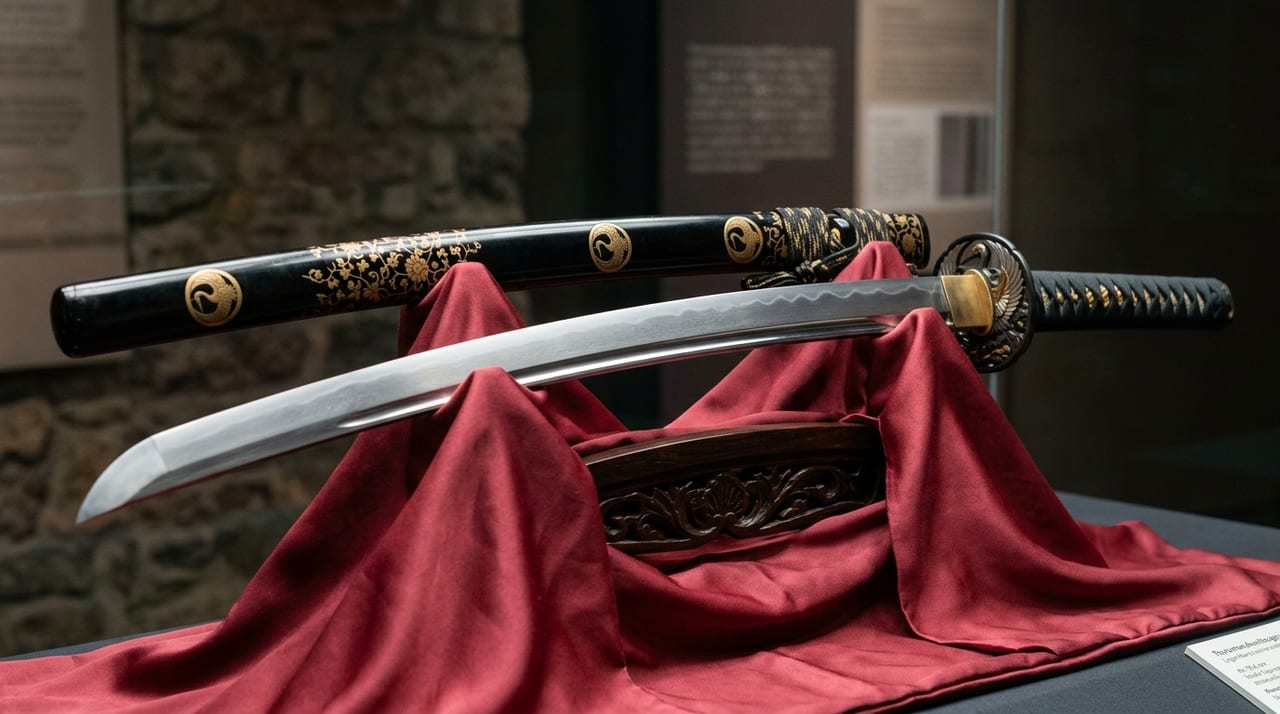
 * Image is for illustrative purposes only.
Tsurumaru Kuninaga
鶴丸国永
Also known as: Crane Circle
Description
Overview of the Sword
A celebrated great sword forged by the late Heian period swordsmith Gojō Kuninaga, it bears the name "Tsurumaru" from the crane-circle crest (tsuru no maru) depicted on its original mountings. The blade length is given as approximately 78.6 centimeters (2 shaku 5 sun 9 fun and a half), characterized by a deep and graceful curvature with an elegant waist curve. The blade width is somewhat narrow, displaying the delicate and dignified form characteristic of late Heian period swords.
Manufacturing Method and Characteristics
The ground metal is densely packed with fine wood-grain patterns and displays minute ground boiling, presenting clear steel color infused with refined luster. The blade pattern is based on a small-nie-deki straight edge with subtle undulation, resulting in a calm appearance that, while lacking ostentation, conveys profound dignity and serene beauty. Gojō Kuninaga was a swordsmith of the late Heian period residing in the Gojō district of Yamashiro Province, regarded as an early master of the Yamashiro tradition alongside Sanjō Munechika. While Munechika is known for his flamboyant work style, Kuninaga is characterized by an orderly and composed aesthetic, sometimes described as "quiet Kuninaga." The "crane-circle" crest depicted on Tsurumaru's mountings shows cranes spreading their wings in a circular form, symbolizing longevity and auspiciousness. Cranes are considered auspicious birds believed to live for a thousand years, and the sword's survival through a millennium embodies the very essence of "cranes for a thousand years," earning it renown as a legendary blade.
Provenance of the Sword
The provenance traces back to Hōjō Sadatoki (1271–1311) of the Kamakura period. Sadatoki was the ninth shōgun of the Kamakura shogunate and is said to have acquired this sword during the Adachi Yasumori Rebellion (the Shimotsuki Disturbance) in 1285. The subsequent lineage is complex, but during the Sengoku period it passed into the hands of Oda Nobunaga, and during the Edo period it was treasured by the Sendai clan daimyo, the Date family.
Current Holdings
Following the Meiji Restoration, it was donated to the Imperial Household and became an Imperial possession (goyōbutsu), now managed by the Imperial Household Agency. As an Imperial possession, opportunities for public exhibition are extraordinarily rare, and the actual sword can be viewed only during special exhibitions held once every several years. In the game Touken Ranbu, the character Tsurumaru Kuninaga is depicted in white garments with a carefree and ethereal bearing, becoming one of the game's most popular characters. Due to this influence, the actual sword's exhibitions attract enormous crowds, becoming a social phenomenon.
Legends & Stories
Legends and Tales
Tracing the provenance of Tsurumaru Kuninaga reveals how many rulers' hands this blade passed through. The earliest certain owner was Hōjō Sadatoki, the ninth regent of the Kamakura shogunate. Regarding how Sadatoki obtained Tsurumaru Kuninaga, one theory holds that the Shimotsuki Incident of Kōan 8 (1285) was involved. The Shimotsuki Incident was a political coup in which Taira Yoritsuna, an administrative official of the Hōjō tokusō house, destroyed the powerful gokenin Adachi Yasushige; it is believed that a portion of Yasushige's property came into Sadatoki's possession. If Tsurumaru Kuninaga was one of those "spoils of war," then this blade changed hands amid bloody struggles for power.
Into the Hands of Warriors
The subsequent provenance is not entirely clear, but it is said to have passed through the hands of multiple warlords from the Muromachi through Sengoku periods, and there is also a tradition that Oda Nobunaga once possessed it.
Modern Era and Present Day
It ultimately came into the hands of the Date clan, lords of Sendai domain, and in 1901 (Meiji 34), upon Emperor Meiji's visit to Sendai, the fourteenth head of the Date house, Date Munemoto, presented it to become an imperial treasure. Tsurumaru Kuninaga became suddenly famous in the modern era, with the decisive influence being the browser game "Touken Ranbu -ONLINE-," which began distribution in 2015. In the game, Tsurumaru Kuninaga is depicted wearing white robes with a carefree personality who enjoys surprising others, and quickly became one of the most beloved characters. Its impact was extraordinary; when the actual Tsurumaru Kuninaga was put on special display, fans flocked from across the nation, creating a social phenomenon with lines of enthusiasts waiting for hours. This "Touken Joshi" (sword girl) boom greatly expanded the reach of Japanese sword culture, creating a new cultural phenomenon where young women previously unfamiliar with swords began visiting museums to learn about the history and culture of Japanese blades. Tsurumaru Kuninaga became the pioneering blade in this movement, symbolizing cultural continuity and renewal—a sword forged a millennium ago acquiring new life through contemporary pop culture. A crane lives a thousand years—just like the crane that lives on beyond a thousand years, this sword continues to attract new fans even now.