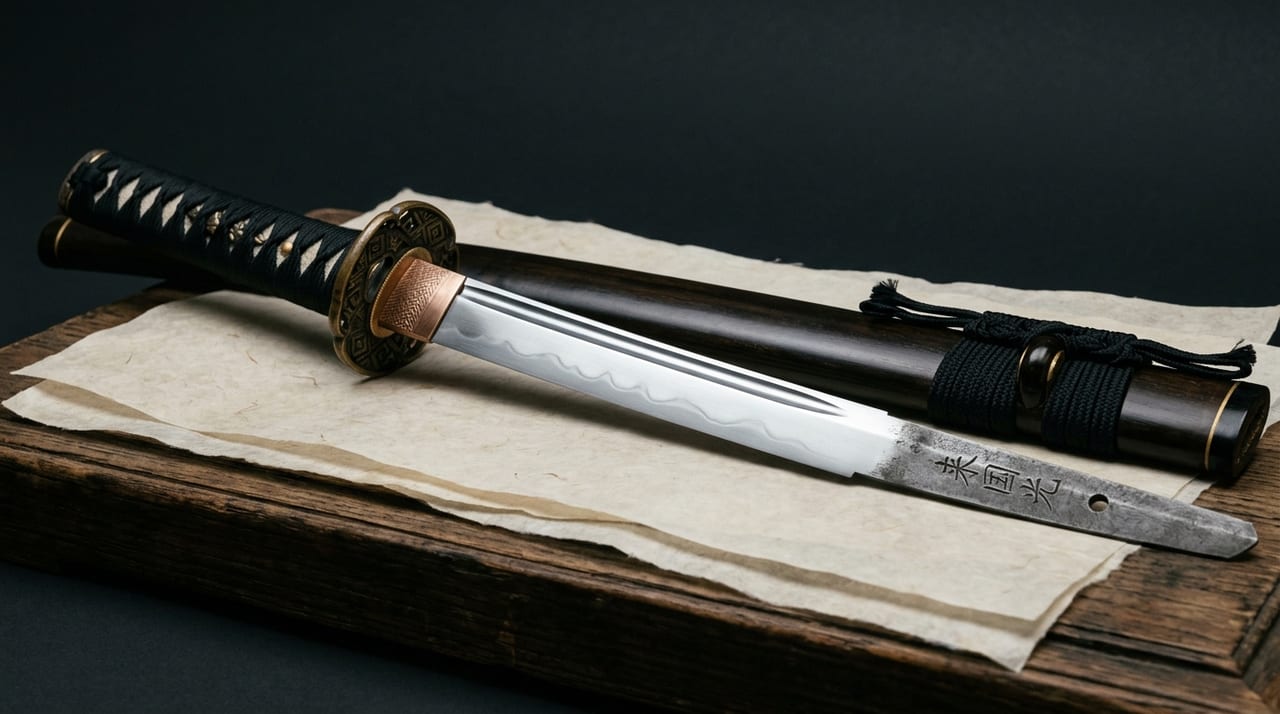
 * Image is for illustrative purposes only.
Tsuda Echizen no Kami Sukehiro
津田越前守助広
Also known as: Second-generation Sukehiro; Kaku-Tsuda; Maru-Tsuda; originator of the toranba temper
Description
Masters of Ōsaka Shintō
Tsuda Echizen no Kami Sukehiro was a swordsmith of the early Edo period, born in 1637 (Kan'ei 14) in Settsu Province. He was adopted as the heir of the first Sukehiro, known by the nickname “Soboro Sukehiro,” and learned swordsmithing from him. In 1657 (Meireki 3) he received the title Echizen no Kami. He later served Aoyama Munetoshi, the castellan of Ōsaka Castle, and became a master who represents Ōsaka shintō. He is ranked among the finest makers of the shintō period and is classified as an ōwazamono (of the highest cutting grade).
Origin of the Tōranba
What made Sukehiro's name immortal is the tōranba (wave-surge temper line), which he originated himself. This hamon, likened to great waves surging back and forth, gives rounded tips to the broadly undulating notare and produces a magnificent scene of a deep nioiguchi rich in nie. This style had a strong influence on the swordsmiths of Ōsaka in the same period, and it was further inherited by the swordsmiths of the shin-shintō period. It can be said to be a great invention in the history of hamon in Japanese swords.
Kaku Tsuda and Maru Tsuda
Sukehiro changed the way he cut his signature throughout his life, and this serves as a clue for dating his work. From about age twenty-two to about thirty, he cut signatures prefixed with “Minamoto” or “Fujiwara.” From about age thirty-one to about thirty-eight, the character ta (田) in “Tsuda” was cut in a square, upright kaisho style, known as “Kaku Tsuda” (square Tsuda). From age thirty-eight to forty-six, it was cut in a rounded, cursive-like style, known as “Maru Tsuda” (round Tsuda).
Reputation and Legacy
Sukehiro died in 1682 (Tenna 2) at the young age of forty-six. Although his life was short, he is said to have left about 1,700 blades, and the breadth and quality of his work stand far above the rest. Alongside Nagasone Kotetsu of Edo, he is called a yokozuna of shintō. Together with Inoue Shinkai of the same city of Ōsaka, he receives the highest recognition as one of the two great masters of Ōsaka shintō. Joint works by the two smiths also survive, reflecting the vitality of the Ōsaka forging world at the time.
Legends & Stories
The toranba temper Sukehiro devised is said to render in the hamon the surge and retreat of ocean waves. In a life of only forty-six years he is held to have forged some 1,700 blades, and he was ranked with Inoue Shinkai of Osaka as one of the two great figures of the Osaka shinto school. Collaborative blades by the pair still survive, testimony to a relationship between two supreme masters who competed with and yet acknowledged one another.