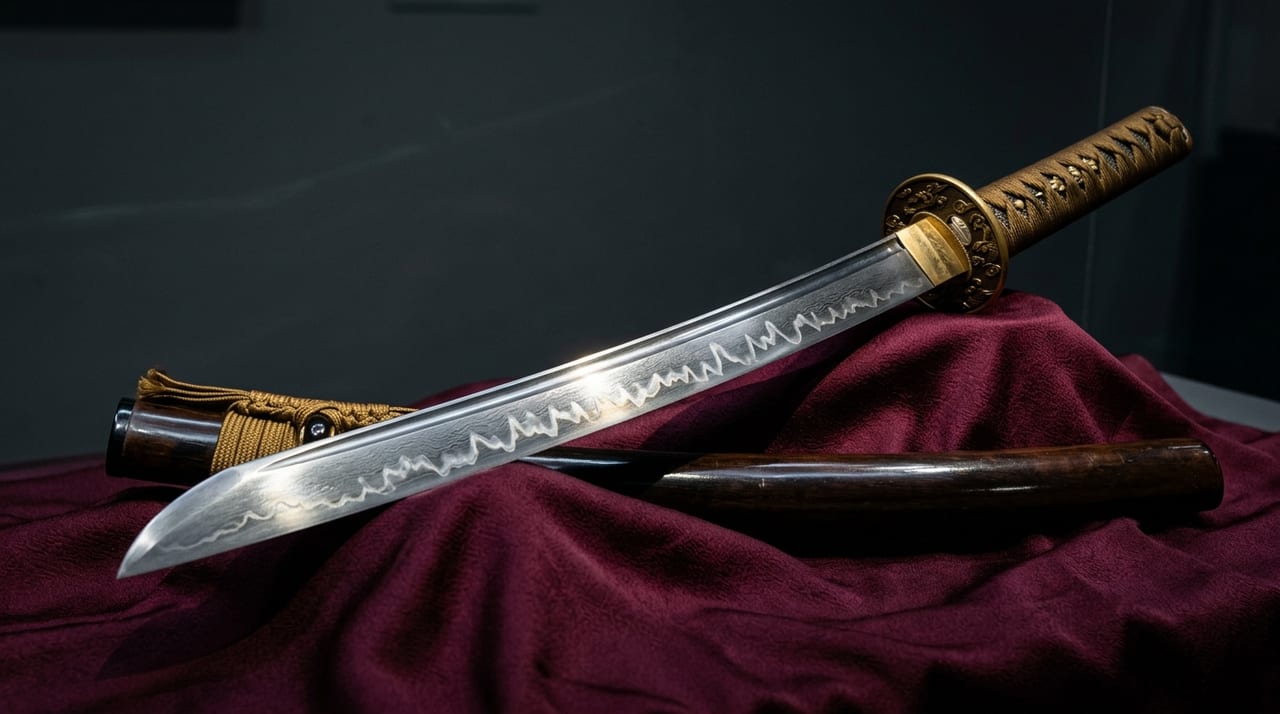
 * Image is for illustrative purposes only.
Hotei Kunihiro
布袋国広
Also known as: Hotei Kunihiro — Wakizashi Forged by Horikawa Kunihiro at the Ashikaga School
Description
Overview
Hotei Kunihiro is a wakizashi forged in the eighth month of Tenshō 18 (1590) at the Ashikaga School in Shimotsuke Province by the swordsmith Kunihiro, who would later become renowned in Kyoto's Horikawa district as one of the greatest masters of the shintō era. The blade measures approximately 31.2 cm.
Inscription and Circumstances of Forging
The blade is signed "Nisshū-jū Shinano no Kami Kunihiro saku" on the front, with the dated inscription "Tenshō 18th year, 8th month, forged at the Ashikaga School in Yashū" on the back. Kunihiro, a native of Hyūga Province (present-day Miyazaki Prefecture), wandered the provinces as a yamabushi ascetic before arriving in Ashikaga, where he is believed to have forged this blade for a figure connected to the Ashikaga School. As the oldest dated extant work bearing the title "Shinano no Kami," it holds significant documentary value for tracing the evolution of Kunihiro's signed works.
Carved Motifs
The obverse bears a carved staff, while the reverse depicts the sleeping figure of Hotei (Budai) leaning against his sack, alongside the inscribed characters "夢香梅里多." No consensus exists on the meaning of these four characters, with interpretations ranging from a Zen phrase to references to Miroku Bosatsu or Hotei's state of enlightenment. A mole-like carving on Hotei's right arm has likewise been variously explained as a depiction of Kunihiro's own physical feature or of Priest San'yō of the Ashikaga School.
Designation
The blade was certified as an Important Art Object on June 29, 1937.
Present Location
After passing through the Tayasu family and other hands, the blade is now held by the Ashikaga City Cultural Foundation.
Legends & Stories
A tradition holds that Kunihiro carved the figure of Hotei in his own likeness in order to pray for the repose of those he had killed. This paradoxical pairing of a blade meant for killing with an image of Buddhist mercy has been noted as reflecting Kunihiro's religious background as a wandering yamabushi ascetic.