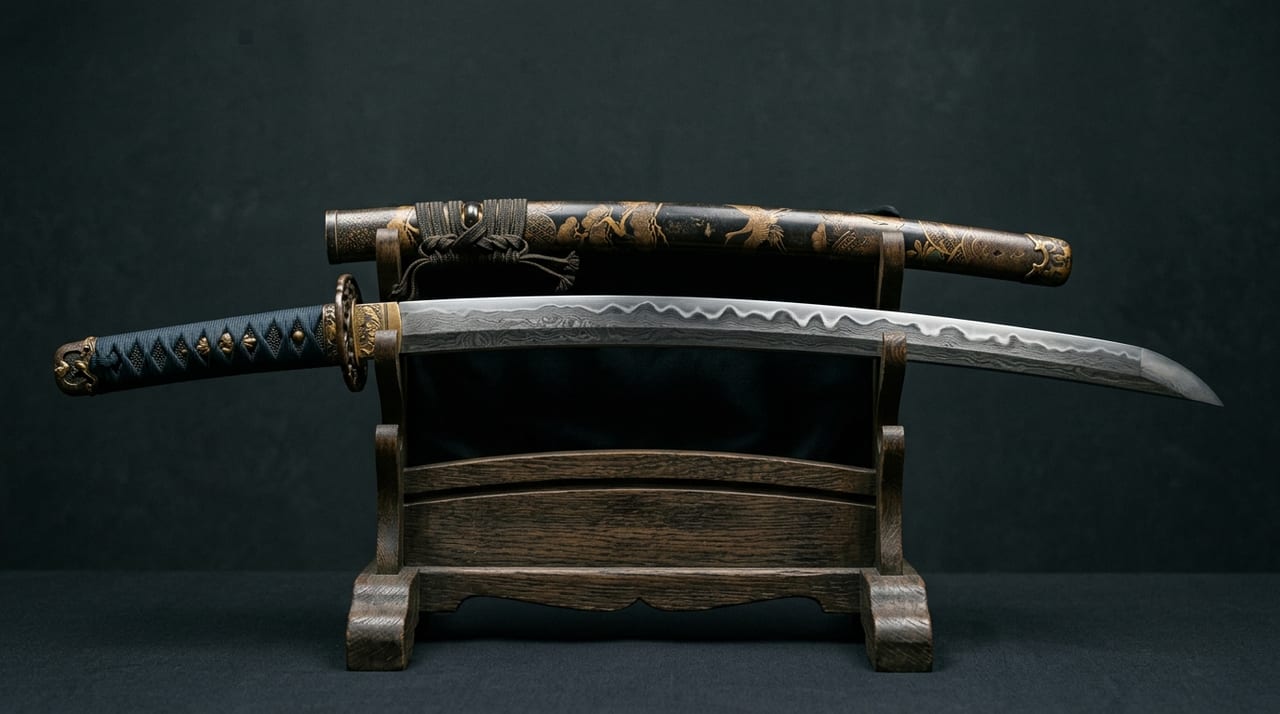
 * Image is for illustrative purposes only.
Yamabushi Kunihiro
山伏国広
Also known as: Katana signed "Kunihiro of Furuya in Hyūga, made while a yamabushi"; Kunihiro's yamabushi-period work
Description
The Only Dated Blade from Kunihiro's Wandering Years
Yamabushi Kunihiro is a katana forged by Horikawa Kunihiro — widely regarded as the greatest master of the shintō era — during the years before he took the Horikawa name, when he travelled the provinces as a yamabushi (mountain ascetic). The tang bears a long inscription reading "made by Kunihiro of Furuya in Hyūga Province while he was a yamabushi," together with the date "Tenshō 12, second month, the equinox" (1584) and the name of the patron, "Iida Shinshichirō Fujiwara no Sukeyasu, resident of Hyūga Province." The sobriquet Yamabushi Kunihiro derives directly from this inscription.
Kunihiro was born into the Iida family of Hyūga Province (present-day Miyazaki Prefecture) and served the daimyo Itō Yoshisuke. When the Itō were defeated by the Shimazu in 1577 and their domain collapsed, Kunihiro lost his lord and supported himself by forging blades while travelling among the sacred mountains of the Shugendō tradition. This blade was made in the midst of that wandering, at Furuya in Hyūga, on commission from Iida Sukeyasu, a former retainer of the Itō house.
Style
The blade measures 77.3 cm in cutting edge length with a curvature of 2.1 cm, and 99.1 cm overall. It shows the bold Momoyama-period form, broad in width with the curvature carried toward the point. The jigane is a well-packed ko-itame hada, and the hamon is chiefly gunome-midare. Carvings are an outstanding feature: the obverse bears a bō-hi groove together with Sanskrit characters and the inscription "bu-un chōkyū" (long-lasting fortune in arms), while the reverse bears a bō-hi, Sanskrit characters and a figure of Fudō Myōō. The faith of a man who walked the mountains as an ascetic is inscribed directly onto the steel.
Assessment and Designation
Early works by Kunihiro are exceedingly rare, and this is the only dated blade surviving from his yamabushi years. As such it is an indispensable benchmark for understanding how the Horikawa school's style took shape. It was certified an Important Art Object on 16 December 1942 and designated an Important Cultural Property on 2 February 1955. It is today in a private collection in Osaka Prefecture.
Legends & Stories
After the Itō of Hyūga — Kunihiro's lord — were destroyed by the Shimazu, the swordsmith wandered the provinces in the guise of a mountain ascetic. It was during those years that he forged this blade at the request of Iida Sukeyasu, a retainer of his fallen house. The carved words "bu-un chōkyū" (long-lasting fortune in arms) and the image of Fudō Myōō are said to embody a prayer for the restoration of the lord he had lost.