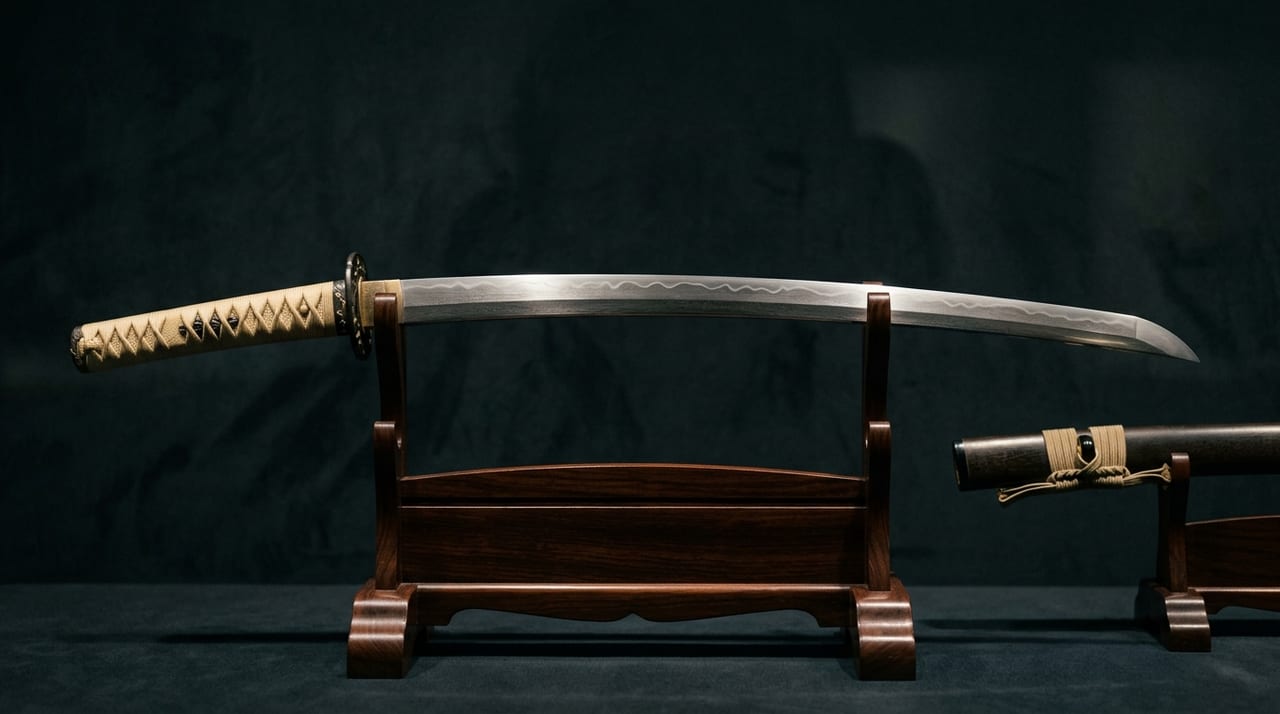
 * Image is for illustrative purposes only.
Tachi Signed Umetada Myōju
太刀 銘 埋忠明寿
Also known as: Tachi inscribed "Yamashiro no Kuni Nishijin ju-nin Umetada Myōju... Keicho 3, not to be passed to others"
Description
Meaning of the Inscription
The work is inscribed with the long signature "Yamashiro no Kuni Nishijin jūnin Umetada Myōju (kaō)", followed by "Keichō 3, 8th month — not to be passed to others." The phrase means "not to be handed to anyone else." The inscription itself shows that Myōju treated this work with special care, as a masterpiece he intended to be passed down within his own family. It was designated an Important Cultural Property on August 29, 1950 (Shōwa 25).
The Umetada Family and the Progenitor of Shintō
The Umetada family had long been a clan whose hereditary trade was sword fittings (metalwork). Within this family, Myōju was a rare smith who took up the making of blades in earnest and left works of high standard. He is counted among the figures who opened the era of the shintō ("new swords") that began in the Momoyama to early Edo period, and he is revered as the progenitor of shintō smiths.
Style
The blade measures 64.7 cm in length with a sori of 1.4 cm. It is shinogi-zukuri with iori-mune, the sori is shallow, and the kissaki is elongated. The jigane is ko-itame mixed with masame, with nie. The hamon is notare-midare, and the nioiguchi is somewhat subdued, with nie. On the omote there is a bōhi and a dragon. On the ura there is a bōhi, a Sanskrit seed syllable (bonji), and a carving of a standing Fudō Myōō. These carvings show the carving skill unique to Myōju, who was born into a family of metalworkers.
Present Collection
This work is owned by the Kyoto National Museum, where it is presented as one of the museum's masterpieces. Most of Myōju's surviving works are tantō with carvings. The only long blade (nagamono) is said to be this single work, handed down in the Sōma family.
Position in Sword History
Standing at the turning point from kotō to shintō, Myōju's works anticipated the values of the shintō period onward, in which the sword was regarded as an art object that went beyond a mere weapon. Together with Horikawa Kunihiro and others, he is highly regarded today as a swordsmith representative of the dawn of the shintō era.
Legends & Stories
The unusual clause "not to be passed to others" appended to the signature reveals something of Myōju's pride as a smith. For a man born into a family of metalworkers who nonetheless achieved the highest level in blade-forging itself, this sword represented the honor of his house, and it has been handed down as a symbol of the standing the Umetada family achieved in swordmaking thereafter.