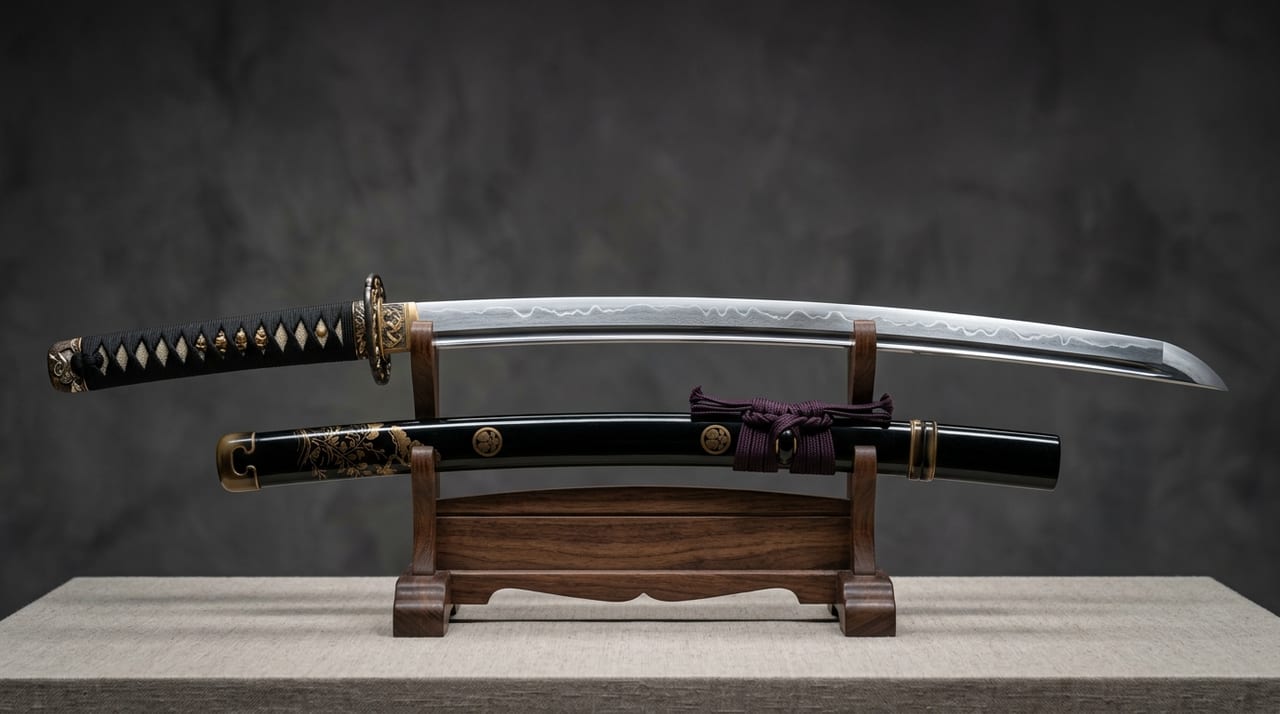
 * Image is for illustrative purposes only.
Taikei Naotane
大慶直胤
Also known as: Taike Naotane (Taikei Naotane) - Master swordsmith of the late Edo period, at the pinnacle of shinshintō
Description
Taikei Naotane (1778–1857) was a renowned swordsmith of the late Edo period and is counted among the finest masters of the shinshintō era. Born in Dewa Province (present-day Yamagata Prefecture), his given name was Shōji Minobē. He later moved to Edo and became a student of Suishinshi Masahide, known as the founder of shinshintō, where he undertook rigorous study of ancient koto blades and practical sword-forging training, acquiring technical skills that surpassed even those of his master. The name 'Taike' was adopted by Naotane himself and carries the auspicious meaning of 'great joy.'
Naotane's sword-forging embodied the spirit of koto restoration, and he produced numerous reproductions inspired by celebrated blades of the Kamakura and Northern and Southern Courts periods—particularly the Bizen Ichimonji school, the Rai school, and the Sōshū tradition. However, his work transcended mere imitation. He synthesized Edo's refined polishing techniques with his own exceptional forging skill, fusing the clarity and precision distinctive to shinshintō with the bold magnificence of koto swords, thereby establishing a unique aesthetic realm. In terms of the clarity of the jigane, the precision of the hamon, and the refinement of the nakago finishing, his work demonstrated the highest standards of late Edo period smithing. He is frequently hailed in sword circles as 'the finest of shinshintō.'
His extant works encompass uchigatana, tachi, tantō, and wakizashi, with numerous pieces designated as Important Swords now housed in museums and private collections throughout Japan, including several that have been designated as Important Cultural Properties. The Tokyo National Museum and the Sword Museum (Sumida Ward, Tokyo) are the principal institutions holding his works, with selections occasionally displayed during special exhibitions. Since the Meiji period, Naotane's reputation has only grown, and in modern Japanese sword scholarship, he holds an important position as a representative swordsmith of the late Edo period.
Legends & Stories
Among the anecdotes about Taike Naotane, the most widely known is the legend of his 'masterpieces in old age'—the story that his skill in sword forging never declined even in his advanced years. When Naotane passed seventy, his disciples urged him to retire from forging, concerned for his physical strength, but he declared, 'My communion with steel is my very life,' and continued swinging the hammer until nearly eighty. The blades forged in this final period possess a subtle, austere beauty and depth distinct from his earlier works, and are particularly prized by later appraisers.
There is also a legend that when Naotane first held a celebrated tachi of the Ichimonji school from the Kamakura period, he sighed and said, 'Such fine jigane cannot be forged again,' but after years of research and practice, he succeeded in realizing nearly equivalent quality. It is also said that his master, Suishinshi Masahide, told his students, 'Taike is my teacher as well,' a testament to the extraordinary skill that impressed even his own master.