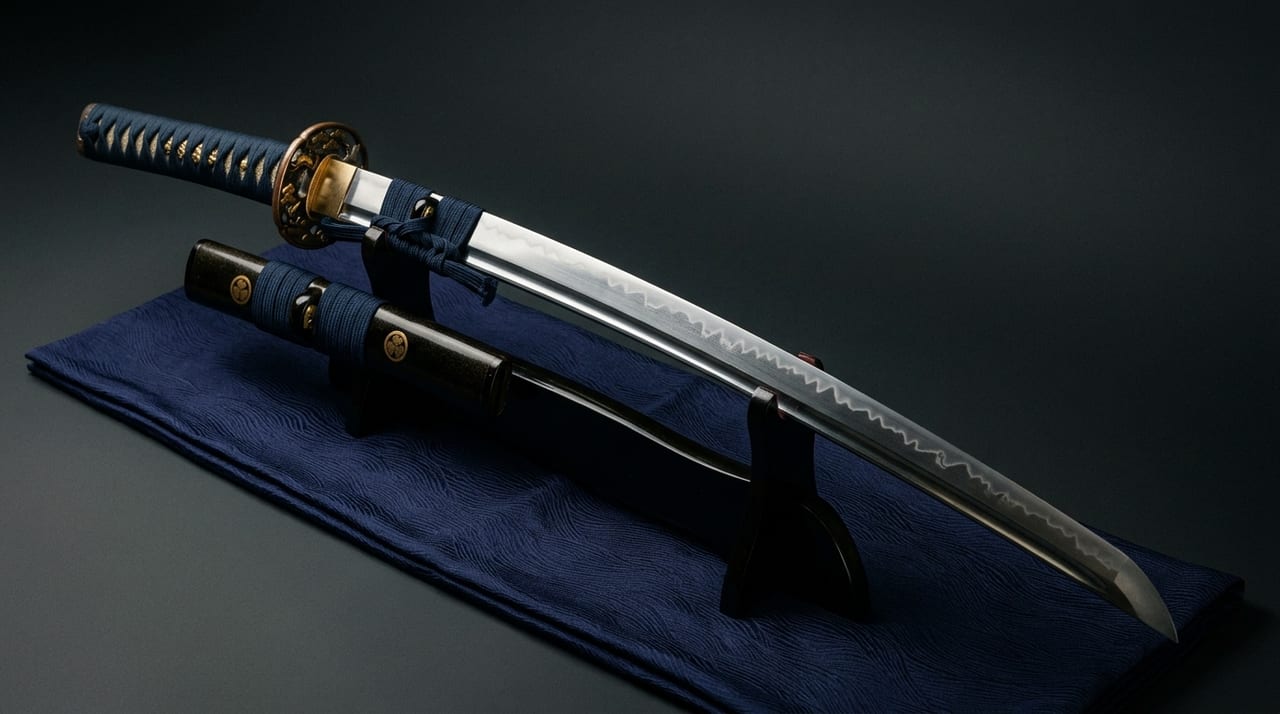
 * Image is for illustrative purposes only.
Sword of Echizen Yasutsugu
越前康継の刀
Also known as: Echizen Yasutsugu Katana—Masterpiece of the Official Tokugawa Shogunal Swordsmith
- Smith
- Echizen Yasutsugu (first generation)
- Era
- Early Edo Period (Early 17th Century)
- Type
- Katana
- Designation
- Important Cultural Property (wakizashi dedicated to Atsuta Jingū); Important Art Object
- Location
- Atsuta Jingū (Nagoya), Tokyo National Museum, and other locations
Description
Echizen Yasutsugu (first generation) was taken into service by Yūki Hideyasu, lord of the Echizen domain, moved to Echizen (present-day Fukui Prefecture), and was permitted by Tokugawa Ieyasu and Tokugawa Hidetada to cut the three-leaf hollyhock (aoi) crest on the tang. He was an official sword smith (goyō kaji) recognized by the Edo shogunate. Works made from the Keichō era (1596–1615) through the Genna era (1615–1624) are known for their particularly high quality even within the shintō period, and were prized as offerings presented to the Tokugawa shogunal house and to the various daimyō. Yasutsugu's swords are well regarded for the refinement of their jigane (base steel) and the consistent quality of their hamon (temper line). His original style features itame-hada in the manner of the Seki smiths, with a hamon in which notare and gunome are mixed and sunagashi appears. After the re-tempering (saiba) of famous blades (meibutsu) that were fire-damaged in the fall of Osaka Castle, he also made copies of works such as Sōshū Sadamune, and the influence of the Sōshū tradition is evident. Many of his works bear the inscription 'Yasutsugu' on the tang along with the aoi crest, and many also carry the added inscription 'Motte Nanbantetsu' (made with imported Western iron), showing his close ties to the shogunate. After the death of the first Yasutsugu, the name 'Yasutsugu' was passed down through generations, but the first and second were both highly skilled and both are listed in later rankings of wazamono. Among the first Yasutsugu's works, a wakizashi with an aoi crest dedicated to Atsuta Jingū is designated an Important Cultural Property, and there are also swords designated Important Art Objects. Echizen Yasutsugu is one of the representative shintō smiths of the early Edo period. His family line divided into the Edo and Echizen Shimosaka families, and they served as official smiths until the late Edo period.
Legends & Stories
According to the Sunpu-ki, in the intercalary sixth month of Genna 1 (1615), Yasutsugu was ordered at Nijō Castle to search for and re-temper famous blades (meibutsu) and famous swords (meitō) that had been fire-damaged when Osaka Castle fell. Prompted by this, he also began making copies of famous blades. Because Ieyasu permitted him to use the 'Yasu' character from Ieyasu's name and to cut the aoi crest on the tang, he is also called 'Gomon Yasutsugu' and 'Aoi Shimosaka'.