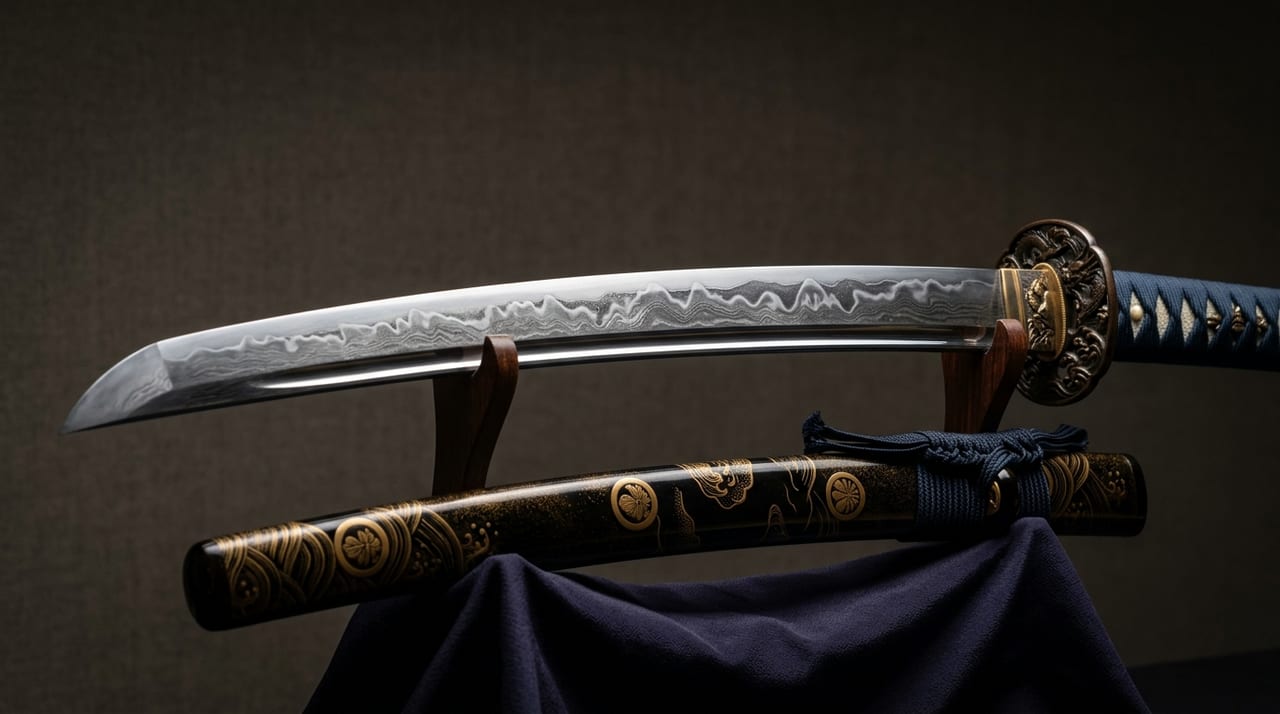
 * Image is for illustrative purposes only.
Katana by Ikkanshi Tadatsuna
一竿子忠綱の刀
Also known as: Uchigatana by Ikkanshi Tadatsuna (Last Great Master of Osaka Shintō)
Description
Ikkanshi Tadatsuna was a swordsmith based in Osaka (Settsu Province) during the mid-Edo period, often acclaimed as 'the last great master of Osaka Shintō.' His artistic sobriquet 'Ikkanshi' (One-Rod Hermit) evokes a recluse holding a single fishing rod, reflecting his reputation as an artist who stood above worldly concerns. Tadatsuna's swords are celebrated for their spectacular 'tōran midare' (billowing-wave irregular) hamon—a wild, surging pattern that evokes rough ocean swells and ranks among the most individualistic temper lines in all of Japanese swordsmithing. Within the large, turbulent waves, thick nie accumulates; ashi and yō (activities within the hamon) interweave in complex, varied formations. The jigane displays the flowing itame grain characteristic of Osaka work, rich with ji-nie and a luminous moisture. He also excelled as a carver (horimono), leaving numerous blades engraved with dragons, Fudō Myōō, and Sanskrit characters. Some works include the date and kao (personal cipher) alongside signatures such as 'Sesshū-jū Tadatsuna' or 'Ikkanshi Tadatsuna,' demonstrating his ambition for completeness as a craftsman. Appearing frequently in late Edo appraisals and continuing to receive high assessments from the Society for the Preservation of Japanese Art Swords, Tadatsuna stands at the apex of Osaka Shintō.
Legends & Stories
One legend tells that the morning after Tadatsuna dreamed of a dragon riding the waves, he began forging in a state of single-minded inspiration, never leaving the forge for three days and nights, and the blade produced was said to be the most beautiful tōran midare ever made. The reason the hamon resembles ocean waves, so the story goes, is this divine dream—and among Osaka sword merchants, his tōran midare blades were revered as swords inhabited by the dragon deity. Another tradition holds that one of Tadatsuna's carved blades survived the Great Meireki Fire unburned and was enshrined as a 'fire-warding sword,' attracting the veneration of those who believed in the spiritual power dwelling within the blade.
Related Famous Swords
肥前忠広の刀
Important Cultural Property and Important Sword (multiple designations)The Sword of Hizen Tadahiro
Tadayoshi (later the first-generation Tadahiro)
河内守国助の刀
Jūyō Tōken (Important Sword, multiple pieces designated)Katana by Kawachi no Kami Kunisuke
Kawachi no Kami Kunisuke (2nd generation)
越前康継の刀
Important Cultural Property (Multiple Designations)Sword of Echizen Yasutsugu
Echizen Yasutsugu (first generation)
大慶直胤
Numerous works designated as Important Cultural Properties and Important SwordsTaikei Naotane
Taikei Naotane