Taikei Naotane — The Edo Tōshō Hailed as the Pinnacle of Shinshintō
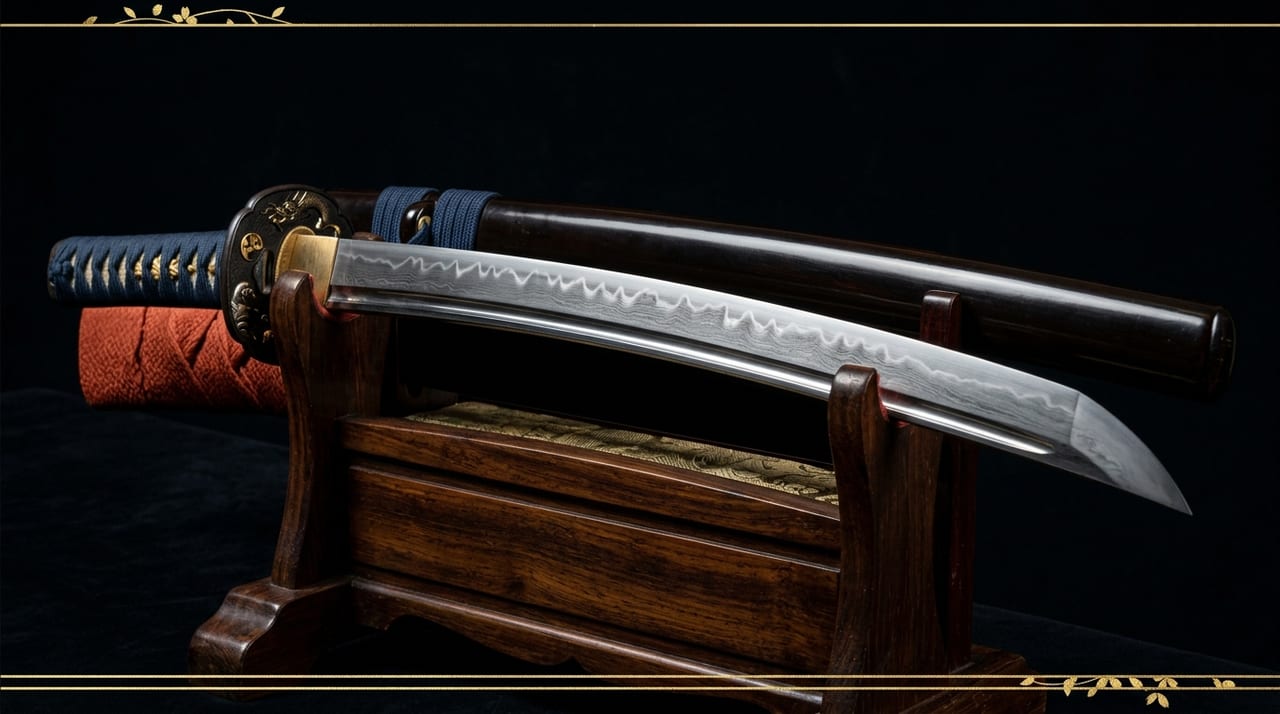 * Image is for illustrative purposes only.
Table of Contents
The Life and Career of Taikei Naotane
Taikei Naotane was born in Dewa Province (present-day Yamagata Prefecture) in An'ei 8 (1779). His given name (common name) is recorded as Shōji Minobee.
At a young age he traveled to Edo and became a student of Suishinshi Masahide, a pioneer of the shinshintō movement. Having studied kotō research and the new blade-making techniques grounded in it under Masahide, Naotane became independent after his master's death and carried on a prolific sword-making career in Edo.
Naotane's most active years centered on the first half of the nineteenth century — the Bunka (1804–1818), Bunsei (1818–1830), and Tenpō (1830–1844) eras — and he continued working into the Kaei and Ansei periods. A large number of works bearing his own records and mei survive, and this sheer abundance speaks to the tōshō's productive output. Because he continued working at the highest level over such a long span, the changes in his style across his early, middle, and later years can still be traced today through his surviving works.
He died in Ansei 4 (1857) at around the age of eighty. His longevity and the length of his active career were among the factors that allowed him to leave behind so many masterworks.
Characteristics of His Style — Establishing Originality While Learning from Kotō
The characteristics of Taikei Naotane's blades can be organized into three main points.
- Variety of form: Naotane did not confine himself to the kotō style of any single region or school; instead he thoroughly studied and mastered the different styles of Yamashiro-den, Bizen-den, and Sōshū-den, then produced blades of different forms and construction according to each commission and its intended use. This was a literal practice of his teacher Suishinshi Masahide's teaching to "learn from kotō." Even among works "made by Naotane," the form and the character of the jigane differ greatly from blade to blade for this very reason; when appreciating them, it helps to first determine which tradition a given work is based on.
- Richness of activity in the jigane: In Naotane's blades, activity (surface character, utsuri, and nie) appears richly in the jigane, and his tanren skill in pursuing the texture of kotō jigane — rather than mere formal imitation — is highly regarded. In particular, the group of works in the Bizen-den style, in which utsuri rises in a jigane of fine itame mixed grain, is one of the styles at which Naotane excelled.
- Variety of hamon: He left works featuring many different hamon styles, including gunome, chōji, suguha, and large irregular gunome. His skill in forming hamon was high, and the mastery evident in the depth and uniformity of the quenching is recognized. The fact that the quenching is deep and uniform is appreciated not only as a visual highlight but also because the hamon's character tends to be well preserved even after repeated polishing over many years.
Place Among the "Three Masters of Edo"
Naotane is frequently counted among the "Three Masters of Edo" by sword researchers and collectors of the Bakumatsu period. The Three Masters of Edo is the standard designation referring to the three figures of Suishinshi Masahide, Taikei Naotane, and Minamoto Kiyomaro. He is also sometimes discussed under the grouping "Three Outstanding Masters of Shinshintō," though the selection of individuals varies by researcher.
This standing was shaped by the assessments of sword researchers from the Meiji period onward, but by such measures as the number of surviving works, appraisal ratings, and the number of officially designated cultural properties, it is certain that Naotane is one of the tōkō who best represent the shinshintō era.
Disciples and Lineage of Tōkō
Taikei Naotane is also known as a teacher who trained many disciples. Among his students there were several tōshō who were active from the Bakumatsu period into the early Meiji era.
Naotane's son, Naokatsu, also worked as a tōshō and left works that inherited his father's techniques.
The lineage of Suishinshi Masahide → Taikei Naotane → his disciples formed the core of the shinshintō tōkō network from the late Edo period through the Bakumatsu era, and studying this lineage is important for understanding the technical and intellectual development of the shinshintō movement. It should be noted that works by tōkō in a master–disciple relationship tend to resemble each other in style, so Naotane's own works and those of his students can sometimes be confused. Knowledge of the lineage, used together with a kanteisho, becomes one clue for determining authorship.
Representative Surviving Works and Appraisal Ratings
A large number of Taikei Naotane's blades survive, and multiple works have received designations of Jūyō Tōken or above from the official appraisal body, NBTHK. The NBTHK appraisal classifications proceed through the levels of Hozon Tōken, Tokubetsu Hozon Tōken, Jūyō Tōken, and Tokubetsu Jūyō Tōken, and examples of Naotane's works falling into these higher classifications have been confirmed.
Naotane's works are also held in art museums and historical museums, and are frequently cited as examples in specialist sword literature. As representative examples of shinshintō for study in contrast with kotō, Naotane's blades are also used in an educational capacity for sword appraisal.
What to Know When Seeking a Blade by Taikei Naotane
Because Naotane enjoyed high popularity during his lifetime and is also a tōkō with a large number of surviving works, he is a tōkō for whom the existence of gimei imitating his mei is frequently pointed out. The fact that authenticity tends to be an issue precisely because of his popularity as a tōkō is the first practical point to understand when searching for one of Naotane's blades.
For this reason, when seeking a sword said to be by Naotane, it is essential to first confirm whether a kanteisho from NBTHK exists. A kanteisho is the result of experts examining not only the shape of the mei but also comprehensive elements such as the form, jigane, and hamon, and it provides an objective basis that does not rely solely on an individual's personal judgment.
Furthermore, because Naotane was a tōkō who worked across Yamashiro-den, Bizen-den, and Sōshū-den, trying to learn "the look characteristic of Naotane" from a single template tends to lead to misidentification. For each blade, it is necessary to first consider which tradition it is based on, then carefully compare the form, jigane, and hamon against each other and check them against the content of the kanteisho. Works in which a nenki (characters indicating the year of production) remains on the mei have high documentary value for tracing the changes in Naotane's style, and examining them alongside other works deepens one's understanding.
Naotane's Contemporary Standing in Sword Research
In contemporary research on Japanese swords, Taikei Naotane is evaluated as an exemplary tōkō who demonstrates "the technical apex of the shinshintō period."
In particular, the back-and-forth between kotō research and actual blade-making technique — a practical approach that did not merely look and learn, but fed what was learned back into one's own tanren — is also referenced as a model for contemporary tōshō learning from kotō. Suishinshi Masahide put forward the ideal of "learn from kotō," and Naotane is recorded in history as the tōshō who practiced it to the highest level.
Those interested in the history of Japanese swords and the works of notable tōshō are welcome to browse the TOUKENZA online catalog.