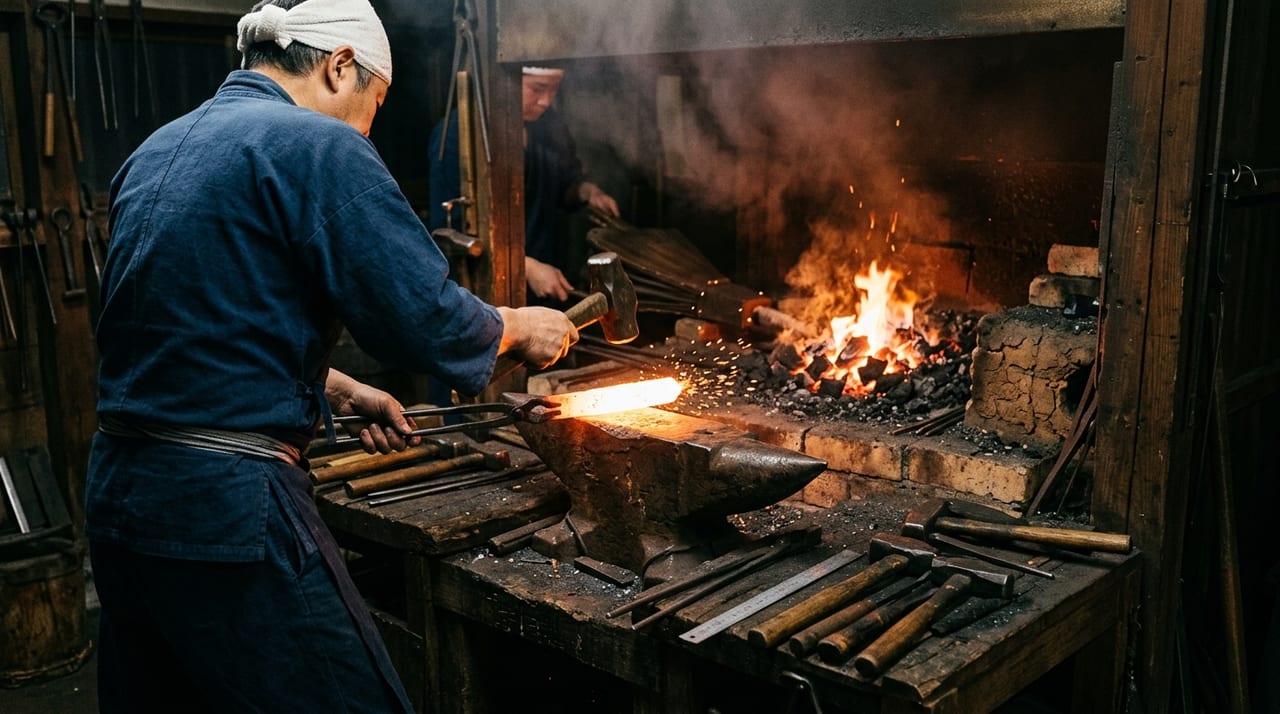
 * Image is for illustrative purposes only.
Taikei Naotane
大慶直胤
Description
Taikei Naotane — one of the great masters of the shinshintō, a leading smith in the revival of kotō
Taikei Naotane (1779–1857) was a swordsmith of the late Edo period, born in Dewa Province in An'ei 8 (1779) and dying in Ansei 4 (1857). As the leading disciple of Suishinshi Masahide, he contributed greatly to the establishment of the shinshintō (new-new swords). Naotane faithfully carried out his teacher Masahide's ideal of the "revival of kotō," and as a versatile smith who learned and mastered the techniques of all five of the Gokaden—Bizen-den, Yamashiro-den, Sōshū-den, and Yamato-den among them—he is regarded as one of the summits of the shinshintō world.
Suishinshi Masahide (1750–1825) was the greatest contributor to the technical renewal of swordmaking in the late Edo period, and is remembered in the history of the Japanese sword as the advocate of the sword reform calling for a return to "the forging methods of kotō (old swords)." Masahide criticized the styles of shintō (new swords) of late Edo as having drifted from the severe beauty of kotō, and argued that the true form of the Japanese sword should be recovered by researching and reconstructing ancient techniques. This revolutionary proposal marked the beginning of the shinshintō era, and Naotane, as its most important practitioner, reached heights that surpassed even his teacher's ideals.
A versatile smith who mastered the Gokaden
The greatest technical feature of Taikei Naotane is that he left works of high standard in all five of the principal Japanese sword traditions (gokaden): Bizen, Yamashiro, Sōshū, Yamato, and Mino. Mastery of such a broad range of traditions is extremely rare even among swordsmiths, and it demonstrates Naotane's great eagerness to learn and his natural technical talent.
In the revival of the Bizen-den, he skillfully reproduced the hamon of Kamakura-period Bizen works, centered on chōji-midare. In the Yamashiro-den, he precisely expressed the hoso-suguha in the style of the Rai school, and in the Sōshū-den, he masterfully recreated the rugged appearance of a lively ō-nie covering the entire surface of the blade.
In the jigane as well, he used forging methods suited to each tradition, distinguishing them properly: a ko-itame, tightly packed jigane for Bizen-den, a rugged jigane with coarse nie mixed in for Sōshū-den, and a fine, uniform jigane for Yamashiro-den. He made his works with an accurate understanding of the characteristics of each tradition. This skillful use of traditions is highly regarded by researchers, and Naotane's works are studied as outstanding examples of the revival of the traditions in shinshintō.
Abundant surviving works and collections
The surviving works of Taikei Naotane include katana, wakizashi, tantō, and naginata, and their number is among the largest of any shinshintō smith. Many dated works survive, confirming that he made blades throughout the later Edo period. The length of his working career, which continued until his death at the age of 79, shows that he was long-lived and kept his technical standard up to his final years.
His works are held by the Tokyo National Museum and museums in various other places. Naotane's works are included in notable collections both in Japan and abroad, and he is still highly regarded today as a representative smith at the highest level of shinshintō.
Sword culture and Naotane's social role in the late Bakumatsu period
The late Edo period, in which Taikei Naotane was active, was a time when Japan's politics and society were moving toward great upheaval. Amid a succession of events that shook society—the Ōshio Heihachirō Rebellion (1837), the Tenpō Reforms, and the arrival of the Black Ships (1853)—the significance of the sword as the spiritual anchor of the samurai class was once again being questioned. The shinshintō movement to revive kotō should be understood not merely as a technical return to the past, but as also carrying the cultural and spiritual meaning of re-establishing a samurai spirit that was in turmoil.
As a prominent smith of Edo, Naotane received commissions from many samurai and daimyō, and he won the approval of clients who had the highest discernment of their time. This shows that Naotane's skill was recognized as a true artistic achievement that went beyond mere antiquarian taste, and he is remembered in history as a smith who answered the cultural demands of the Bakumatsu period.
The significance of Taikei Naotane at TOUKENZA
At TOUKENZA, we present Taikei Naotane as a rare smith who was the summit of shinshintō and who brought the revival of kotō to fruition as an artistic achievement. Naotane's technical range, which encompassed all five of the Gokaden at a high level, stands out even among shinshintō smiths, and through his abundant surviving works we aim to convey to today's enthusiasts the high standard of Japanese sword art of the shinshintō era. Holding one of Naotane's swords is an experience of touching one of the peaks of Japanese sword culture, where the intellectual curiosity and technical innovation of the late Edo period came together.
Famous Works
- Katana signed Taikei Naotane (Tokyo National Museum)