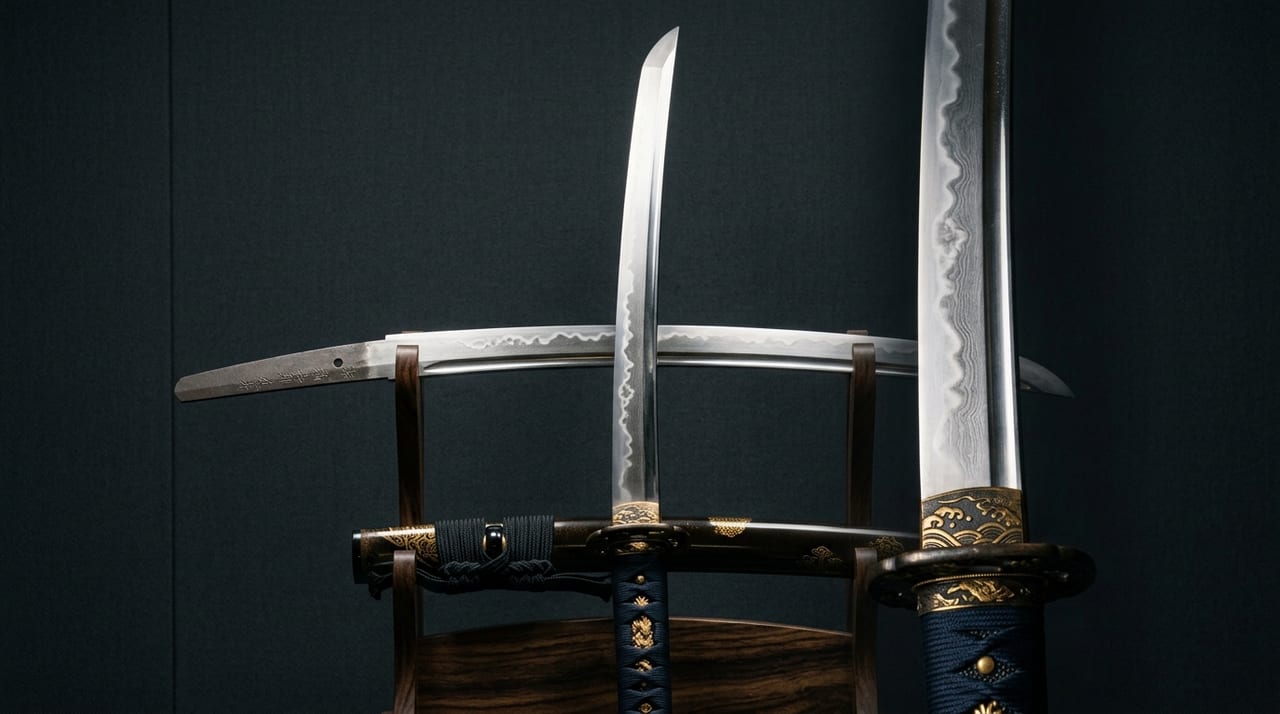
 * Image is for illustrative purposes only.
Katana by Suishinshi Masahide
水心子正秀の刀
Also known as: Masahide Katana
Description
Suishinshi Masahide was a pioneer of the fukkotō (revival sword) movement, active in the late Edo period, and a leading figure of the Edo sword world. Under the banner of 'revival of old swords' (kotō fukkō), he systematized a theory of sword-making modeled on famous blades of the Heian to Kamakura periods. At a time when shintō (swords of the Edo period) tended to emphasize ornamentation, Masahide argued for 'the reconciliation of practicality and beauty' and held an advanced philosophy: to scientifically analyze the forging techniques of old swords and attempt to reproduce them. The Tokyo National Museum holds a sword bearing the signature 'Suishinshi Masahide' with a kao monogram, dated the 2nd month of Bunka 5 (1808), with a blade length of 73.3 cm. In his book Kenkō Hiden Shi, Masahide described the forging techniques of old swords in detail, and his theory later spread widely among swordsmiths of the late Edo period. Masahide's swords hold an important place in sword history as works representing the fukkotō movement.
Legends & Stories
In the 3rd year of An'ei (1774), Masahide was taken into service by Akimoto Nagatomo, lord of Yamagata Domain, and continued forging swords at the smithy in the Akimoto family residence in Hamachō in Edo. Among his disciples were master smiths such as Taikei Naotane and Hosokawa Masayoshi. Sword researcher Iida Kazuo describes him as a rare educator among swordsmiths. His writings include Kenkō Hiden Shi, as well as Tōken Jitsuyō Ron and Tōken Bengi.