Sword Appraisal Culture in the Bunka-Bunsei Era (1804-1829): How the Art of Judging Blades Spread from Samurai to Townspeople
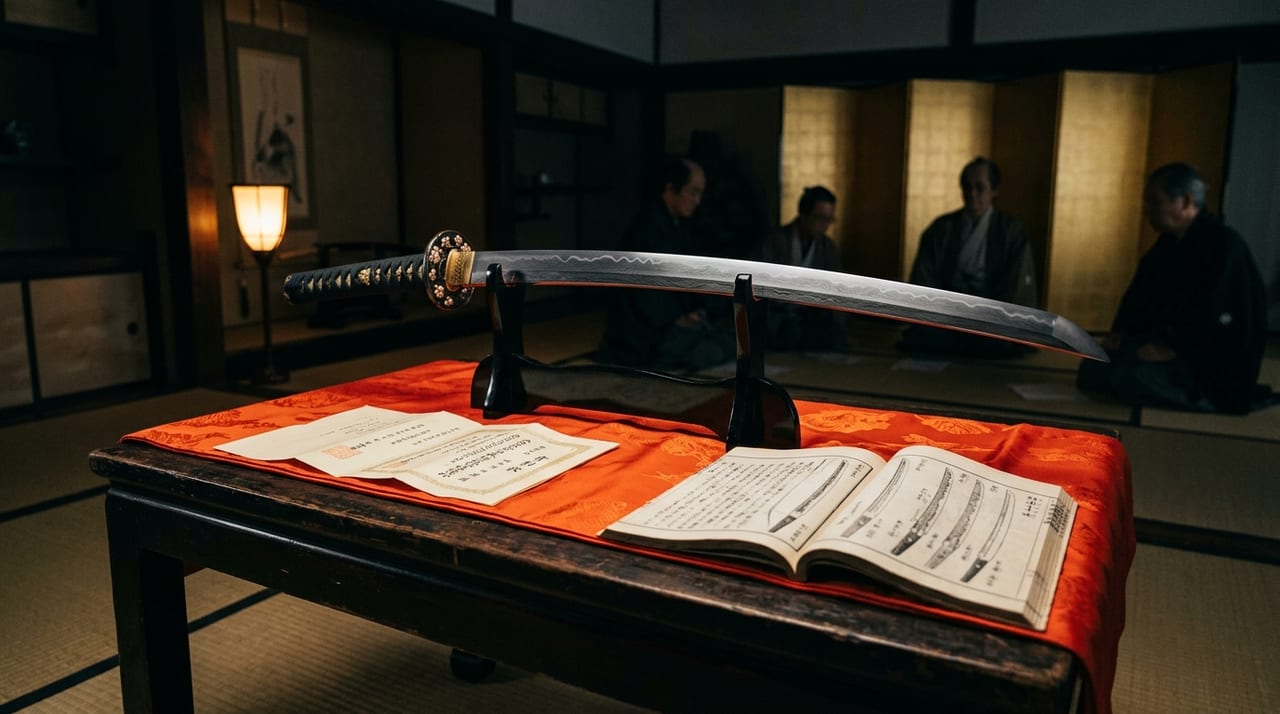 * Image is for illustrative purposes only.
Table of Contents
Blade Society of the Bunka and Bunsei Periods — The End of the "Age of Peace" and a New Perspective on Swords
The Bunka (1804–1818) and Bunsei (1818–1830) periods of the late Edo era saw a time when, while politically positioned at the tail end of a period of stability, significant economic and cultural changes were beginning to emerge. The tightening measures of Matsudaira Sadanobu's Kansei Reforms (1787–1793) had run their course, and the merchant culture known as "Kasei Culture" flourished.
The world of blades also reached an important turning point during this period. On one hand, a revival movement in shinshintō (new new swords) with Suishinshi Masahide as its founder accelerated, and swordsmiths seeking to reproduce the beauty of old blades in both theory and practice appeared one after another. On the other hand, the act of "viewing" blades—that is, the culture of appraisal and appreciation—ceased to be the exclusive domain of the warrior class and began to spread to wealthy merchants and men of letters.
These two currents had a mutually complementary relationship. High-quality examples of shinshintō educated the eyes of blade enthusiasts, and the existence of blade enthusiasts spurred the creative drive of swordsmiths.
The Honami Family and the Commercialization of Certification Documents — The Marketization of "True Certificates" as Authority
During the Edo period, the supreme authority on blade appraisal was the Honami family. Positioned as official appraisers for the Tokugawa shogunate and various domains, the Honami family issued documents called "true certificates" (hon'gaki) in the form of folded papers (origami) or sheath inscriptions (sayagaki) affixed to blades. These functioned as official documents guaranteeing the authenticity and quality of blades.
During the Bunka and Bunsei periods, demand for the Honami family's certification documents expanded rapidly. Not only warrior households, but also merchant houses and wealthy farmers began to own blades as family treasures and sought origami certificates as proof of their value. The Honami family expanded their appraisal operations in response, and blades with "origami attached" became established as a market category.
The fact that the expression "origami-attached" (with certification) has persisted in modern usage to mean "a stamp of approval for reliability" reflects the historical fact that the Honami family's appraisals became widely embedded in society during this era.
However, this commercialization also sparked criticism. Some raised concerns about disparities in the quality of appraisals, and comments like "if you pay, you can get an origami certificate" were heard with irony. The "credibility problem of appraisal documents" that continues to be repeated in the modern authentication industry already had its origins in this period.
The Spread of Blade Literature — The Democratization of Knowledge and the Birth of "Blade Enthusiasts"
Another characteristic of the Bunka and Bunsei periods was the large-scale publication of books and illustrated works on blades. Due to the maturation of woodblock printing technology and improvements in literacy rates, numerous blade explanation books at prices affordable to the common people were published.
Representative examples include works that systematized the blade knowledge of the warrior class and "Sword Smith Name Registries" (meikan) that illustrated the characteristics of blades by school and production region. These books appeared on the shelves of blade dealers and lending libraries (kashihonya) and were read not only by warriors but also by curious townspeople.
A characteristic of publications from this period was the abundance of visually descriptive content that explained the features of the surface, blade pattern, and tang with illustrations. Rather than simply listing swordsmith names, practical appraisal knowledge such as "works by this swordsmith have these characteristics" was transmitted.
The spread of these books gave rise to the social existence of "blade enthusiasts" (aitōka). These were individuals who, neither swordsmith nor blade merchant, collected and appreciated blades as a hobby—while this had long existed in warrior culture, during the Bunka and Bunsei periods it expanded to the merchant classes and became the direct prototype of today's collector culture.
Blade Enthusiast Salons and "Appreciation Gatherings" — The Cultural Space Where Blades Connect People
During the Bunka and Bunsei periods, blade appreciation gatherings were held regularly in Edo, Osaka, and Kyoto. These differed from what would later be called "blade exhibitions" in that they were cultural assemblies aimed at sharing knowledge and taste rather than at buying and selling.
Participants were a mix of warriors, wealthy merchants, and men of letters who brought blades to display and critique one another. Leading swordsmiths such as Suishinshi Masahide sometimes participated, and venues where appraisers, swordsmiths, and blade enthusiasts sat together to discuss became established as a form of intellectual salon.
Such gatherings facilitated direct exchange between shinshintō swordsmiths and blade enthusiasts. Swordsmiths did not merely forge blades in response to commissions but also articulated their own aesthetic sensibilities and creative philosophies, which cultivated the appreciation of enthusiasts. Conversely, feedback from blade enthusiasts influenced swordsmiths' creative work, creating a virtuous cycle.
Suishinshi Masahide and Blade Theory of the Bunka-Bunsei Period — "Know the Beauty of Old Blades"
The figure who epitomized this period was Suishinshi Masahide (1750–1825). While he excelled in actual sword-forging as a swordsmith, he exerted an even greater influence on later generations as a blade theorist.
Masahide's writings were pioneering works that analyzed the beauty of old blades in scientific and theoretical terms.
- "Practical Theory of Blades"
- "Blade Inquiry and Clarification"
- "Secret Teachings of the Sword Smith"
The works that systematically discussed the structure of the blade body, the principles underlying blade patterns, and the properties of whetstones were widely read during the Bunka and Bunsei periods and provided a common knowledge foundation for swordsmiths, polishers, and blade enthusiasts alike.
The social significance of Masahide's blade theory lay in the fact that "the technique of forging blades" and "the knowledge of appreciating blades" became connected as a shared language. Through this connection, blade appraisal transformed from pure artisanal intuition into something that could be, to some degree, verbalized and systematized. This connects directly to the foundations of modern blade appraisal education.
What the Bunka and Bunsei Periods Left Behind — Continuity to the Modern Day
The blade culture of the Bunka and Bunsei periods left much to the modern era.
- Certification document culture
- The tradition of blade enthusiast salons
- The written codification of blade theory
These are all direct ancestors of modern Japanese blade industry, appraisal profession, and collector culture.
The modern examination system of the NBTHK (Japanese Sword and Art Preservation Society) can be seen as a contemporary continuation of the Honami family's origami certification system. Furthermore, the culture of "blade appreciation societies" where blade enthusiasts gather regularly to share information is a direct continuation of the salon culture of the Bunka and Bunsei periods.
From a historical perspective, rather than disappearing with the dissolution of warrior society, it was this period when blade culture acquired new bearers in the form of townspeople, merchants, and men of letters—this was the first turning point at which the Japanese blade was undergoing a transformation from "weapon" into "cultural property."