Dating Methods for Swords Excavated from Kofun — Stratigraphy, Associated Artifacts, and Inscriptions as Yardsticks for the History of the Nihontō
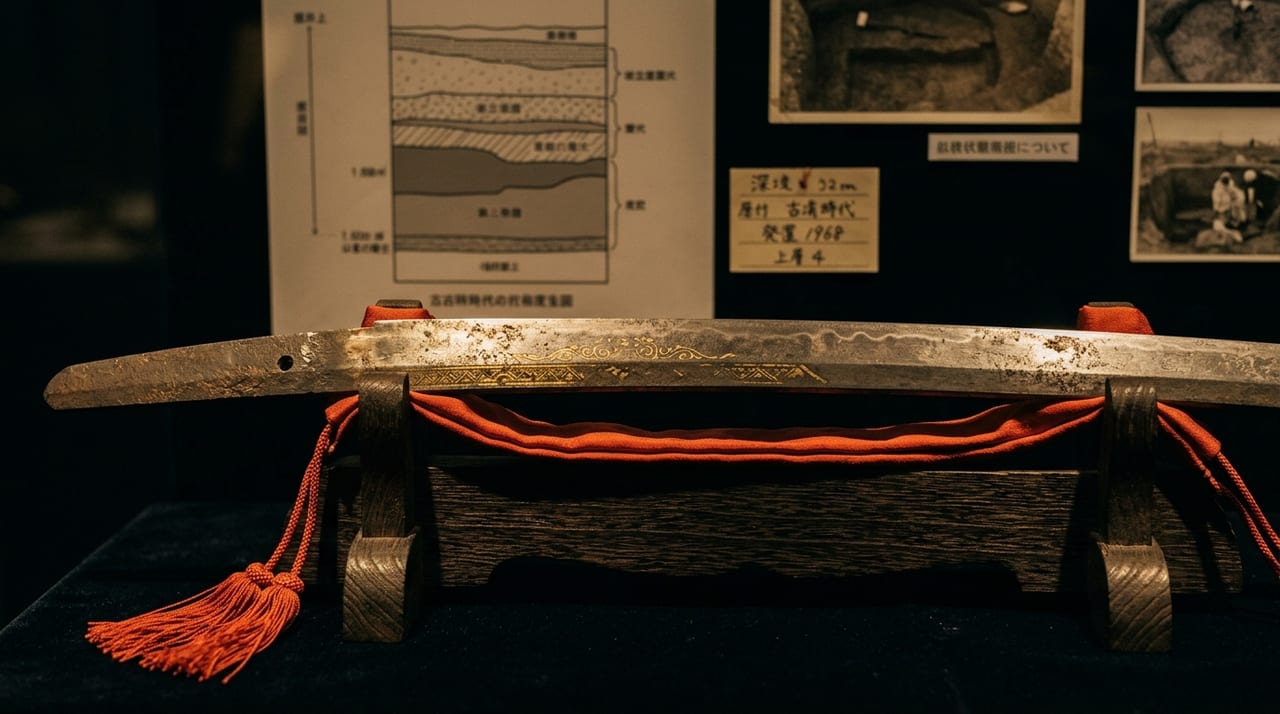 * Image is for illustrative purposes only.
Table of Contents
The "Silence" of Iron as a Material
When we discuss the history of the nihontō, we tend to take for granted the question of "when it was made." Yet swords excavated from the Kofun period and the Yayoi period are almost entirely without documentary support recording the year of manufacture. What establishes the date is not the sword itself but the archaeological method of reading the "context" in which the sword was buried.
Pottery shows changes in form and decoration, and timber retains tree rings as a record of time. Iron as a material, however, tends not to show significant compositional changes even after several centuries from the time of manufacture, and it is technically difficult to determine directly from an iron object itself the year it was made. If corrosion and oxidation have advanced, the very premises of analysis collapse; moreover, kaji techniques vary considerably by region across different periods, and no established framework exists for determining a date unambiguously from shape alone. The fundamental reason that dating nihontō relies heavily on information "outside the sword" lies in these material constraints.
At an excavation site, even the position, orientation, and depth at the moment a sword is discovered become subjects of documentation, and detailed site plans showing the find-spot are attached to the report. Not just the sword itself, but the information of "where and how the sword was placed" serves as material for dating, and this is where the archaeological principle that excavation context is the primary source manifests itself.
Stratigraphy — Making the Context of Burial a Yardstick for Dating
The most fundamental method of dating is stratigraphic observation, which involves reading the way geological strata are layered. Burial facilities within kofun are often sealed all at once at the time of construction, and grave goods excavated from the same burial space can generally be regarded as having been interred at the same time. When a sword is detected together with armor, horse fittings, jewels, and the like, the entire combination is treated as "a grave-goods set belonging to a single period" and provides a clue to the date of a sword that cannot be determined on its own.
However, cases in which this premise breaks down are by no means rare.
- Disturbance by grave robbery — pits dug in later periods cause grave goods to be moved or mixed in
- Secondary burials — when a kofun was used across multiple periods, the strata overlap and it becomes unclear which period a given grave good belongs to
- Natural geological movement — landslides and groundwater erosion disrupt the order of deposition
When such disturbance is suspected, it is dangerous to determine a date from stratigraphy alone, and care must always be taken to cross-check with other methods.
Relative Chronology Through Associated Artifacts — What Pottery and Horse Fittings Tell Us
Of equal importance alongside stratigraphy is relative chronology through associated artifacts. Other artifacts buried together in the same burial space are called "associated artifacts," and if their period can be determined, the date of the sword can be narrowed down.
Pottery is the prime example. Haji ware, Sue ware, and similar types change in form and manufacturing technique relatively rapidly over time, so typological chronology research has accumulated for each region, making it possible to estimate "swords found together with this pottery type are from approximately what century." Horse fittings and personal ornaments are similar: the timing of their introduction from the continent (China and the Korean Peninsula) and the process of their domestic dissemination can be traced to some extent, so the relative antiquity or recency of a sword can be judged from its association with these items.
What is important is that this method gives "relative dates" rather than "absolute dates." By accumulating relationships such as "sword A is older than pottery B" and "C and D were buried at the same time," multiple sites and excavated objects are placed along a single chronological axis. The essence of relative chronology can be said to lie in the work of placing not individual swords but the entire artifact composition of a kofun onto chronological coordinates.
Inscriptions — The Potential and Limitations of Evidence Close to Written Sources
A very small number of excavated swords have inscriptions carved into them that indicate the circumstances or year of manufacture, and these become outstandingly powerful clues. Among the best known is the iron sword with gold-inlay inscription excavated from the Inariyama Kofun in Gyōda City, Saitama Prefecture. Both faces of the blade carry a 115-character inscription inlaid in gold, which records the sexagenary-cycle year "kanoto-i." Researchers matched this sexagenary-cycle year against the names and official titles recorded in the inscription, and further against the date range obtained from associated artifacts and stratigraphy, carrying out the work of narrowing down which "kanoto-i year" it corresponds to. The tachi excavated from the Etafunayama Kofun in Nagomi-machi, Kumamoto Prefecture, is another well-known example with an inscription surviving in silver inlay, from which names, official titles, and words of prayer can be read. Such swords with inscriptions are limited in number but have become important fixed points in the study of the history of weapons.
However, the handling of inscriptions involves the following constraints.
- Many inscriptions express years in the sexagenary cycle (combinations of the ten heavenly stems and twelve earthly branches), and because one full cycle is 60 years, multiple candidate years arise
- The reading of the inscription itself is difficult, and there are cases where scholars disagree on interpretation
- There are artifacts for which the possibility that the inscription was added or falsified in a later period cannot be ruled out
Given these constraints, it is appropriate to understand that an inscription is not "an all-purpose proof capable of establishing an absolute date on its own" but rather a composite historical source that acquires meaning only when archaeological context and philological reading are combined.
The Role and Limitations of Scientific Dating Methods
Radiocarbon (¹⁴C) dating is a method that can be applied whenever organic matter is present. If wooden saya or tsuka, lacquer, or timber used in the burial adheres to or coexists with the sword, these can be measured as samples. With the spread of accelerator mass spectrometry (AMS), the range of application to minute samples has expanded, increasing the situations in which organic matter associated with excavated swords can be utilized.
However, this method too has limitations. Measured values always carry a margin of error, and the resolution may be insufficient for determining fine chronological divisions within the Kofun period. Furthermore, the time lag between when timber was felled and when it was processed into a finished product (the so-called "old wood effect"), as well as contamination of samples, also become sources of error.
As a result, the role of scientific dating is to reinforce the estimates accumulated by stratigraphy and relative chronology with confirmation that "this date range is acceptable." The reality is that it functions as one material for cross-referencing answers produced by multiple methods, and the fact that this is a more modest role than what the word "scientific" might suggest is often not widely known.
Situating Swords on the Timeline of Weapons History
Dating excavated swords is not a task that handles swords in isolation. Research on Kofun-period grave goods is often conducted in terms of a complete set of armaments including horse fittings, bows and arrows, and armor, with the background perspective of capturing the reception of continental equestrian culture and the overall transformation of the weapons system that accompanied it. The changes in such elements as the blade length of straight swords, the shape of the nakago, the presence or absence of a tsuba, and the style of kantō (ring pommels) are being reread — organized in parallel with changes in the complete weapons set — not merely as "the evolution of the sword" but as an indicator reflecting the military and political structures of the time.
The more the precision of dating improves, the higher the resolution of this positioning within weapons history becomes. The fact that the dating of a single sword is directly connected to the research on the chronology of the entire body of grave goods and to the understanding of the history of continental exchange is precisely what makes ancient sword research both fascinating and difficult.
The date of an excavated sword is established only by combining stratigraphy as the context of burial, associated artifacts as the yardstick of relative chronology, inscriptions as an exceptional but powerful clue, and supplementary scientific dating methods — only through this combination can a single sword be placed on the timeline of weapons history as a whole. At TOUKENZA, listing information for nihontō is published together with explanatory columns grounded in this kind of historical background.