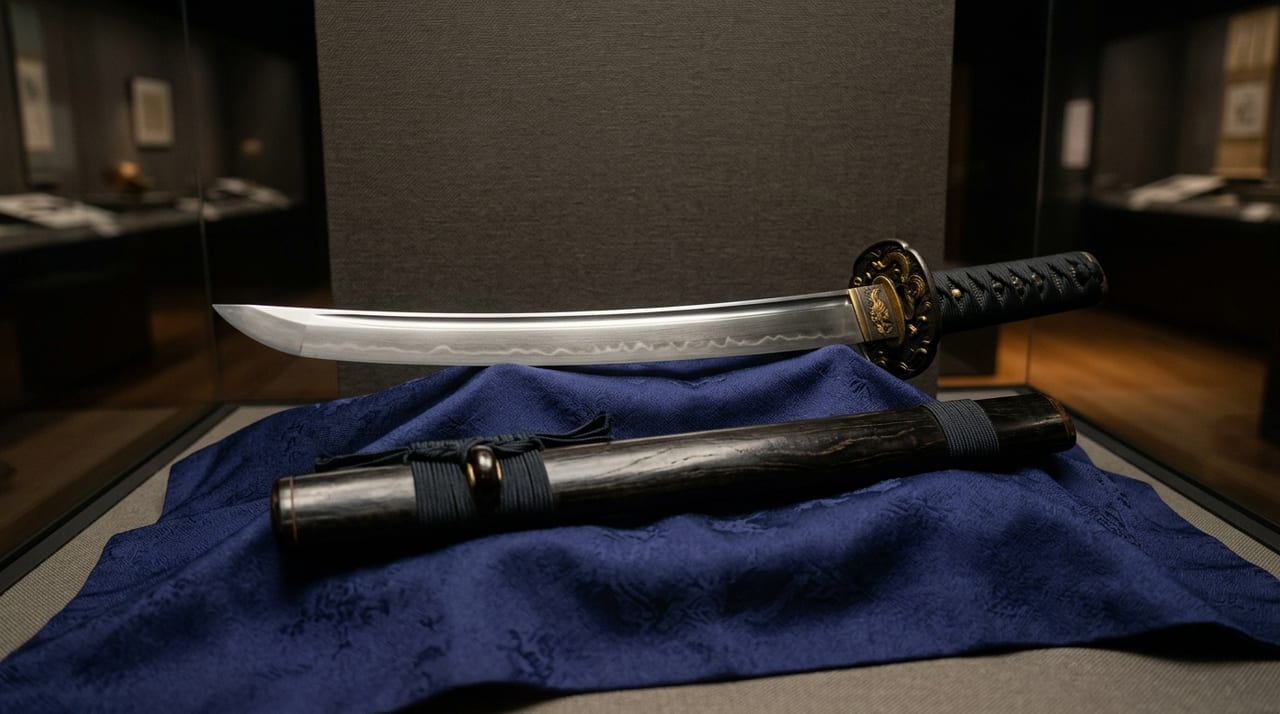
 * Image is for illustrative purposes only.
Shintōgo Kunimitsu
新藤五国光
Also known as: Founder of the Sōshū tradition · Kamakura Ichimonji · Hand of God
Description
Overview of Shintōgo Kunimitsu—The Source of the Sōshū Tradition
Shintōgo Kunimitsu (late 13th century) was a smith active in Kamakura during the mid-Kamakura period, and is recorded in the history of Japanese sword-smithing as the most important figure who established the foundation of the later Sōshū tradition. The epithet 'Shintōgo' is said to mean 'new Tōgorō,' and while his origins and background remain subjects of scholarly debate, the most influential theory holds that he was the son of Kunitsuna, a smith from Awataguchi in Yamashiro Province, who relocated to Kamakura to become the founder of Sōshū smithing. Kunimitsu, working in the special environment of the Kamakura Shogunate's seat of power, absorbed the techniques of the Bizen and Yamato traditions and established his own distinctive Sōshū tradition style. The brilliant achievements of the Sōshū tradition exemplified by Masamune and Sadamune that followed could not have been realized without Kunimitsu; in this sense, Kunimitsu is one of the most important 'founders' in Japanese sword-smithing history.
Technical Characteristics—Early Sōshū Style
The technical characteristics of Shintōgo Kunimitsu's blades show several important differences when compared to the mature period of the Sōshū tradition (the Masamune era). In Kunimitsu's period, the characteristic Sōshū 'nie-filled hamon with deep nioi-guchi' had not yet fully developed, and his works generally display relatively restrained blade patterns. However, in the jigane, the characteristic Sōshū 'flowing large mokume with thick jihada and abundant jinie' is already evident, allowing us to see the precursor to the jigane of the later Masamune. Kunimitsu left numerous exceptional tantō, demonstrating the highest standards of Kamakura smithing through the graceful beauty of his sugata and the high quality of his jigane. The blade length exhibits the standard proportions of the late Kamakura period, and his graceful sugata with soft curvature became the 'standard of Kamakura beauty' that later smiths emulated.
Reputation as a Master of the Tantō
Among Kunimitsu's works, the tantō are especially highly regarded. The late Kamakura period was an era when tantō became widespread as daily-carry weapons for samurai, and Kunimitsu's tantō remain as the finest works that answered the highest demands of the time. The characteristic of Kunimitsu's tantō lies in the refinement achieved by combining the practical sugata of hira-zukuri or kanmuri-otoshi-zukuri with fine jigane close to raibada and restrained, graceful hamon. These tantō are believed to have been presented to influential military commanders of the Kamakura Shogunate and embody the ideal of the sword as 'the finest functional artwork'—a concept that could only have been born in Kamakura as a political center. The tantō designated as National Treasures continue to receive the highest assessment as supreme masterpieces of the early Sōshū tradition.
The Special Environment of Kamakura
It was no coincidence that Kunimitsu established his smithing workshop in Kamakura. Kamakura was the political capital of Japan at the time and the greatest center of sword demand, where influential military lords and their retainers from across the nation gathered. Moreover, Kamakura was home to numerous major Zen temples such as Kenchō-ji and Engaku-ji, and a new spiritual culture influenced by Chinese and Song-Yuan civilization was flourishing. This dual environment—the concentration of political power and the stimulation of new culture—is believed to have drawn out Kunimitsu's creativity to its fullest extent. The technical exchange with smiths of other schools whom Kunimitsu met in Kamakura, his spiritual dialogue with Zen monks, and the highest standards demanded by the greatest military commanders—all of these became the fertile ground for creating the innovative Sōshū style. The 'balance of refinement and strength' evident in Kunimitsu's blades can be said to reflect the spiritual character of Kamakura as a city.
Technical Transmission to Masamune and Sadamune
Shintōgo Kunimitsu's greatest historical significance lies in his technical transmission to the next generation of disciples. Masamune emerged in the generation of Kunimitsu's direct or indirect disciples and fully developed the Sōshū tradition that Kunimitsu had initiated, achieving the 'perfection of the Sōshū tradition.' The technical transmission from Kunimitsu to Masamune is told as one of the most dramatic master-disciple relationships in Japanese sword history, with the assessment that 'Kunimitsu sowed the seeds and Masamune brought forth the flowers.' Kunimitsu's flowing large mokume jigane provided the foundation for Masamune's majestic large-nie hamon, and the graceful sugata of Kunimitsu's tantō was inherited by Sadamune's delicate refinement. The development of the Sōshū tradition across these three generations—Kunimitsu, Masamune, and Sadamune—is one of the most vivid narratives of technical evolution in Japanese sword history.
Contemporary Assessment and Position
In contemporary sword research, Shintōgo Kunimitsu receives absolute respect as the 'father of the Sōshū tradition,' and his works designated as National Treasures and Important Cultural Properties constitute unwavering evidence supporting this assessment. Kunimitsu's masterpieces housed in institutions such as the Tokyo National Museum and Tokugawa Art Museum convey the 'origins of the Sōshū tradition' to contemporary viewers through periodic exhibitions. In sword authentication, Kunimitsu's works possess the highest authority as 'reference pieces of the Sōshū tradition,' and the evaluative framework of 'close to Kunimitsu' or 'deviating from Kunimitsu' functions as the standard in authenticating later Sōshū works. The fact that blades forged over seven hundred years ago in a Kamakura smithy continue to serve as the highest standard of Japanese sword culture in the modern era is the most eloquent testimony to the universal, timeless nature of a true master craftsman's work. The 'graceful sugata and refined jigane' displayed by Kunimitsu's tantō prove that the great Sōshū tradition had an exceptional starting point from the beginning and demonstrate the historical significance of how Kamakura's intellectual environment gave birth to the world's finest sword-smithing tradition.
Legends & Stories
As a Smith of the Kamakura Shogunate
The era in which Shintōgo Kunimitsu lived was a time when the Kamakura Shogunate's power reached its zenith while beginning to harbor internal contradictions. Against the unprecedented external pressure of the Mongol invasions (the 1274 Bun'ei campaign and the 1281 Kōan campaign), Kamakura warriors defended Japan, but subsequent discontent over reward assessments and economic hardship began to erode the shogunate's foundation. Kunimitsu was a smith who forged blades for Kamakura's highest-ranking power holders during this tense era, and it is said that influential members of the Hōjō clan visited his workshop seeking the finest blades. Kunimitsu's position as a 'shogunal smith' transcended mere commercial significance, and he served as a symbolic embodiment of national power. A mutually reinforcing relationship existed in which the political power of the Kamakura Shogunate conferred 'the legitimacy of the warrior class' upon Kunimitsu's blades, while his supreme technical skill further elevated the shogunate's authority.
The Mystery of the Name 'Shintōgo'
The epithet 'Shintōgo' carries many mysteries. According to one theory, it means 'new Tōgorō' and is an epithet indicating that he was a new-generation Tōgorō active in Kamakura. Another theory suggests it derives from a specific place name or personal name in Kamakura. The epithet, which includes the character for 'new' (shin), can also be interpreted as suggesting that Kunimitsu consciously sought to break away from old traditions. A smith who created a new style in Kamakura—this narrative of 'relocation and creation' tells the story of the Sōshū tradition, one of the most dramatic innovations in Japanese sword history, from the perspective of one man's life transformation. It is not an exaggeration to interpret Kunimitsu's self-awareness as 'new' as the wellspring of the spirit of innovation later inherited by Masamune.
Exchange with Zen Monks and Spiritual Influence
In the late Kamakura period, Kamakura witnessed the successive founding of major Zen temples such as Kenchō-ji and Engaku-ji, an era when Chinese and Song-era Zen culture was being actively introduced. Shintōgo Kunimitsu's smithing workshop was located in Kamakura, the center of this Zen culture. The Zen concept of 'one stroke severing delusion' (ittō ryōdan)—the spiritual state of cutting through confusion with a single stroke—has deep affinity with the medium of the sword, and exchange between Zen monks and smiths formed a cultural foundation for deepening the 'spiritual meaning of the sword.' While no historical records directly document what interaction Kunimitsu had with Kamakura's Zen monks, the 'pure beauty with all excess stripped away' characteristic of his tantō strongly evokes a resonance with Zen aesthetics. In later times, the sword and Zen thought became inseparably linked within the spiritual system of 'bushidō,' but the seeds of this union may have been sown in the cultural environment of Kamakura where Kunimitsu lived.
The Master-Disciple Legend of Kunimitsu and Masamune
While precise historical evidence for the master-disciple relationship between Shintōgo Kunimitsu and Masamune is scarce and remains debated among scholars, the traditional sword world maintains the story of 'Kunimitsu raising Masamune' as a firm legend. According to this legend, the young Masamune entered Kunimitsu's workshop and, as his direct disciple, mastered the fundamental techniques of the Sōshū tradition before independently developing revolutionary techniques—the bold hamon with large turbulent nie and vigorous ground-patterning—that far surpassed his master's achievements. The story of a disciple surpassing a master when both are supreme artisans is a pattern seen widely throughout Japanese culture, and the Kunimitsu-Masamune master-disciple relationship is perpetuated as one of its most brilliant examples. Even today, seven centuries later, the sword world maintains the maxim 'without Kunimitsu, there is no Masamune,' testament to Kunimitsu's exalted position.
Kunimitsu in the Tokugawa Art Museum and Daimyo Culture
During the Edo period, works by Shintōgo Kunimitsu were treasured as the supreme possessions of daimyo families. Multiple representative tantō by Shintōgo Kunimitsu survive as National Treasures and Important Cultural Properties. The celebrated tantō 'Aizu Shintōgo' (National Treasure), a favorite blade of Gamo Ujisato, is housed in the Fukuyama Art Museum (Hiroshima Prefecture), while other Kunimitsu tantō are preserved at the Sano Art Museum (Shizuoka Prefecture), Atsuta Shrine (Aichi Prefecture), and elsewhere. These are precious legacies transmitting the 'origins of the Sōshū tradition' to the present day.
Contemporary Research and Kunimitsu's Unsolved Mysteries
Many mysteries surrounding Shintōgo Kunimitsu remain unsolved in the modern era. Basic biographical facts about Kunimitsu—his birthplace, dates of birth and death, background, and details about his disciples—cannot be confirmed due to insufficient historical records. Moreover, among works traditionally attributed to Kunimitsu, some are difficult to authenticate, and contemporary sword scholars are employing comprehensive research methods combining scientific analysis and traditional connoisseurship to establish Kunimitsu's 'authentic works.' Paradoxically, this abundance of mysteries maintains an enduring magnetic attraction to Kunimitsu, keeping him central to debate in cutting-edge Japanese sword research. The works of a 'founder' are always mingled with legend and fact, and this very mingling transforms Kunimitsu from a historical figure into a 'living legend'—the reason he continues to shine at the center of sword culture in the modern world.