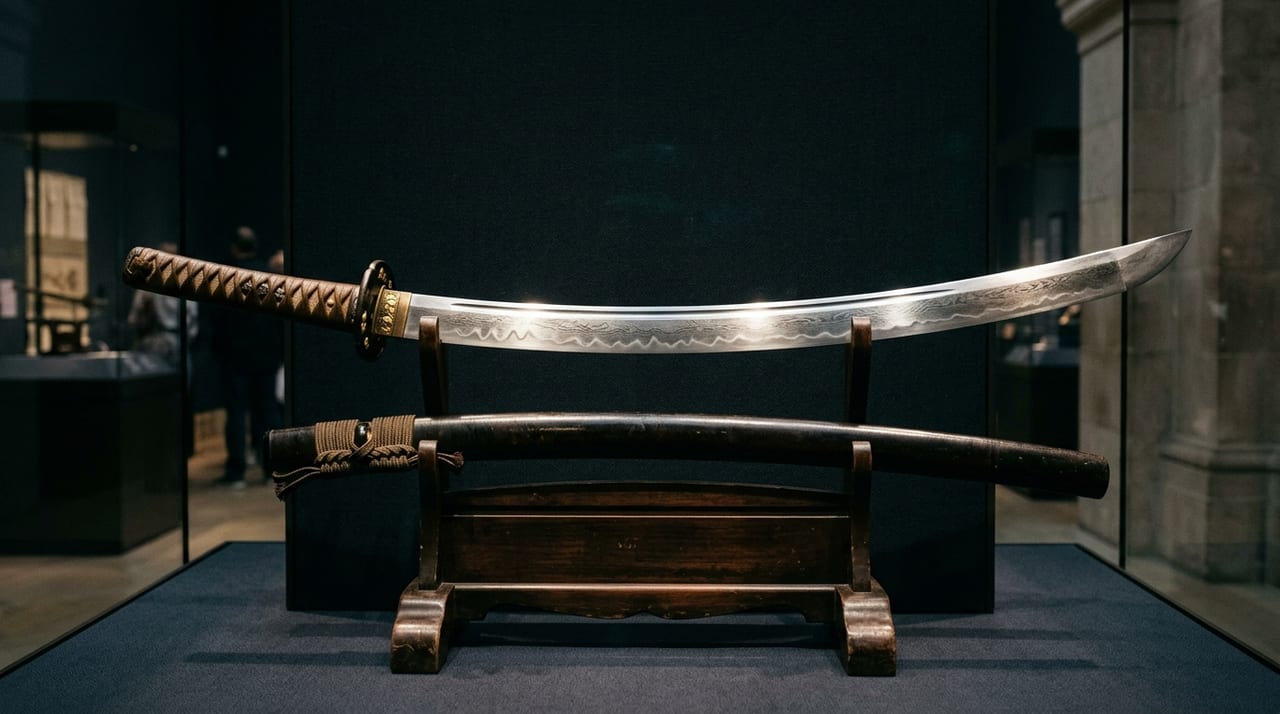
 * Image is for illustrative purposes only.
Kiriha Sadamune
切刃貞宗
Also known as: Kiriha Sadamune • Son of Masamune • Celebrated blade of the Soshu tradition
Description
Overview of the Sword
Kiriha Sadamune is an unsigned sword forged by the renowned swordsmith Sōshū Sadamune (dates of birth and death unknown; active in the early 14th century), who worked in Sagami Province (present-day Kanagawa Prefecture) during the late Kamakura period. Designated as an Important Cultural Property, it is held at the Tokyo National Museum. The name "Kiriha" derives from the blade's form—kiriha-zukuri (chisel-edged construction)—and is known among Sadamune's works as a piece of exceptional refinement. As the direct successor to Masamune, the foremost representative of the Sōshū tradition, Sadamune is remembered as "the figure closest to Masamune," and Kiriha Sadamune is a masterwork that exemplifies his artistic style.
The Life of Sōshū Sadamune and the Sōshū Tradition
Sōshū Sadamune is traditionally said to have been either the son or adopted son of Masamune, studied under him, and worked as a swordsmith in Kamakura. While Masamune occupies the highest position in the history of Japanese swords, Sadamune is the most essential successor who inherited and developed the Sōshū tradition, and has long been revered as "the supreme bloodline connected to Masamune." Sadamune's swords inherit the bold grandeur of his father Masamune while infusing their own unique beauty with elegance and refinement. The ji-gane displays a forceful texture with mokume interwoven in the itame grain; the ji-nie is thick and the ji-gane is prominent with excellent scenery. The hamon is a vibrant wavy pattern mixing gunome, large gunome, and chōji, characterized by vivid "ō-nie" (large nie) that glitters intensely. This ō-nie scenery is a remarkable quality unique to the Sōshū tradition that other smiths cannot easily replicate, and the beauty of the nie particles floating within the blade never grows tiresome no matter how many times one observes it.
The Special Form of Kiriha-zukuri
"Kiriha-zukuri," which gives Kiriha Sadamune its name, refers to a construction method in which the cross-section of the blade is asymmetric rather than left-right symmetric—one side thick, the other thin. This form aims to achieve both cutting efficiency and structural strength, and is seen in swords with specially designed blades. In contrast to the common hira-zukuri and shinogi-zukuri construction methods, kiriha-zukuri represents a more distinctive choice. Sadamune's use of this form is highly valued as an exemplar that embodies the Japanese sword's ideal of "the integration of beauty and function." The asymmetry of the blade's cross-section also affects patterns of light reflection, creating an aesthetic effect in which the sword displays different aspects depending on the viewing angle.
Provenance and Preservation
After being possessed by Toyotomi Hideyoshi, Kiriha Sadamune passed to Fukushima Masanori. Following Masanori's death, in Kan'ei 1 (1624), it was presented to Tokugawa Tadanaga, the younger brother of the third shogun Tokugawa Iemitsu. Subsequently it entered the Kishu Tokugawa family collection. In Genroku 10 (1697), Tokugawa Tsunanori, the third daimyo of Kii Domain, presented it to the fifth shogun Tokugawa Tsunayoshi, making it part of the shogunal collection. It was designated as an Important Cultural Property in 1963 (Showa 38) and is currently held at the Tokyo National Museum.
Comparison with Masamune and Sadamune's Unique Identity
The saying "Wherever Masamune is, Sadamune is there" demonstrates how deeply rooted the relationship between Masamune and Sadamune is in Japanese sword appreciation culture. If Masamune is the "father," "heaven," and "the ultimate of martial prowess," then Sadamune is the "child," "earth," and "the depths of beauty." In Kiriha Sadamune, this comparison is clearly evident: unlike the cosmic grandeur of Masamune's works, it unfolds a beauty that is more introspective and profound. This is of utmost importance from the perspective of inheriting and developing the Sōshū tradition, and Kiriha Sadamune transcends being merely a masterwork—it is an indispensable blade in any discourse on the genealogy of Japanese sword aesthetics. The aesthetics of the Sōshū tradition, produced by these two pinnacles of successive generations, Masamune and Sadamune, exerted profound influence on the later Edo new swords and formed the foundation of Japanese sword art.
The Blade of Kiriha Sadamune
Kiriha Sadamune has a blade length of approximately 72 centimeters and, though unsigned, is attributed to Sadamune. The distinctive kiriha-zukuri form concentrates the essence of the Sōshū tradition, and even after undergoing re-polishing, the forceful quality of its ji-gane and the excellence of its ō-nie hamon remain entirely undiminished. It is a masterwork of the Sōshū tradition that conveys Sadamune's mastery—inheriting the bold grandeur of Masamune while adding his own distinctive depth.
Legends & Stories
Sadamune's Origins—The Weight of the Oral Tradition of Being Masamune's Son
Sadamune of Sōshū has various theories about his origins since ancient times, and diverse oral traditions exist such as "real son of Masamune," "adopted son of Masamune," and "senior disciple of Masamune." The theory most widely believed has been that he was Masamune's real son, and based on this theory, the Kiriha Sadamune would be invested with absolute authority as "the supreme masterpiece forged by a sword smith who carried Masamune's blood." The authority conferred by bloodline is a value that has been universally prioritized in Japanese warrior, artistic, and craft culture, and in Sadamune's case it functions as the ultimate manifestation—the son of Masamune, who is called the god of sword smiths. Among the Ten Philosophers of Masamune, names such as Yoshihiro, Yukimitsu, Hasebe, and Kanemichi are listed, but Sadamune is often accorded special status as the figure closest to Masamune. What the warlords and daimyo who possessed the Kiriha Sadamune felt may not have been merely the possession of an excellent sword, but rather a sense of spiritual connection—"possessing the blade closest to Masamune's spirit." The authority of bloodline in Japanese swords is not merely a matter of genealogy, but is founded on the cultural belief that technique, aesthetic sense, and spirituality are transmitted from parent to child and from master to disciple, and the Kiriha Sadamune has been an object of veneration as the material embodiment of this belief.
Its Transmission Through the Hands of Celebrated Warlords
The Kiriha Sadamune is a distinguished blade that passed through the hands of the foremost warlords and shogunal families throughout the early modern period. Its transmission passed from Toyotomi Hideyoshi to Maeda Toshiie, then further to the Fukushima family, and later came into the possession of the Tokugawa shogunal house. In the 10th year of Genroku (1697), Tokugawa Tsugutaka, the third daimyo of the Kii Tokugawa family, is said to have presented it to Tokugawa Tsunayoshi, the fifth shogun, restoring it once again to the possession of the shogunal house. The genealogy of owners itself—Hideyoshi, Toshiie, Fukushima Masanori, the shogunal family, and the Kii Tokugawa family—eloquently speaks to the supreme rank of this blade.
The Functional Aesthetics Expressed by Kiriha-Zukuri
The construction style called kiriha-zukuri, which gave its name to "Kiriha Sadamune," is a method that places special emphasis on functional rationality among the techniques of constructing Japanese swords. By making the cross-section of the blade asymmetrical, it achieves both the sharpness of the thinly polished side and the strength of the thickly preserved side—this is the crystallization of artisanal wisdom that resolves seemingly contradictory demands in a single structure. Why Sadamune chose this construction is often interpreted as "deep consideration for practicality as a short sword," but at the same time the asymmetric cross-section creates a unique reflection of light on the blade, producing also an aesthetic effect. The integration of function and beauty—this is the core of Japanese craft aesthetics, and the Kiriha Sadamune is still highly regarded today as a work that embodies this principle at the highest level. The fact that this construction ultimately produced the unique name "Kiriha Sadamune" is a fine example demonstrating that the practical judgment of a craftsman can become an aesthetic legacy passed down even a thousand years hence.
Important Cultural Property Designation and Modern Evaluation
The Kiriha Sadamune, designated as an Important Cultural Property on February 14, 1963 (Showa 38), is currently housed in the Tokyo National Museum. Extant signed works by Sōshū Sadamune are few, and a blade in which all three elements—form, jigane, and hamon—are as perfectly unified as in the Kiriha Sadamune is extremely rare. Among the three great masters of the Sōshū tradition—Masamune, Sadamune, and Yoshihiro—Sadamune's position tends to remain somewhat in the shadow of Masamune and Yoshihiro even in modern times, but the existence of the Kiriha Sadamune as a National Treasure continues to speak eloquently that Sadamune was a supreme master craftsman in no way inferior to the other two. The display at the Tokyo National Museum continues to impart profound emotional resonance to domestic and international visitors as an opportunity to experience the pinnacle of sword art fostered by Japanese warrior culture.
The Spirit of Kamakura Warriors and the Kiriha Sadamune
The late Kamakura period, when the Kiriha Sadamune was forged, was a time when the samurai class had experienced the Mongol Invasions (Genpei) and when the samurai's sense of consciousness and pride had reached their zenith. In this turbulent era when the Nanboku-chō (North and South Courts) conflict was beginning, the possession of the finest blade was one of the most important spiritual pillars for a warlord. This blade of Sadamune was a complete entity that could function both in real combat and as a sacred object to be enshrined in a household altar, and the warlord who wore the Kiriha Sadamune at his waist surely felt throughout his entire being the protection of the steel infused with Masamune's bloodline as he went to the battlefield. The robust yet elegant aura emanated by the swords of the Sōshū tradition embodies in its purest form the ideal of "excellence in both arms and letters" cherished by Kamakura warriors, and the Kiriha Sadamune continues to shine today as the embodiment of that ideal. In samurai society after the Mongol Invasions, the sword transcended being a mere weapon and became a spiritual symbol, and the celebrated blades created by supreme craftsmen like Sadamune became "sacred objects that harbor divine protection" and served as spiritual pillars for warlords. After seven centuries, the Kiriha Sadamune continues to radiate its brilliance in the Tokyo National Museum, transmitted to future generations as proof that the art of the Japanese sword has achieved the ideal fusion of weapon and beauty.