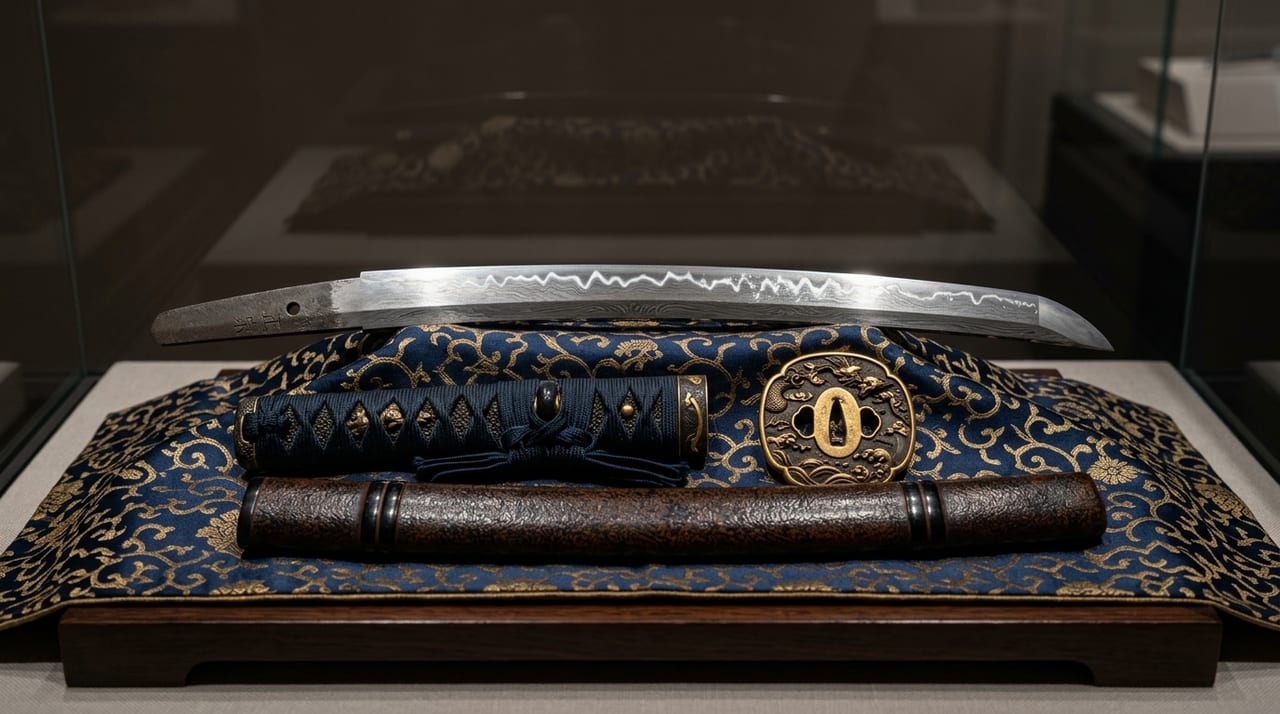
 * Image is for illustrative purposes only.
Kanze Masamune
観世正宗
Also known as: Kanze Masamune; the Sword of the Nō Theater Masters
Description
Sword Overview
Kanze Masamune is a sword forged by Okazaki Masamune in the late Kamakura period, and takes its name from the Kanze family—the foremost noble house of Japan's traditional performing arts of Nō theater—to which it was transmitted. The Kanze school, as the foremost of the five schools of Nō theater, continues to represent Japanese traditional culture to the present day. The fact that the Kanze family preserved a Masamune short sword as a treasured heirloom across generations embodies a rare historical reality where Japan's martial culture and performing arts culture intersect at the highest level. With a blade length of approximately 64.4 cm, this large polished-away unsigned blade is a masterwork designated as a National Treasure that fully exemplifies the characteristic Sōshū-tradition jihada and hamon of Masamune.
Manufacturing Method and the Beauty of the Sōshū Tradition
Masamune's bladesmithing is highly esteemed as the supreme embodiment of the Sōshū tradition's bold and elegant beauty. In Kanze Masamune, the dynamic jihada with flowing patterns set in the steel is well-adorned with jinie, and the hamon displays an active irregular pattern mixing pointed forms and reverse curves, with deep ashi and vigorous nie. The blade exhibits the vivid landscape characteristic of Masamune—intense nie shimmering within the cutting edge—in spectacular fashion.
The Kanze Family and the History of Nō Theater
The Kanze school is a school of Nō theater perfected by the father and son Kan'ami and Zeami in the Muromachi period, and became the mainstream of Japanese Nō theater through the powerful patronage of Ashikaga Yoshimitsu. Zeami (c. 1363–1443) is positioned as one of the highest figures in the history of Japanese arts, as an artist who synthesized the theory and practice of Nō theater. Standing as descendants of Zeami at the apex of the Nō theater world, the Kanze family's preservation of a Masamune blade as a treasured heirloom makes this a celebrated sword occupying a special place in Japanese cultural history, distinguished by its unique transmission route from the warrior class to a performing arts family.
From the Tokugawa Clan to the Tokyo National Museum
Kanze Masamune was acquired by Tokugawa Ieyasu from the Kanze family and given to the second shōgun Tokugawa Hidetada, thereafter passing to the Tokugawa shōgunal family. Following the Meiji Restoration, it was presented by the Tokugawa family to the Arisugawa-no-miya family, and then passed through the Takamatsu-no-miya family, which succeeded to that house. It is currently housed in the Tokyo National Museum. It was designated as a National Treasure in 1959 (Showa 34).
Legends & Stories
Noh and the Sword — The Treasure of Martial Arts Enshrined in the House of Art
The fact that the Kanze family preserved a Masamune blade as a treasured object represents a rare instance where diverse aspects of Japanese culture converge at the highest level. Noh, the performing art that developed under the patronage of the samurai class during the Muromachi period, has an aesthetic that resonates deeply with the spirit of bushidō. Many Noh plays feature samurai, daimyo, and divine spirits as their protagonists. That the Kanze family—standing at the pinnacle of Noh—preserved a Masamune blade as a treasured object demonstrates how profoundly the world of Noh and the world of the Japanese sword were bound together through their shared dedication to "the refinement of beauty and spirit."
Zeami Motokiyo and Ashikaga Yoshimitsu — The Golden Age of the Kanze School
Zeami Motokiyo (ca. 1363–1443), the Noh master and playwright who elevated the Kanze school to the supreme performing art of the realm, achieved the pinnacle of artistic expression under the patronage of Shogun Ashikaga Yoshimitsu. Yoshimitsu, known not only for his patronage of Noh but also as a collector of Japanese swords, very likely enabled the Kanze family to acquire the Kanze Masamune through their intimate relationship with him. The concept of "hana"—the flower—set forth in Zeami's theoretical work Fūshikaden describes an artistic achievement that perpetually surprises the viewer with fresh discoveries. This resonates profoundly with the defining quality of Masamune blades: "the more carefully you observe them, the more new discoveries emerge." The Kanze Masamune stands at the confluence where Zeami's "flower" and Masamune's "beauty of the nie" intersect—a renowned blade of exceptional merit.
From the Samurai House to the Imperial Family, and Then to the Museum
According to the Kyōhō Meibutsu-chō, the Kanze Masamune was seized from the Kanze family by Tokugawa Ieyasu and, after being bestowed upon Tokugawa Hidetada, subsequently passed through repeated acts of bestowal and presentation between the shogun's house and the samurai nobility. During the Meiji period, it was presented to the Arisugawa-no-miya family, and later passed through the Takamatsu-no-miya family before being enshrined in its current location at the Tokyo National Museum as a National Treasure. Inscribed upon this single blade is the journey of centuries—from the world of Noh in the Muromachi period, through the samurai culture of the Edo era, across the modern imperial court, to the contemporary public museum.