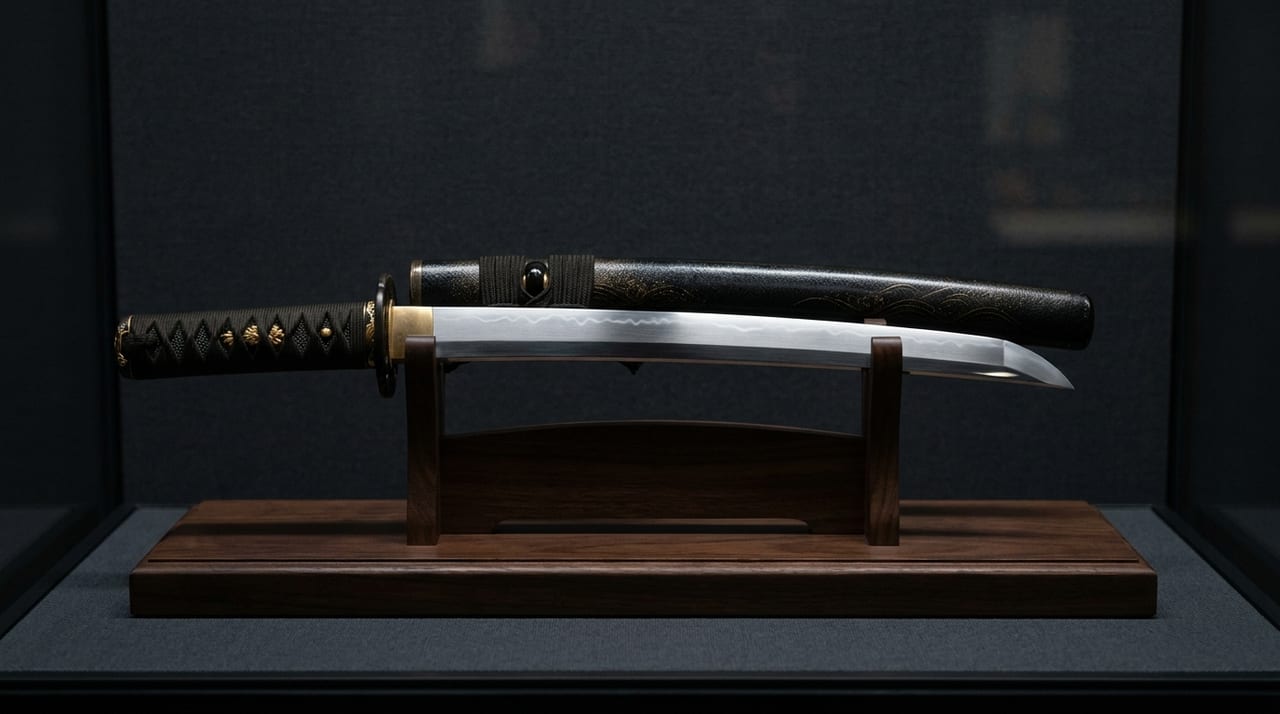
 * Image is for illustrative purposes only.
Gotō Tōshirō
後藤藤四郎
Also known as: Gotō Tōshirō; Masterpiece of Tōshirō Yoshimitsu
Description
Overview of the Blade
Goto Tōshirō is a tantō forged by the celebrated Kamakura-period master swordsmith Awataguchi Yoshimitsu (also known as Tōshirō). The blade takes its name from Goto Shōzaburō Mitsutugu, a distinguished member of the Goto family who served as overseer of the Edo shogunate's Gold Mint and who once possessed this blade. Awataguchi Yoshimitsu is known by the epithet "Tōshirō" and is regarded as the legendary swordsmith who perfected the tantō as an independent and fully realized art form. Goto Tōshirō is a representative example of the Kamakura-period tantō, with a blade length of roughly nine sun (approximately 27.3 cm). The steel exhibits a tightly compressed ko-itame hada with fine, evenly distributed ji-nie that gleams with lustrous quality. The hamon exemplifies Yoshimitsu's distinctive character: a straight-tempered ko-midare with finely distributed nie that evokes subtle depth and consummate refinement rather than ostentation, earning the admiration of sword connoisseurs through its perfection and profundity. Yoshimitsu's tantō represent the ultimate expression of "the beauty of quietude," standing in sharp contrast to the dramatic intensity of the Sōshū Masatsune school. Goto Tōshirō is recorded in sword history as the exemplary manifestation of this quiet beauty within the cultural context of the Goto family tradition.
Awataguchi Yoshimitsu and the Establishment of the Tantō
Awataguchi Yoshimitsu (dates unknown; active in the late 13th century) was the preeminent master of the Awataguchi school, a celebrated swordsmith lineage of Yamashiro Province, and was known by the epithet "Tōshirō." Though the tantō form existed before Yoshimitsu, he was the first to perfect it as an independent artistic accomplishment and to establish it as a definitive standard. Through "Yoshimitsu tantō," he set the criterion for tantō beauty in Japanese sword tradition. His works are characterized by their tightly packed steel, uniformly distributed ji-nie, and relatively serene yet profoundly expressive hamon—a refined beauty that stands in marked contrast to the dramatic forging style of Sōshū Masatsune. As the pinnacle of the Yamashiro tradition, Yoshimitsu's tantō were treasured by tea masters as celebrated tea utensils (meibutsu) and held the highest rank as ceremonial gifts and votive swords among the warrior nobility. Authenticated works by Yoshimitsu number roughly a dozen, and this scarcity further enhances their value. The Awataguchi school was formed by Yoshimitsu's brothers and students, and the succession of smiths bearing names such as Kuniyoshi, Hisakuni, Arikuni, Tamekuni, Kuniyasu, Kunikiyo, Kunika, and Yoshimitsu constitute one of the most illustrious lineages in Japanese sword history.
The Goto Family and Their Connection to Yoshimitsu Tantō
The Goto family has been a renowned lineage of metal craftsmen (kōkin) since the Muromachi period, known for their supreme mastery in forging tantō fittings such as tsuba, kozuka, and kogai, and they served the Tokugawa shoguns as official craftsmen to the Edo shogunate. The name "Goto Tōshirō" derives from the fact that Goto Shōzaburō Mitsutugu possessed a Yoshimitsu tantō. The Goto Shōzaburō house served as overseers of the Edo shogunate's Gold Mint and constituted a collateral branch distinct from the main Goto house (Goto Sōke), which was celebrated for kinkane-zogan work. The Goto family's fittings are renowned for the distinctive refined expression known as "Goto-bori" (Goto carving), and when their most masterful fitting assemblies were combined with Yoshimitsu's finest tantō, there emerged a supreme artwork uniting the pinnacle of Japanese metalworking and sword arts. The Tokugawa Art Museum stands as one of the most vital institutions preserving the crystallization of samurai culture for the contemporary age. In the approach of preserving and displaying the Goto family's fittings collection and blade collection as an integrated whole, Goto Tōshirō holds singular significance.
Tea Ceremony and Yoshimitsu Tantō: The Resonance Between the Beauty of Wabi and the Beauty of the Blade
From the Azuchi-Momoyama through the Edo period, when tea ceremony flourished, Yoshimitsu tantō were especially prized as "celebrated blades" (meibutsu) displayed in the alcove (tokonoma) of the tea room. Historical records show that celebrated tea masters including Sen no Rikyū, Furuta Oribe, and Kobori Enshū possessed Yoshimitsu tantō as treasured pieces, creating a cultural space where blade aesthetics and tea aesthetics converged. Yoshimitsu's tantō, with their serene steel and refined hamon, possess profound affinity with the wabi aesthetic sensibility, and it is said that their essential beauty comes fully to light within the sparse aesthetic realm of the tea room itself. In the distinctly Japanese cultural practice of appreciating swords as a category of tea utensil, the Yoshimitsu tantō has remained the supreme icon. The fact that Goto Tōshirō was transmitted to the Goto family—the Edo shogunate's supreme congregation of metal craftsmen—demonstrates the refined aesthetic judgment of the Goto house and stands as testament to the cultural achievement in which tea aesthetics and sword appreciation converge within the Goto family context.
Goto Tōshirō Within the Genealogy of Yoshimitsu Tantō
Yoshimitsu's tantō receive different "Tōshirō" epithets according to their provenance—among them Goto Tōshirō, Hakata Tōshirō, Hōchō Tōshirō, Maeda Tōshirō, Akita Tōshirō, Namazuo Tōshirō, and Yagen Tōshirō—and are collectively positioned in sword history as the "Tōshirō series," each bearing its own distinct historical context. Goto Tōshirō stands out within the Tōshirō series as particularly prominent in cultural and institutional authority, owing to its distinguished provenance from the Goto family, the official metal craftsmen to the Edo shogunate. In the game "Touken Ranbu," Goto Tōshirō was given character settings embodying the Goto family lineage, significantly contributing to increased awareness among younger generations of Yoshimitsu tantō.
Transmission to the Modern Era
Goto Tōshirō is presently housed in the Tokugawa Art Museum as a National Treasure. As a Yoshimitsu tantō with clear provenance and excellent preservation, it has become an indispensable resource for research on the Awataguchi school and comparative study of Yoshimitsu's works. As a masterpiece left by the Kamakura period's foremost tantō craftsman, Goto Tōshirō retains the power to speak directly to contemporary viewers across more than seven centuries.
Legends & Stories
Yoshimitsu and the Invention of the Tantō—A Revolution in Sword Form
Before Awataguchi Yoshimitsu established the tantō as an independent form of Japanese sword, the tantō was recognized primarily as a secondary weapon to the large blade and tachi. Yoshimitsu standardized the tantō as an independent artistic form of perfect completion and, by elevating its aesthetic to the absolute limit, established within Japanese sword culture the unique beauty inherent to the tantō form—a world of hada and hamon condensed within the compact blade length. Yoshimitsu is counted among the master craftsmen known as the "Three Greatest Swordsmiths" (Tenka San-saku, or Meibutsu San-saku) together with Masamune and Gō Yoshihiro, and occupies an unshakeable position as a master of the tantō. The Gotō Tōshirō, as one of the supreme embodiments of Yoshimitsu's tantō aesthetic, has continued to stand at the apex of Japanese sword history for seven hundred years.
Yoshimitsu's Workshop and the Awataguchi Clan
Awataguchi is a place name located in Higashiyama Ward, Kyoto, where a clan of swordsmiths formed the "Awataguchi school." Among the Awataguchi school, which produced excellent swordsmiths such as Kunitomo, Hisakuni, Arikuni, and Yoshimitsu, Yoshimitsu stood out as a genius of the highest caliber. The disciples and successors of Yoshimitsu spread the Yamashiro tradition to various regions, but Yoshimitsu's own works bearing authentic signatures are extremely rare in number, and this rarity further elevates the value of each individual blade. The fact that Gotō Tōshirō is recognized as one of these precious works with authentic signatures means that this blade is testimony to something transcending a mere meibutsu—a scholarly and artistic witness.
Tea Masters and Swords—The Story of Yoshimitsu Tantō in the Tea Room
During the Azuchi-Momoyama period, the aesthetic consciousness of the tea ceremony permeated all of Japanese culture, and swords came to be appreciated with the same aesthetic eye as tea utensils. Just as Toyotomi Hideyoshi created a golden tea room and collected meibutsu utensils as proof of authority over the realm, famous swords too were incorporated into the world of tea. Because the intimate quietness of Yoshimitsu's tantō's hada resonates completely with the wabi aesthetic of tea, it became the most treasured sword form among tea masters. The fact that Gotō Tōshirō was transmitted to the Gotō family—the finest group of metalworkers serving the Edo bakufu—demonstrates the refinement of the Gotō family's aesthetic discernment, which pursued the beauty of both blade and mounting simultaneously. As a combination that enables the ultimate appreciation experience where the beauty of the tantō blade and the decorative beauty of the mounting are integrated, it represents the apex of Tokugawa culture.