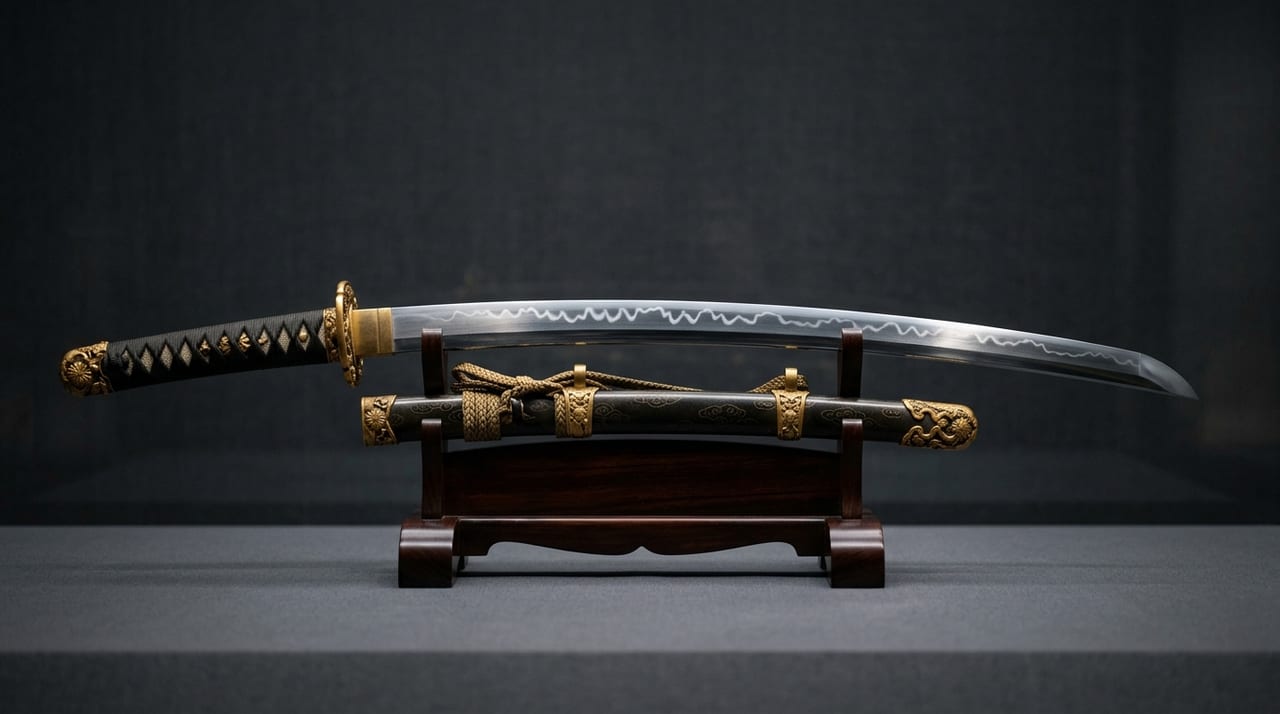
 * Image is for illustrative purposes only.
Gojō Kuninaga
五条国永
Also known as: Gojo Kuninaga — Smith of Tsurumaru Kuninaga — Master swordsmith of the late Heian period
Description
Gojō Kuninaga was a master swordsmith of the Yamashiro school tradition, representative of the late Heian period (12th century), who established his workshop at Gojō in Kyoto. As a leading swordsmith of the Gojō school (Gojō-ha), he left an immense legacy during the formative period of the Japanese sword. Kuninaga is particularly well known as the smith who forged the tachi "Tsurumaru Kuninaga," now transmitted as an Imperial Household treasure — making him known not only to sword enthusiasts but to the general public.
The Gojō school, based at Gojō in Kyoto, was a master smithing group that stood at the pinnacle of Kyoto sword-making from the Heian through the Kamakura period. Following the Sanjō school tradition, it produced numerous celebrated swords in response to the demands of the imperial court, aristocracy, and warrior houses. Kuninaga is the most renowned smith of the Gojō school; while extant examples are few, each is counted among the most important surviving works in Japanese sword research — every one a National Treasure or Important Cultural Property-class masterpiece.
The hallmark of Kuninaga's blades is the "elegant yet robust" form typical of Heian Japanese swords. The slender tachi silhouette with deep koshi-zori embodies martial strength combined with the refinement of court culture, representing the aesthetic ideal revered by both the aristocratic society and the warrior class of the Heian period. The blades are slender and deeply curved, with high shinogi and refined construction; the hamon is primarily suguha or gently undulating ko-midare, with deep nioi and fine, uniform nie. The jigane presents densely packed ko-itame-hada that is clear and serene, with fine ji-nie that conveys a sense of profound depth.
Among Kuninaga's surviving tachi, "Tsurumaru Kuninaga" is the most celebrated — preserved as an Imperial Household treasure in the Imperial Household Agency, it ranks among the most distinguished swords in Japan. Other Kuninaga tachi are also transmitted at shrines throughout the country as sacred divine treasures, and as first-rank witnesses to the essence of Heian sword culture, they continue to attract unceasing attention from researchers and enthusiasts to this day.
Legends & Stories
The most celebrated legend associated with Gojō Kuninaga is the story of the white crane embedded in the name of the National Treasure "Tsurumaru Kuninaga." According to tradition, while Kuninaga was forging this tachi deep in the night, a white crane flew over the forge, and particles of light rained down from its wings and entered the blade. When he examined the hamon the following morning after completing the forging, a graceful curve resembling a crane in flight appeared within the blade. The name "Tsurumaru" derives from this legend, and the sword is said to have been presented to the imperial court as a numinous blade blessed by the auspicious omen of the crane.
Another tradition holds that before forging, Kuninaga underwent a hundred-day retreat (hyakunichi-sanrō) at Gojō Tenjinja (present-day Shimogyo Ward, Kyoto), praying for divine protection while forging without ceasing. On the final day of the retreat, a divine dream was granted by the Heavenly Deity (Tenjin), and the form of the hamon revealed in that dream was faithfully reproduced in Tsurumaru Kuninaga. The flowing beauty of the hamon — like the wings of a crane — was believed by the people of the intensely sword-reverent Heian period to be the divine will of the god made manifest in iron through Kuninaga's hands.
The provenance of Tsurumaru Kuninaga — passing through the Hōjō family, Oda Nobunaga, and the Sendai Date family, before being presented to the Meiji Emperor in the Meiji period and becoming an imperial possession — further reinforces the belief in this sword's sacred nature. The conviction took root in court society that "the crane is the auspicious bird symbolizing a thousand years of life; Kuninaga's tachi, bearing that divine spirit, is the Imperial Sword (mitsurugi) that eternally protects the imperial house." The name Gojō Kuninaga shines today — through the imperial sword Tsurumaru Kuninaga — as the supreme legacy of Heian sword culture, radiating an imperishable light passed down to posterity.