Gojo Kuninaga — Master Smith of Heian Kyoto and the Sanjo School Lineage
 * Image is for illustrative purposes only.
Table of Contents
What Kind of Swordsmith Was Gojo Kuninaga?
Gojo Kuninaga (五条国永) was a swordsmith who flourished in the late Heian period—roughly the 11th-12th centuries—based in Gojo (五条) in Yamashiro Province (やましろのくに, present-day Kyoto Prefecture). He is counted among the pioneering figures who shaped the dawn of Japanese sword history, recognized as one of the master craftsmen of the earliest period of ko-to (ancient swords).
The late Heian period was an era when samurai of the former administrative provinces began to rise, and demand for swords increased from both the aristocracy and the samurai class. During this period, Yamashiro Province saw the formation of two major swordsmith groups—Sanjo (三条) and Gojo (五条)—each establishing their own distinctive technical system under the names of their respective locations.
Gojo Kuninaga is sometimes praised as one of the "twin pillars of Yamashiro ko-to," standing alongside Sanjo Munechika (三条宗近), regarded as the founder of the Sanjo school. Both took advantage of their proximity to Heian-kyo, the cultural center, and produced high-quality swords for the nobility and warrior classes.
The Gojo School and the Sanjo School—Two Great Currents of Heian-kyo Sword Culture
In Yamashiro Province, centered on Heian-kyo (present-day Kyoto), a swordsmith group known as the "Gojo school" formed along Gojo Avenue (ごじょうおおじ). Gojo Kuninaga remained renowned as its central craftsman to later generations.
Features of the Gojo School: Gojo school blades were primarily characterized by suguha (straight blades) embodying the fundamentals of the Yamashiro tradition, with jihada featuring tightly packed itame-skin patterns. Heian-period tachi, compared to those of the Kamakura period and beyond, were fundamentally characterized by "deep koshi-zori (curvature near the hilt) that gradually tapers toward the point"—a classical form—and Kuninaga's works likewise adhered to this style.
Comparison with the Sanjo School: While Sanjo Munechika (famous for the renowned work "Mikazuki Munechika") established roots in the Sanjo Avenue area, Kuninaga inherited the place name "Gojo" as the name of his workshop. There are theories that the Gojo school developed as an independent lineage, and debate among modern scholars continues regarding the technical relationship between the Gojo and Sanjo schools.
The Sword-Making Style of Gojo Kuninaga
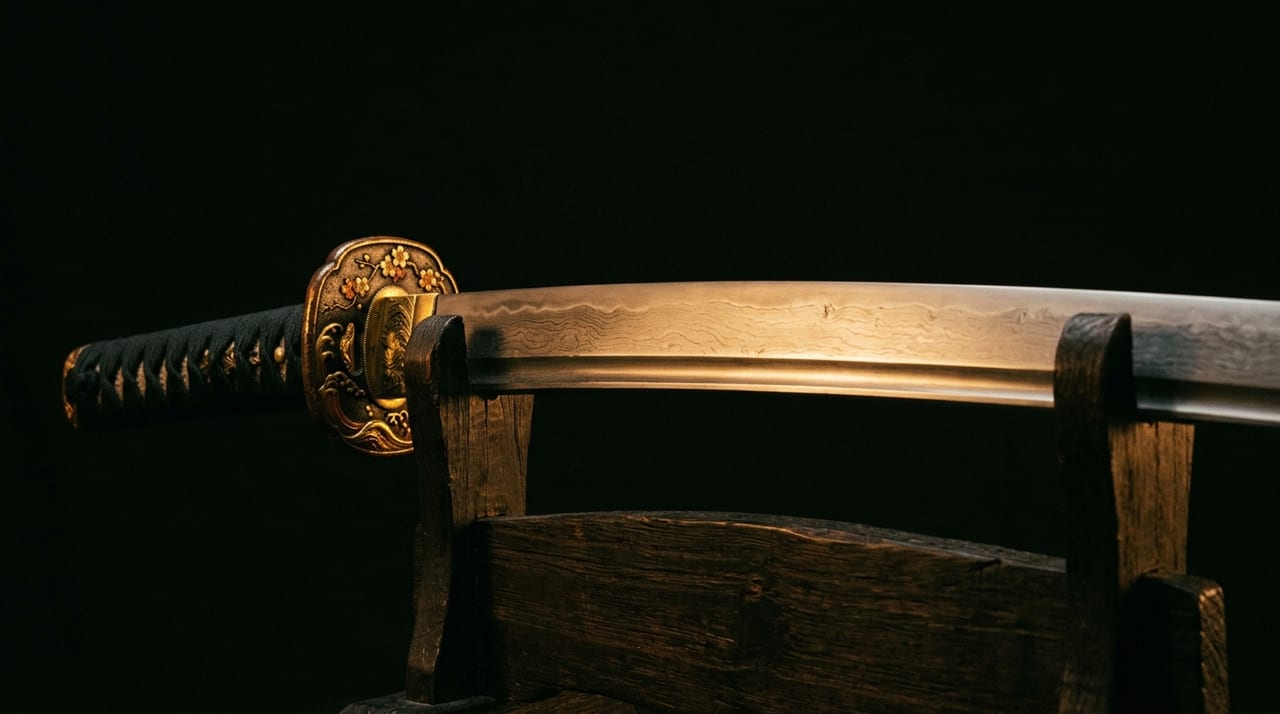
The characteristics of Gojo Kuninaga's work as Heian-period ko-to can be organized into three key aspects: jihada, hamon, and sugata.
| Item | Features |
|---|---|
| jihada (steel surface) | Tightly packed itame-skin pattern demonstrating the classical character of the Yamashiro tradition forms the foundation, with jinie (fine nie particles in the ground steel) evenly distributed in fine detail. The texture of "moist jihada" common to Heian-period ko-to is highly valued. Many expert appraisers assess that it possesses "a more classical flavor" when compared to the jihada of the Rai and Awataguchi schools. |
| hamon (blade pattern) | Based on suguha (straight blade), with small irregular patterns (komidare) mingled within, the primary style is austere and classical in character. The hardened edge is relatively narrow, with a soft and controlled nioiguchi (hamon edge). Late Heian ko-to were hardened with emphasis on nioi (subtle contrast), which differs fundamentally in aesthetic principle from the nie-based (brightly visible particle) blade patterns of the Kamakura period and beyond—a crucial point in appraisal. |
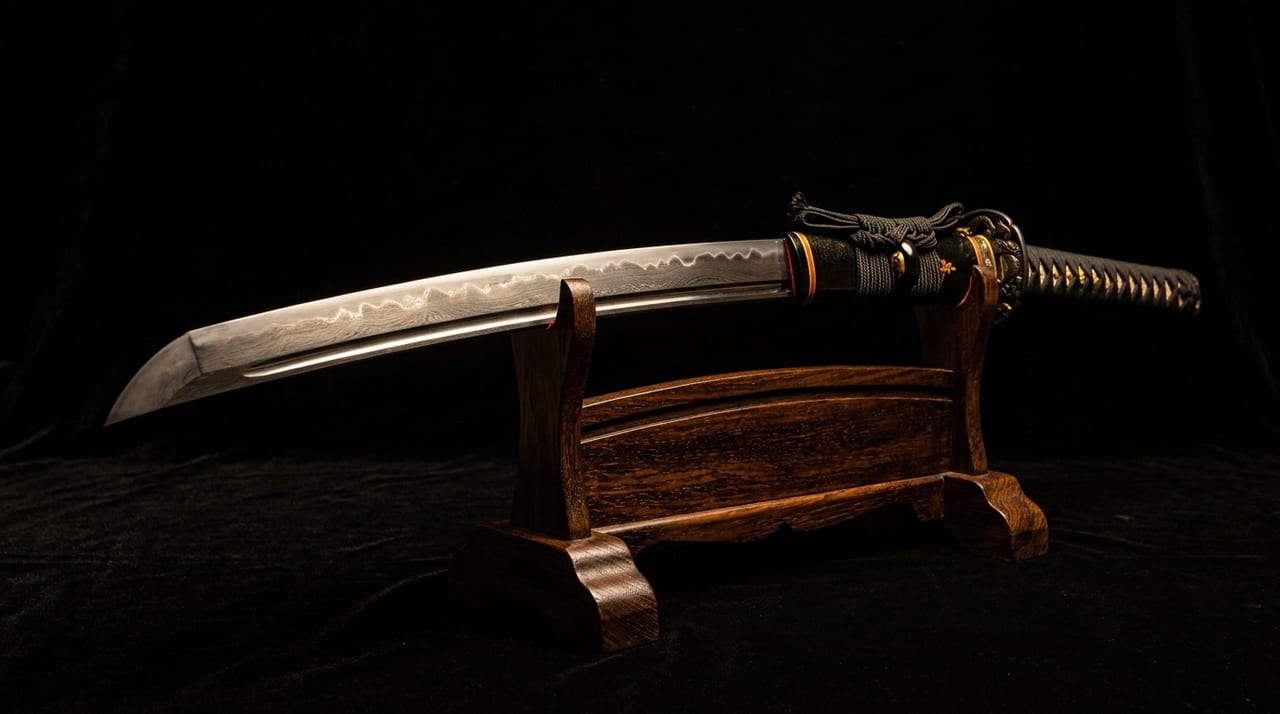
| sugata (form and bearing) | Extant Gojo Kuninaga tachi typically display the form of classical Heian-period tachi with deep koshi-zori (curvature near the hilt). Based on shinogi-zukuri (ridged construction) and iori-mune (rounded spine), they are characteristically distinguished by a "classically refined bearing" in which the blade narrows slightly from the base (moto-haba) toward the point (saki-haba). |
Extant Works and Cultural Property Designation
Because Gojo Kuninaga's works date to the ancient Heian period, the number of extant examples is limited. Most surviving examples have been transmitted through ancient temples and shrines, or major domestic museums, and many are designated as Important Cultural Properties or National Treasures.
Major institutions such as the Tokyo National Museum and Kyoto National Museum house and have on deposit Gojo Kuninaga works in their collections, with opportunities for public display in special exhibitions. With high scholarly value as among the very oldest of ko-to, his works are positioned as foundational materials for Japanese sword research.
The Lineage of Gojo Kuninaga and His Influence on Later Generations
Following Gojo Kuninaga, multiple swordsmiths were active in the Gojo area, forming a continuous lineage of the "Gojo school." The Gojo area came to be recognized as an important center of Yamashiro sword culture.
The historical significance of Gojo Kuninaga as a Heian-period swordsmith extends beyond mere technical excellence. He is evaluated as a pioneer who supplied high-quality swords during a period of social transformation marked by the rise of the samurai class, and who established the foundations of the Japanese sword as a craft with both cultural and martial dimensions.
Research and Collecting Gojo Kuninaga in the Modern Era
Authentic works by Gojo Kuninaga are today accorded the highest scholarly and cultural evaluation as among the oldest domestically produced Japanese swords. In the field of ko-to appraisal, distinguishing authentic from spurious works of the Heian and early Kamakura periods is one of the most challenging tasks, and a considerable number of works attributed to Gojo Kuninaga as "attributed works" (densho sakuhin) exist.
For sword enthusiasts and scholars, Gojo Kuninaga represents the "origin point" through which to touch the beginnings of the Japanese sword, and his beauty—a tachi of austere and refined suguha—continues to be revered in modern times as the pinnacle of appreciation and research.
Key Points to Verify When Evaluating Works by Gojo Kuninaga
When appreciating or collecting ko-to that date back to the Heian period, like those of Gojo Kuninaga, grasping several practical perspectives will deepen one's understanding.
- Verification of Appraisal Certificates: An appraisal certificate issued by NBTHK (the Public Interest Incorporated Foundation for the Preservation of Japanese Art Swords) is a document presenting expert assessment regarding dating and attribution based on the characteristics of jihada, hamon, and sugata visible on the blade surface, and serves as a crucial reference point when examining ko-to. Particularly for Heian-period works, signed pieces (zaimei—works bearing the maker's name inscribed on the blade) are rare; for unsigned tachi, attribution is often made in the form of "attributed to [maker name]," making it essential to carefully verify the reasoning presented in the appraisal certificate.
- Assessment of Preservation Condition: Tachi that have endured over long centuries may show changes in the appearance of jihada and hamon depending on their polishing history and storage conditions. It is desirable to judge how much the blade's current appearance reflects its original state based on the expert assessment of those who have examined the actual object.
- Confirmation of Provenance: Clarity regarding provenance (the history of how and where the tachi has been transmitted) is also helpful in understanding the background of the work. Works whose transmission through ancient temples, shrines, or established families is documented in records tend to be easier to examine regarding dating and origins compared to works without such documented history.
Frequently Asked Questions
Why Are So Few Works by Gojo Kuninaga Extant?: Beyond the sheer antiquity of the Heian period in which they were made, many swords have been lost or transformed over the long course of history due to fire, warfare, wear from polishing, and other factors. The fact that most surviving works have been transmitted through ancient temples, shrines, and museums is conversely a reflection of their rarity.
What Does "Attributed to Gojo Kuninaga" Mean?: In the case of Heian-period tachi, where signed works are scarce, attribution may be made based on stylistic characteristics such as jihada, hamon, and sugata to a specific swordsmith; in such cases, the work is referred to with the prefix "attributed to" (den). Since there is no definitive signature to back up the attribution, confirming the reasoning presented in the appraisal certificate is helpful in understanding the work.
To Put It in One Sentence, What Is the Difference Between the Gojo and Sanjo Schools?: As seen in this article, both schools are alike in that they were based in Yamashiro Province near Heian-kyo and developed as distinct lineages, but the detailed technical lineage between them remains an area of ongoing scholarly inquiry.