Fujishima Tomoshige and the Kaga Tradition — How Nanbokucho Sword Culture Spread Through Hokuriku
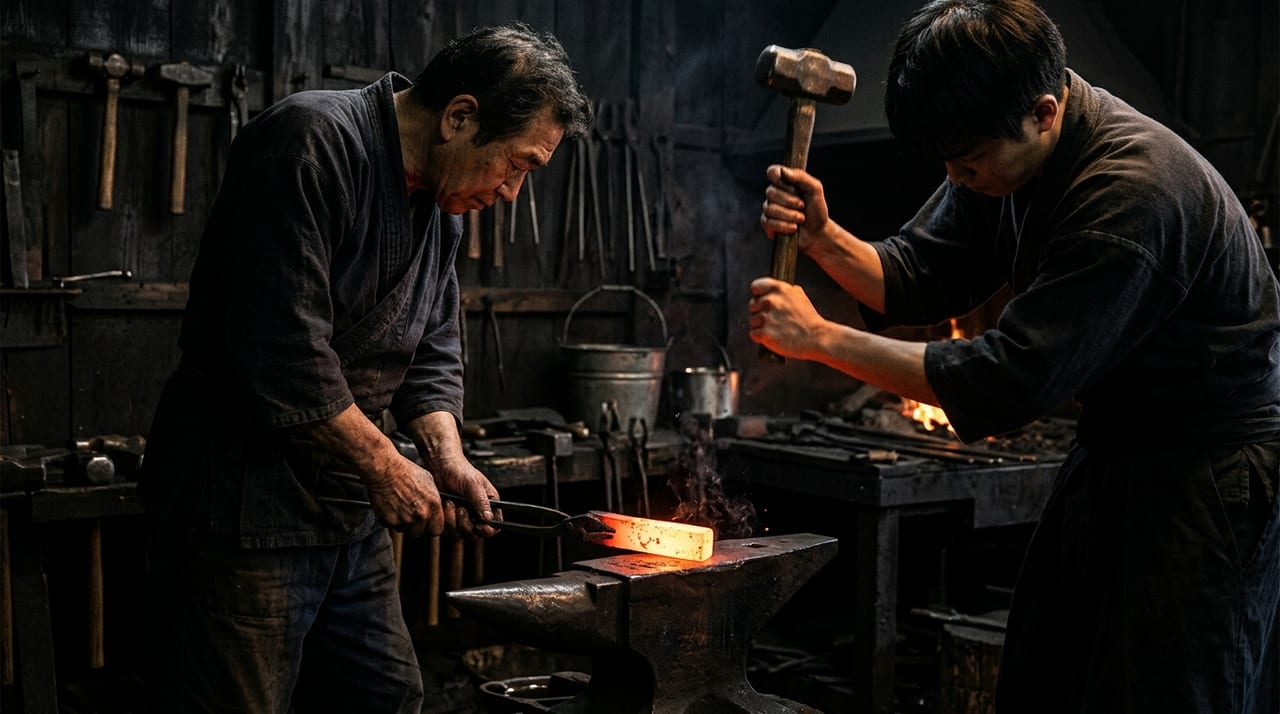 * Image is for illustrative purposes only.
Table of Contents
Fujishima Tomoshige and the Geopolitics of Hokuriku Sword Culture
Fujishima Tomoshige (ふじしまともしげ) was a swordsmith born in Fujishima, Yoshida County, Echizen Province (えちぜんのくに, present-day Fukui Prefecture) during the Namboku-chō period—roughly the mid-14th century—who relocated to Kaga Province (かがのくに, present-day Ishikawa Prefecture) and engaged in sword-making, and is remembered in Japanese sword history as the founder of the Kashū Fujishima school (the Kaga Fujishima school).
The Hokuriku region where Tomoshige was active stood geographically apart from the heartland of the "five traditions" (ごかでん)—Yamashiro, Yamato, Bizen, Sōshū, and Mino. Yet the Hokuriku provinces of Echizen, Kaga, Etchū, and Noto absorbed the central sword culture while developing their own regional sword aesthetic, which could be called the "Hokuriku tradition" (ほくりくでん).
Echizen and Kaga were connected by the overland route that had been developed since antiquity as the "Hokuriku Road" (ほくりくどう), making it a region where the movement of people, goods, and techniques was relatively easy. It is believed that this geographical continuity formed the backdrop for Tomoshige's relocation of his base from Echizen to Kaga.
To understand Tomoshige's technical influence from Echizen to Kaga, it is first necessary to grasp the turbulent historical context of the Namboku-chō period.
The Turmoil of the Namboku-chō and the Role of Hokuriku Swordsmiths
The Namboku-chō period (1336–1392) was a time of internal strife in which the Northern Court (足利方), based in Kyoto, and the Southern Court (後醍醐天皇方), based in Yoshino, were locked in conflict. This turmoil spread warfare throughout Japan, and military lords across the country required large quantities of swords.
Hokuriku—particularly Echizen and Kaga—was an important strategic location in the Namboku-chō conflict, and military commanders from both the Northern and Southern Courts moved troops through the region. This surge in demand provided a stage for Hokuriku swordsmiths to flourish and created the motivation and opportunity for provincial craftsmen like Tomoshige to produce swords comparable in quality to those of the center.
Tomoshige was a student of Rai Kunitoshi (らいくにとし) and was strongly influenced by the Yamashiro tradition (やましろでん, Rai school), and this "adoption of central technique and regional adaptation" is the essence of Hokuriku sword culture. The pattern of learning techniques in Kyoto, the sword-making capital of the center, and then returning to one's homeland or a new land to establish a school was not unique to Tomoshige, but was widespread among swordsmiths from the Namboku-chō through the Muromachi period. Tomoshige is positioned as a representative example of this pattern in Hokuriku.
Tomoshige's Sword-Making Style—Adoption of the Rai School (Yamashiro Tradition) and Kaga's Jigane
Fujishima Tomoshige's sword-making style developed from a foundation of influence from the Rai school (Yamashiro tradition), evolving into a unique style adapted to the materials, environment, and demand of the Kaga region.
Jigane (じがね):
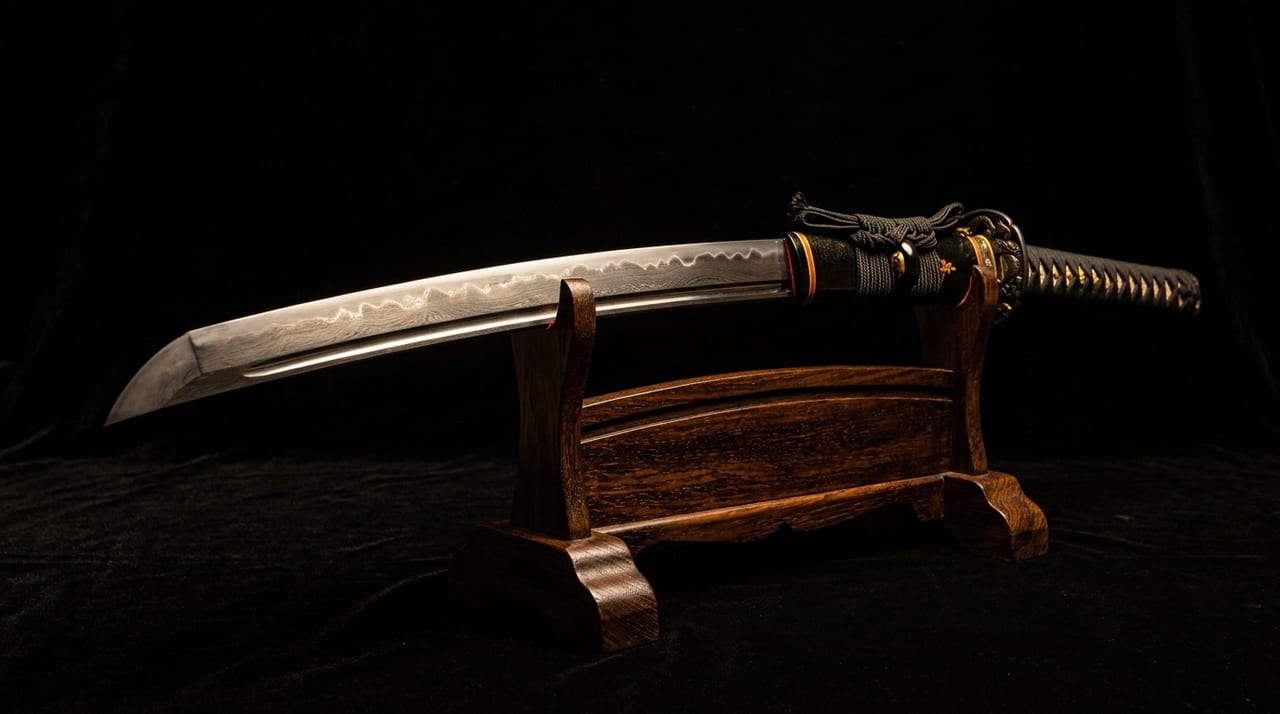
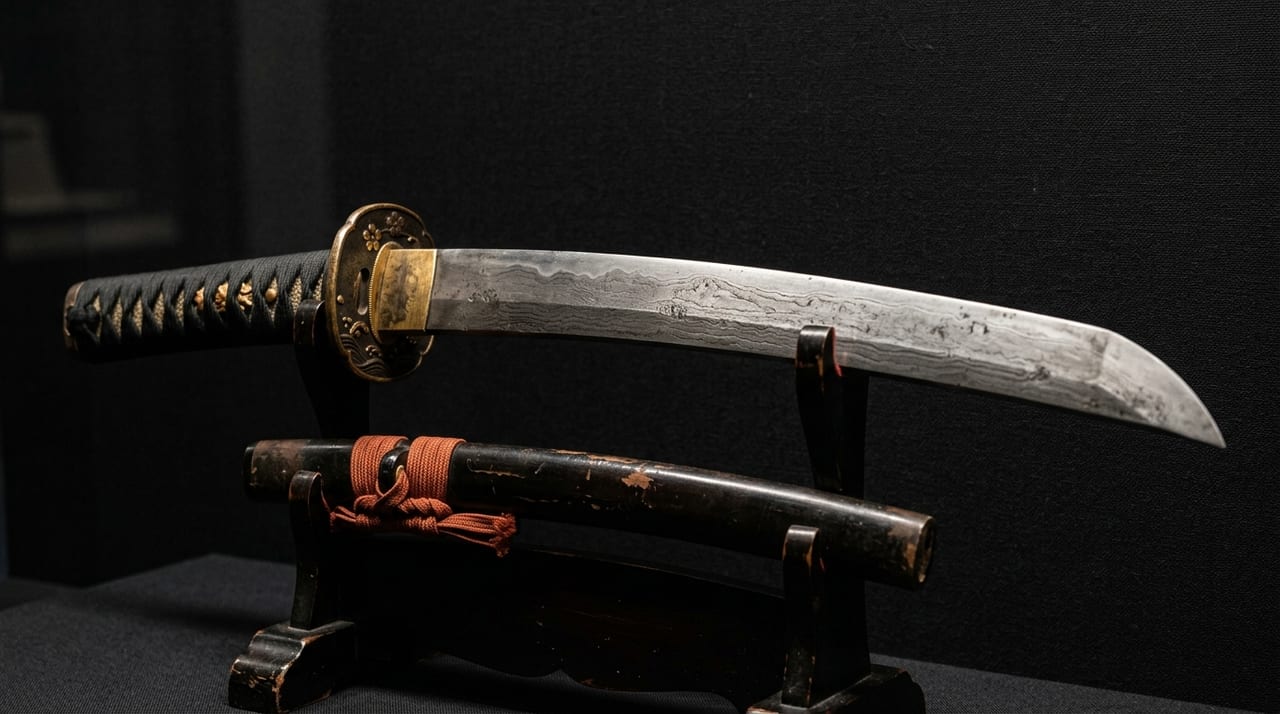
Tomoshige's jigane is based on a fine, densely packed ko-itame (こいためはだ) skin conforming to Rai school tradition, with a fine and even jinie (じにえ) throughout. The material conditions of the Hokuriku region—water, iron sand, and charcoal—impart a distinctive character to the jigane's texture, for which it is valued as jigane with "rich hataraki" (働き).
The "hataraki" of jigane is an appreciation term referring to the richness of fine detail and expression born from the forging process, such as jikei (ちけい) and jinie, and is valued not merely for having a dense skin but for the abundance of subtle variations visible when held up to light.
Hamon (はもん):
The hamon follows a basic style of dignified composition centered on small nie, characteristic of the Rai school. With a tight nioi-guchi (においぐち) and a gentle composition of finely distributed ko-nie (こにえ), it maintains a dignity distinct from the grand designs of the Namboku-chō period.
Here, "nie" refers to the granular luster visible at the boundary of the hamon, while "nioi" refers to the more subtle, mist-like luster, both appreciation terms. The Rai school style is characterized overall by a refined composition with a tight nioi-guchi.
Sugata (形姿):
During the Namboku-chō period, swords throughout the country followed a robust style of "wide body width, thin cross-section, and large kissaki" (大切先). Many of Tomoshige's tachi reflect this era's style and take a form suited to meet the practical needs of Hokuriku samurai.
Influence on the Kaga Tradition—Hokuriku Development of the Fujishima School
The sword aesthetic established by Tomoshige, born in Echizen and practicing sword-making in Kaga, took root directly in Kaga's sword-making culture. The Kashū Fujishima school, with Tomoshige as founder, was subsequently transmitted in Kaga, and records document the activity of swordsmiths of the "Kaga Fujishima" (かがふじしま) lineage.
When the Kaga domain (the Maeda house) developed as a center of daimyo culture during the Edo period, demand for Kaga swords increased, and swordsmiths descended from Tomoshige's lineage met this demand. Kaga is widely known for the development of fine arts and crafts under the protection and patronage of the Maeda house, and swords similarly benefited from the layering of regional demand and craftsman technique. This demonstrates that Tomoshige's technical legacy was transmitted in Kaga.
Tomoshige's Representative Works and Extant Pieces
Many of Fujishima Tomoshige's extant works are preserved in museums and shrines and temples in Hokuriku and Kinki. Given the age of the Namboku-chō period and the limited circulation of provincial craftsmen's works, the number of extant pieces is small.
Multiple works are designated as Important Cultural Property or Important Art Objects and are recognized as representative works of Namboku-chō Hokuriku sword culture in academic circles. Works bearing the two-character signature "Tomoshige" on the nakago are the norm, but a considerable number of unsigned works also exist, and expert appraisal is required to authenticate them as masterpieces.
Perspectives on Evaluating Extant Works
The prevalence of unsigned works is an unavoidable point in assessing Fujishima Tomoshige's pieces. In attributing unsigned tachi to Tomoshige, expert judgment is required to comprehensively assess stylistic characteristics such as jigane hataraki, hamon composition, and sugata. Through such accumulated appraisals over time, a picture of Fujishima Tomoshige's artistic style has been formed.
Modern Evaluation of Fujishima Tomoshige
Fujishima Tomoshige is evaluated as a representative of provincial swordsmiths who, standing outside the "central authority" of the five traditions, responded to the demands of the turbulent Namboku-chō period by producing high-quality swords. Tomoshige's name is sometimes invoked as one of the spiritual sources of the Hokuriku cutlery industry that continues to this day as Echizen uchihamono (えちぜんうちはもの), making him an important figure from a regional cultural history perspective. As a witness to how the craft of the Japanese sword cultivated distinct techniques and aesthetics not only in the center but in each region, Fujishima Tomoshige remains a symbol of Hokuriku sword culture.
Practical Points for Appreciating and Collecting Swords by Fujishima Tomoshige
When collecting and appreciating works by provincial swordsmiths of the Namboku-chō period like Fujishima Tomoshige, attention to several practical perspectives will deepen one's understanding.
- Authentication Documentation: Certificates of authenticity issued by authentication organizations such as the Japanese Sword and Art Cutlery Preservation Society (NBTHK) are important reference materials for authenticating signatures and identifying era and maker. It is essential to verify that the work matches the information recorded in the authentication documents (presence or absence of signature, dimensions, characteristics, etc.).
- Handling Unsigned Works: Given that a considerable number of unsigned works by Tomoshige survive, it is advisable to understand the basis on which the authentication document identifies the maker.
- Verification of Provenance (でんらい): Works with recorded provenance or transmission history serve as reference for confirming academic value. Understanding how a work has been transmitted can help deepen one's appreciation of it.
- Storage Environment: Japanese swords are sensitive to humidity and sudden temperature changes, and regular condition checks by professional polishers (とぎし) or sword dealers are recommended. Amateur maintenance should be avoided, as careless handling can damage the condition of the jigane and hamon.
These perspectives are not unique to Fujishima Tomoshige but are practical principles common to all ancient swords of the Namboku-chō period, and form the foundation for correctly understanding the historical value of the works themselves.