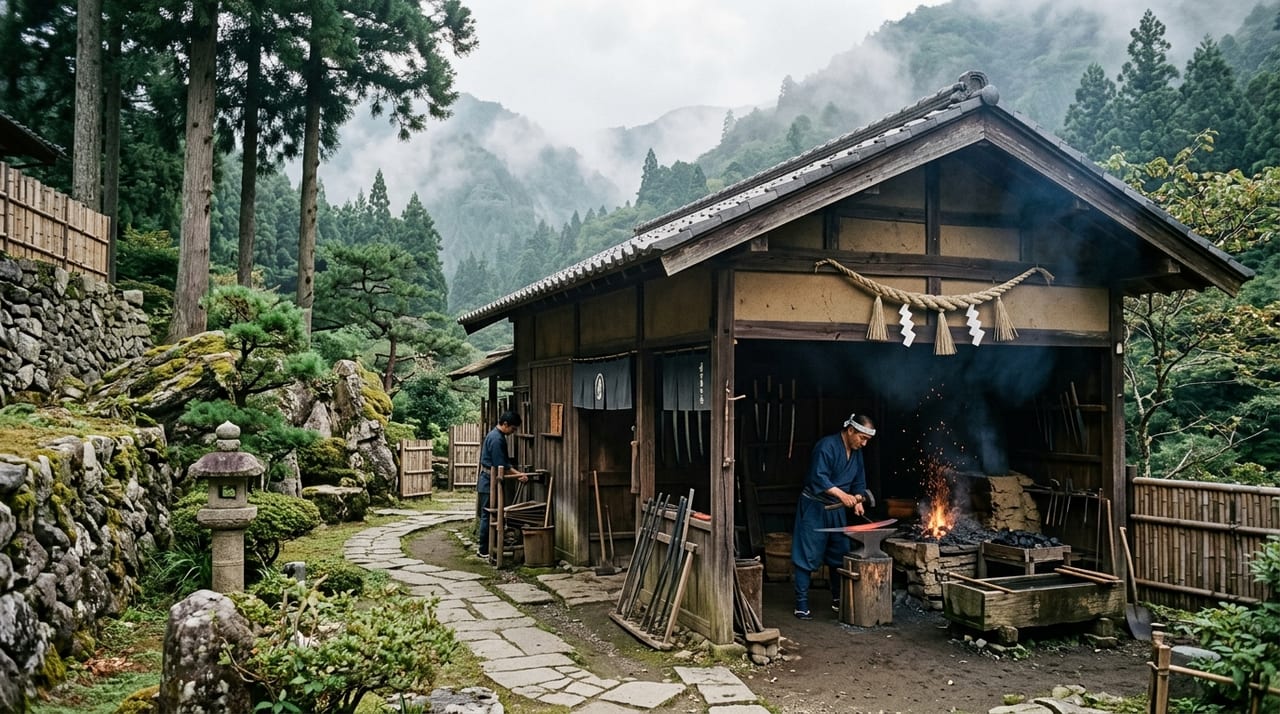
 * Image is for illustrative purposes only.
Shinshintō
新々刀
Through the 'Revival of Ancient Swords' movement championed by Suishinshi Masahide, the technical stagnation of the Shintō period was overcome and new life was breathed into the Japanese sword. The revival of the Sagami tradition exemplified by Minamoto Kiyomaro's 'Yotsuya Masamune,' and Koyama Munetsugu's meticulous recreation of the Bizen tradition—all fruits of a spirit of creative revival using ancient masterpieces as models—marked the final golden age of Japanese sword-making.
Description
Beginnings of Reform
In the late Edo period, Edo swordsmith Suishinshi Masahide published works such as Tōken Jitsuyō-ron and argued that the technical stagnation of Japanese swordmaking could be overcome by researching and reproducing the forging methods of the kotō that had been lost in the Shintō period. Masahide pointed out that the steel of Shintō swords was inferior to that of the kotō, and he set as his goal the reproduction of the nioi-deki hamon and the beautiful utsuri found in the Bizen tradition of the kotō. This ideology of kotō fukko ("revival of ancient swords") had a great impact on the sword world, drew many supporters and disciples, and marked the dawn of the Shinshintō era.
A Return to Kotō
Masahide's own works feature hamon ranging from suguha to gunome-midare, based on nioi-deki in the Bizen tradition, and he pursued the reproduction of a deep kitae-hada reminiscent of the jigane of the kotō. In addition to researching forging methods, Masahide focused on iron refining and repeated experiments to obtain steel close in quality to that of the kotō period. His scholarly attitude was closer to that of a researcher than a swordsmith, and it has had a great influence on later sword studies.
New Techniques
Among Masahide's senior disciples, the one who displayed the most diverse talent was Taikei Naotane. Naotane mastered everything from tōran-midare, which he learned by following his master, to the Bizen tradition and further to the Sōshū (Sagami) tradition. He showed a wide range of styles, from the chōji-midare of the Bizen tradition to the nie-deki of the Sōshū tradition. Together with his master Suishinshi Masahide and Minamoto Kiyomaro, he is counted among the "Three Masters of Edo" (Edo Sansaku).
Notable Swordsmiths
The smith who holds an unshakable reputation as the pinnacle of the Shinshintō period is Minamoto Kiyomaro. Kiyomaro was born into the Yamaura family in Shinano Province (Nagano Prefecture), and together with his elder brother Yamaura Masao, he entered the path of the swordsmith. Going to Edo and setting up a forge in Yotsuya, Kiyomaro thoroughly studied famous works of the Sōshū tradition, including those of Masamune, and magnificently revived the nie-deki hamon. His swords displayed a quality approaching that of the kotō Masamune and Sadamune, from the forging of the jigane to the brilliance of the hamon, and he was given the nickname "Yotsuya Masamune."
Creation of Style
The distinctive features of Kiyomaro's work lie in a powerful jigane of itame mixed with mokume and a dynamic hamon in which deep nie-deki, gunome-midare, yubashiri, kinsuji, and sunagashi intertwine in complex ways. In particular, the size and brightness of the nie grains recall the characteristics of Masamune, and the scenery within the blade changes senpen-banka depending on the angle of viewing. Kiyomaro's swords are a miraculous body of work that is Shinshintō yet possesses the dignity of the kotō, and all surviving works are highly regarded. However, Kiyomaro took his own life on 2 January 1855 (the 14th day of the 11th month of Kaei 7), at the age of forty-two. He is said to have been a considerable lover of sake, and it is also said that he despaired because sake poisoning had made him unable to forge swords, but his premature end is still lamented today.
Influence and Development
Koyama Munetsugu is a renowned smith who reproduced the Bizen-tradition chōji-ba with extreme precision. Munetsugu's chōji-midare has uniform grains and a neat hamon with a tight nioiguchi, and it has a dignity in keeping with the work of the kotō smiths Osafune Nagamitsu and Kagemitsu. Munetsugu also studied under Chōunsai Tsunatoshi, aimed for sharp and beautiful blades, and is said to have had dealings with the sword tester Yamada Asaemon and others.
Nankai Tarō Chōson was a native of Tosa (Kōchi Prefecture) who was active mainly in Kyoto. He was a swordsmith who, in agreement with Masahide's theory of reviving ancient swords, trained many disciples, and he is known for the fact that Takechi Hanpeita owned one of his swords. Chōunsai Tsunatoshi received high regard for his finely executed Bizen-tradition hamon. Gassan Sadayoshi came from the Dewa Gassan smiths, and in the late Bakumatsu period he moved to Osaka, where he preserved a distinctive forged surface called ayasugi-hada, which resembles the grain of cedar. As the founder of the Osaka Gassan school, he passed the technique on to later generations. Sa Yukihide was from Chikuzen, became a domain smith of Tosa, and was a capable smith who forged long and imposing blades. Yamauchi Yōdō described him as "Imayō Masamune," and he holds the nickname "Tosa Masamune."
The Shinshintō period saw the various schools compete under the ideal of kotō fukko, and it enjoyed the last golden age of Japanese sword forging. The Haitōrei (Sword Abolishment Edict) of 1876 (Meiji 9) banned the wearing of swords and brought this brilliant era to a close. However, the spirit of "a return to antiquity" and "new creation" pursued by the Shinshintō smiths continues to be handed down to modern swordsmiths. Compared with the kotō, the Shinshintō have more surviving examples, and many of them are in good condition. For collectors, this makes them an attractive field: they are relatively easy to acquire while still offering a taste of the kotō aesthetic.
Characteristics of This Era
- The "kotō fukko" ("revival of ancient swords") movement advocated by Suishinshi Masahide formed the ideological foundation of the Shinshintō era. He studied and reproduced the forging methods of the kotō that had been lost during the Shintō period, pursuing the revival of nioi-deki hamon and utsuri. His scholarly approach also had a major influence on later sword scholarship
- Minamoto Kiyomaro's magnificent revival of the Sōshū tradition's powerful nie-deki. Over a forceful jigane of itame mixed with mokume, the hamon, in which kinsuji, sunagashi and yubashiri intricately intertwine, recalls Masamune. It holds an unshakable reputation as the supreme achievement of the Shinshintō
- Koyama Munetsugu's extremely refined reproduction of chōji-midare in the Bizen tradition. Its even grains and tightly drawn nioiguchi show a dignified quality comparable to Osafune Nagamitsu and Kagemitsu. He aimed for beautiful swords with a keen cutting edge
- A broad range of skill, from tōran-midare to the Bizen and Sōshū traditions, as represented by Taikei Naotane. Many outstanding smiths emerged who took the ancient traditions as models and displayed diverse styles
- An innovation in iron refining techniques aimed at forging jigane that approached that of the kotō. Masahide repeated refining experiments to obtain iron quality close to that of the kotō period, and his study of forging methods vastly deepened the scientific understanding of swords
- A profusion of diverse styles pursuing both practicality and artistic beauty. Schools aspiring to revive the Bizen, Sōshū, Yamashiro and Yamato traditions competed with one another, forming the final golden age of Japanese sword forging
- The activity of domain smiths (hankō) became lively. Hizen, Satsuma, Tosa, Kaga, Sendai and other domains each retained skilled smiths, and famous swords were forged to uphold each domain's prestige
- The Haitōrei (Sword Abolishment Edict) of 1876 (Meiji 9) banned the wearing of swords, and this glorious era came to a close. However, the spirit of the Shinshintō has been passed down to modern smiths, and the ideal of kotō fukko continues to live on today