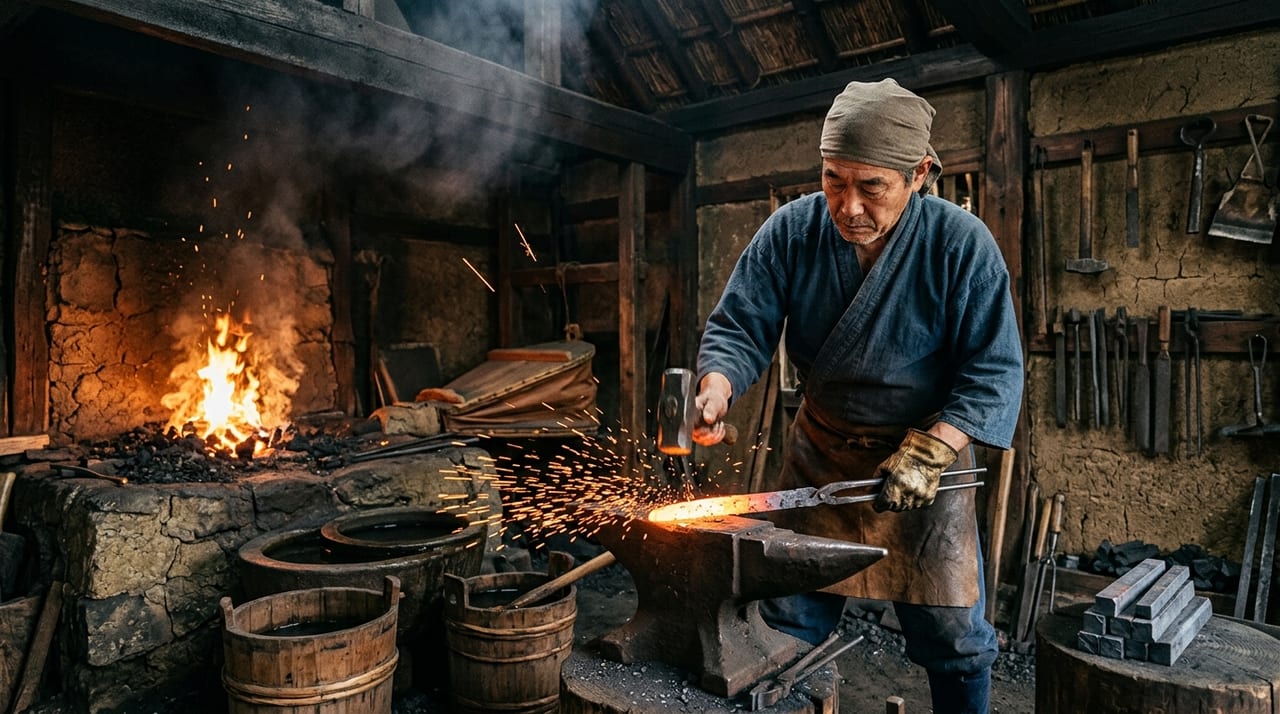
 * Image is for illustrative purposes only.
Hōki no Kami Masayuki
伯耆守正幸
Description
Hōki no Kami Masayuki was a swordsmith active in Satsuma Province (present-day Kagoshima Prefecture) during the Shinshintō period of the late Edo era. His family name was Ijichi, and he worked as a retained smith of the Shimazu clan, lords of Satsuma. Together with his contemporary Oku Motohira, he was praised as one of the "two pillars" of Satsuma Shinshintō swordsmithing, and is credited with restoring the reputation of Satsuma blades.
Lineage
Masayuki was born the son of Ijichi Masayoshi (the second generation), inheriting a Satsuma swordsmithing house. Satsuma had long supported forging groups such as the Naminohira school, but with the appearance of Masayuki and Oku Motohira the province became a nationally recognized center of production in the Shinshintō era. In the twelfth month of 1789, on the same occasion that Oku Motohira received the title Yamato no Kami, Masayuki was granted the title Hōki no Kami. His later blades bear signatures such as "Satsuma no Kuni Hōki no Kami Ason Masayuki."
Style
His work shows strong influence from the Sōshū tradition, with a robust construction featuring a broad mihaba and thick kasane. The curvature tends to be shallow with an extended kissaki, producing a sturdy shape clearly intended for practical use. The hamon combines notare with gunome, with deep and coarse nie, and the interior of the blade shows sunagashi and kinsuji activity. The jigane is a well-forged itame covered with thick jinie, giving the surface a powerful appearance.
Frequently mounted in the distinctive Satsuma koshirae, his blades were valued as practical weapons, and their unyielding character — bound up with the martial culture of Satsuma such as the Jigen-ryū school of swordsmanship — made them widely favored among samurai of the late Edo period.
Reputation
Masayuki worked prolifically through the Kyōwa, Bunka, and Bunsei eras, and his blades sustained the fame of Satsuma swords until the end of the Edo period. Many surviving works have passed formal appraisal as Tokubetsu Hozon Tōken and above, and he is regarded as one of the leading provincial masters of the Shinshintō period — an indispensable figure alongside Oku Motohira in any account of the Satsuma tradition.
Famous Works
- 刀 銘 薩摩国伯耆守朝臣正幸(特別保存刀剣)