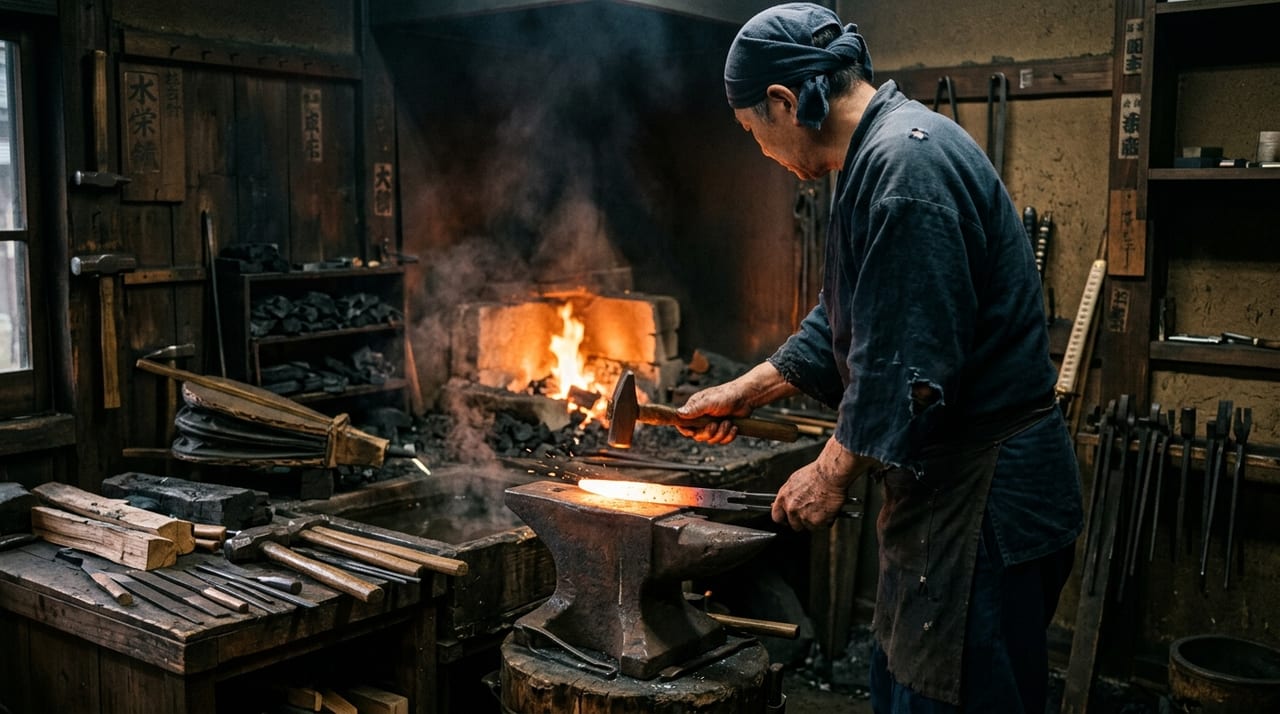
 * Image is for illustrative purposes only.
Koyama Munetsugu
固山宗次
Description
Koyama Munetsugu was born in Kyowa 3 (1803) in Shirakawa, Mutsu Province (present-day Fukushima Prefecture) and was a prominent swordsmith representing the shinshintō (new new sword) period of the late Edo era. His common name was Sōbei, and he also used the pseudonyms Issensai and Seiryōsai. The Koyama family were hereditary sword-smiths; his elder brothers Koyama Munehira and Koyama Munetoshi were also known as smiths, forming the Koyama school with strong ties to Shirakawa. Munetsugu eventually traveled to Edo and sought instruction under the renowned smith Katō Tsunahide, but at that time Tsunahide had already fallen ill and withdrawn from practice, so instead he studied sword-forging under Tsunahide's younger brother, Chōunsai Tsunatoshi. He moved his workshop between Shirakawa, Kuwana, and Edo during the Bunsei and Tenpō eras, and by around Tenpō 8 (1837) he had been taken on as a retained smith of Kuwana Domain. In Kōka 2 (1845), he received the title Bizen no Suke, established his residence in Samonchō, Yotsuya, and became an influential figure in the late Edo period sword world.
His style is renowned for his mastery of the Bizen tradition, and he is evaluated as the foremost master of the Bizen tradition during the shinshintō period. What he excelled at most was forging beautiful, tightly packed ko-itamehada steel with splendid choji-midare featuring vivid nioi-dekite and tight nioi-guchi, and he took as his signature achievement the bright appearance without ara-nie on the blade edge. The models Munetsugu took were the Bizen masterworks such as those of Fukuoka Ichimonji and Osafune that flourished during the Kamakura period, and the core of his creation lay in recreating the splendid qualities of these Kamakura Bizen works—characterized by kawazuko-chōji, reversed choji, and midare-utsuri—using shinshintō-quality steel. In his early works there appear many varied and splendid choji-midare; from around the Kaei era he crafted gunome-chōji with aligned heads; and in his later years he worked continuous gunome, showing stylistic evolution according to period.
Munetsugu's swords were highly evaluated not merely for their observational beauty but also as practical cutting swords. He associated with sword testers such as Yamada Asaemon, and many of his blades survive bearing saidan-mei (inscriptions recording the results of test cuts).
His reputation ranks among the foremost of shinshintō smiths, and he was a central figure of the Koyama school as a foremost master of the Bizen tradition of the late Edo period. It is said he continued forging even after entering the Meiji period, although there remain unclear points in his dates; the works he left behind are revered today as demonstrating the culmination of Bizen tradition's revival.
Famous Works
- Ōsasaho yari (copy of Tonbokiri, Tokyo National Museum collection)