Analyzing Representative Works by Koyama Munetsugu—A Complete Guide to Reading Mei Catalogues and Authenticity Indicators
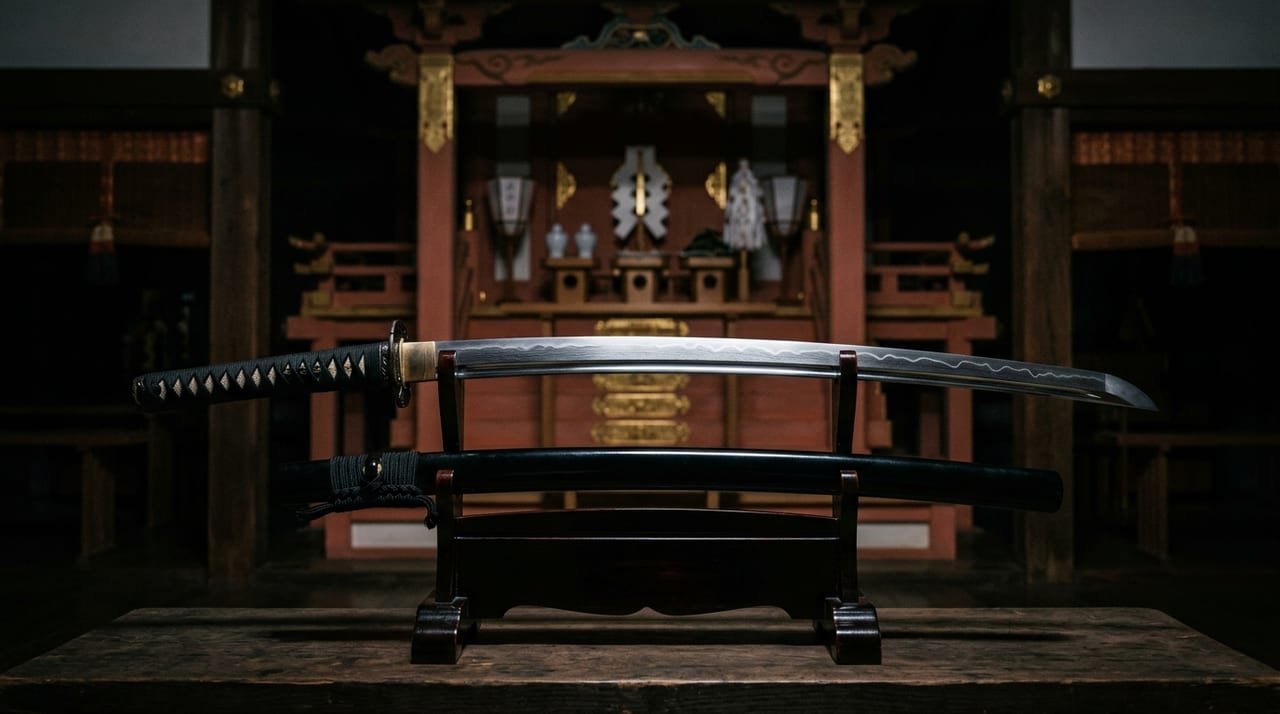 * Image is for illustrative purposes only.
Table of Contents
Viewing Koyama Munetsugu's Works Correctly—Why Authenticity Problems Arise
Koyama Munetsugu (born Kyōwa 3 / 1803, year of death unknown) was a pinnacle of the shinshintō period, hailed in Bakumatsu-era Edo as "the finest swordsmith of the Kantō region." Yet precisely because of his outstanding reputation, it is also a fact that many blades with false signatures (gimei-tō) were made in later times.
Blades signed "Koyama Munetsugu" regularly appear on the sword market, but they include genuine works, blades with signatures added later, works by other smiths bearing his forged signature, and imitations. This article explains the characteristics of Koyama Munetsugu's representative genuine works and provides practical indicators for reading mei catalogues (meikan) and judging authenticity.
Koyama Munetsugu's Career and Forging Periods
Accurately grasping Koyama Munetsugu's forging periods is the first step in judging authenticity.
Early period (Bunka–Bunsei eras, roughly the 1810s–1820s): He trained under his master Chōunsai Tsunatoshi (a disciple of Suishinshi Masahide) and explored his own techniques. Signatures from this period are written in fine, neat characters. Middle period (Tenpō–Kōka eras, 1830s–1840s): His peak, when his style was established. This is when the characteristics of his hamon appear most typically. Late period (Kaei–Ansei eras, around 1848–1854): He continued working into his final years, though some works are said to show a decline in physical strength.
Caution: Many blades bear the "Koyama Munetsugu" signature, but not all of them are his own work. One must always keep in mind the possibility that disciples or successors used the same name, as well as the possibility of forged signatures added in later times.
Koyama Munetsugu's Nakago Mei—Reading the Script Patterns
The first point in distinguishing genuine works is the script of the tang signature. Koyama Munetsugu's signatures have the following characteristics:
Character style:
- Many are inscribed "Koyama Munetsugu saku" (固山宗次作). The way the character "saku" (作) is written has quirks peculiar to Koyama Munetsugu
- The way the 宀 (ukanmuri) radical of "宗" is brushed and the direction of the final hook of "次" are identifying points
- The Hon'ami family's mei catalogue (ko-meikan) contains rubbings (takuhon) of Koyama Munetsugu's signatures, and comparison with these is the basis for judging authenticity
Chisel work: Genuine signatures show the distinctive depth and variation in pressure of hand engraving. Forged signatures often show a depth that is too uniform or, conversely, unnatural irregularity.
Presence or absence of a date: Some of Koyama Munetsugu's works bear a date (nenki) and some do not. Dated works read "Tenpō [year]," "Kaei [year]," and so on. If a date is present, check that it is consistent with his career.
Koyama Munetsugu's Hamon—Representative Patterns
The hamon patterns most often seen in Koyama Munetsugu's genuine works are as follows.
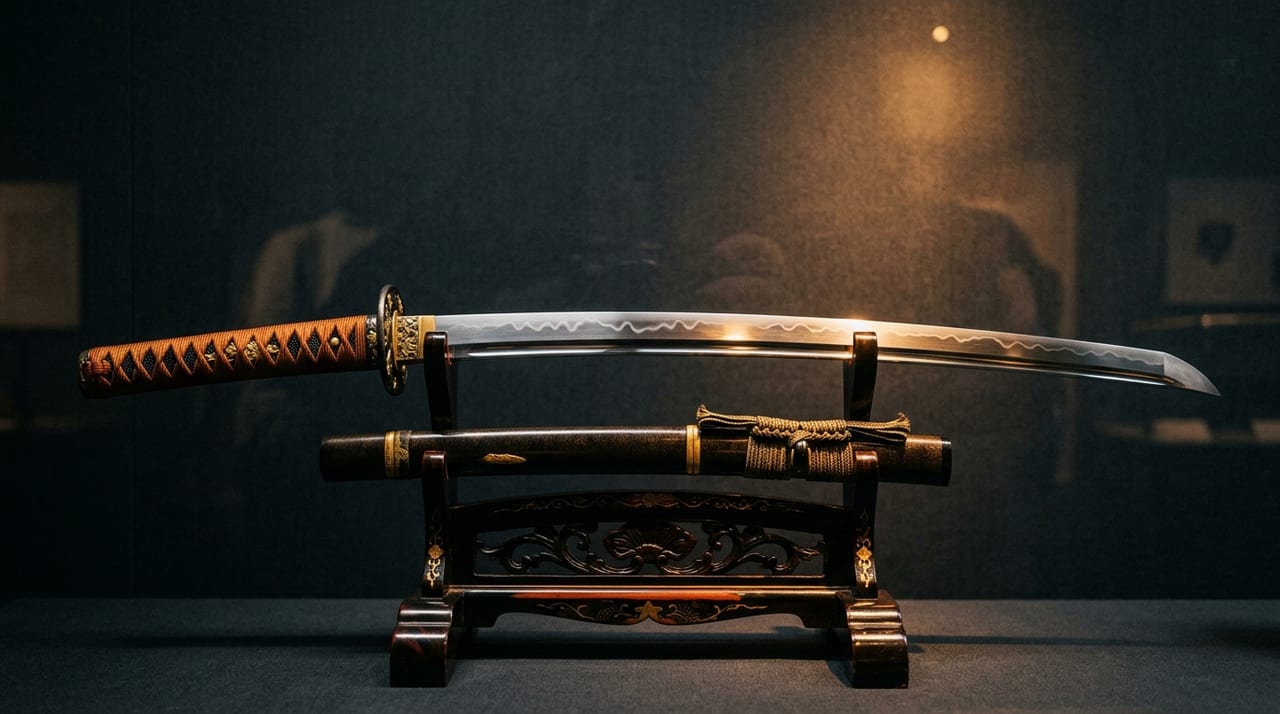
Most common pattern: Bizen-tradition gunome-chōji Many of Koyama Munetsugu's representative works are built around the brilliant gunome-chōji of the Bizen tradition. It may look simple, but its quality is high:
- The habuchi (edge boundary) is clear, with fine, uniform nie
- Ashi and yō are richly active
- The bōshi is ko-maru with a deep turn-back
Next most common: gunome-midare Inheriting the influence of the patriarch Suishinshi Masahide's return to the Sōshū tradition, there are also works that attempt gunome-midare:
- Strong nie with a clearly defined hamon outline
- Long ashi reaching into the edge
- Bright ground steel with rich activity
Rare pattern: attempts at hitatsura Koyama Munetsugu is said to have experimented in part with the hitatsura that the patriarch Suishinshi Masahide pursued, though these are said not to reach the same level of completion.
Koyama Munetsugu's Jigane—Points for Identification
The quality of the ground steel shows a smith's skill plainly. Characteristics of Koyama Munetsugu's jigane:
Type of hada: Ko-itame, tightly forged and uniform. As is characteristic of the shinshintō period, the ground steel looks somewhat bright. Chikei: The chikei are relatively orderly. Violently active chikei are rare in Koyama Munetsugu's genuine works. Quality of nie: Fine nie spread evenly, with few coarse nie—the gentle nie typical of the Chōunsai Tsunatoshi line.
"Bright, clear ground steel" is one of the core elements of Koyama Munetsugu's reputation. If a blade signed Koyama Munetsugu has dark, murky ground steel, suspicion that it is not genuine grows stronger.
NBTHK Appraisal Records for Koyama Munetsugu
Several works by Koyama Munetsugu have passed examination by the NBTHK (Nippon Bijutsu Tōken Hozon Kyōkai), and some have been designated Important Swords (Jūyō Tōken). Typical entries on the certificates:
| Item | Typical entry |
|---|---|
| Type | Katana (occasionally wakizashi) |
| Signature | Koyama Munetsugu saku / sometimes with a date |
| Period | Late Edo period |
| Province | Musashi |
| Assessment | Highly regarded as a master of the shinshintō period |
Few of Koyama Munetsugu's works have reached "Especially Important Sword" (Tokubetsu Jūyō) status. Important Sword is the highest rank most commonly seen for his genuine works.
Distinguishing Genuine Works from Forged Signatures—A Practical Checklist
Practical checkpoints when you have a blade signed Koyama Munetsugu in front of you:
- NBTHK certificate: The first thing to check. Tokubetsu Hozon or higher is ideal; even Hozon provides a certain level of proof
- Signature script: Compare with the rubbings in the old mei catalogues. Be wary of signatures that are too uniform or too rough
- Consistency of the hamon: Does it match Koyama Munetsugu's typical patterns (Bizen-tradition gunome-chōji or gunome-midare)?
- Brightness of the ground steel: Koyama Munetsugu's ground steel is bright. Dark, murky ground steel is out of character
- Bōshi: Ko-maru to chū-maru with a deep turn-back. A widely irregular bōshi is atypical
- Rust color of the tang: Is the patina appropriate for a late Edo blade (reddish brown to blackish brown)?
Market Value of Koyama Munetsugu's Works—Price Guidelines
Price ranges for genuine Koyama Munetsugu works on the current sword market:
| NBTHK rank | Typical price range (good condition) |
|---|---|
| Tokubetsu Jūyō Tōken | ¥3,000,000 to ¥10,000,000 or more |
| Jūyō Tōken | ¥1,000,000–¥5,000,000 |
| Tokubetsu Hozon Tōken | ¥400,000–¥1,500,000 |
| Hozon Tōken | ¥150,000–¥500,000 |
An uncertified blade should be viewed as a "potential investment" that includes research and examination costs; paying a large sum before authenticity has been confirmed is not recommended.
Conclusion—Evaluating Koyama Munetsugu Correctly
To understand and evaluate Koyama Munetsugu's works correctly, three things are indispensable: the mei catalogues (meikan), the NBTHK appraisal system, and knowledge of Sōshū-tradition techniques. The genuine works of a swordsmith hailed as "the finest of the Kantō region" in the turbulent Bakumatsu period are cultural assets that should be passed on to future generations under proper appraisal and evaluation.
Collectors and enthusiasts seeking works by Koyama Munetsugu are strongly advised to start with pieces already certified by the NBTHK. A large investment in an uncertified piece should be made only after properly assessing the risk of a forged signature.