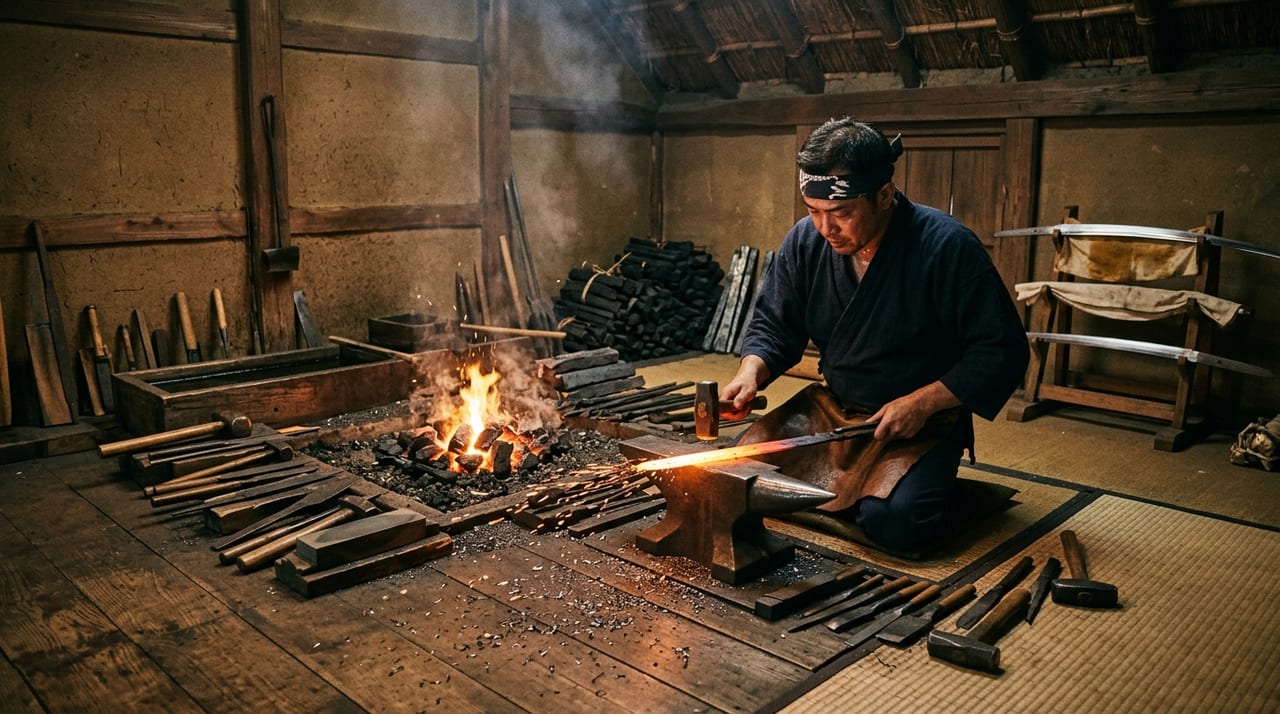
 * Image is for illustrative purposes only.
Fujiwara Kiyondo
藤原清人
Description
Fujiwara Kiyondo was a swordsmith active from the closing years of the Edo period into the Meiji era; his personal name was Saitō Kiyondo. A senior disciple of Minamoto Kiyomaro — the brilliant smith known as the "Masamune of Yotsuya" — he is regarded as the foremost inheritor of his master's style after Kiyomaro's death.
Apprenticeship and His Master
Born in 1829, he began his career as a village blacksmith. In 1852 he entered the workshop of Minamoto Kiyomaro in Yotsuya, Edo. Kiyomaro took his own life two years later, so the period Kiyondo spent studying under him was short.
Yet on his master's death, Kiyondo — the only disciple who remained — hurried to the scholar of national learning Saitō Masamaro, a close friend of Kiyomaro, to help settle his master's affairs. He is said to have taken on every outstanding commission Kiyomaro had accepted but left unfulfilled, cleared nearly all the debts his master had incurred, and supported the bereaved family. This act of loyalty has been handed down as one of the notable episodes in Japanese sword history.
Style
His principal idiom was the Sōshū tradition inherited from his master: a robust sugata with broad mihaba and extended bōshi, tempered with strongly nie-laden notare and gunome-midare. Kinsuji and sunagashi work vigorously within the hamon, closely reflecting Kiyomaro's manner. He also left blades imitating the masame forging of the Yamato Hōshō school, demonstrating a technical range across several traditions.
Title and Later Years
In the sixth month of 1867 he traveled to Kyoto and received the title Buzen no Kami. In his later years he settled in Shōnai in Dewa Province (around present-day Tsuruoka City, Yamagata Prefecture), and blades signed "Shōnai jū Buzen no Kami Fujiwara Kiyondo" are known.
Reputation
He occupies a distinct position even among the smiths of the Kiyomaro school. His works are registered in Japan's Cultural Heritage Online database and are held in collections including the Tokyo Fuji Art Museum, while local commemoration continues through special exhibitions such as those held at the Chidō Museum in Shōnai.
Famous Works
- 刀 銘 藤原清人(文化遺産オンライン登録)
- 刀 銘 荘内住豊前守藤原清人