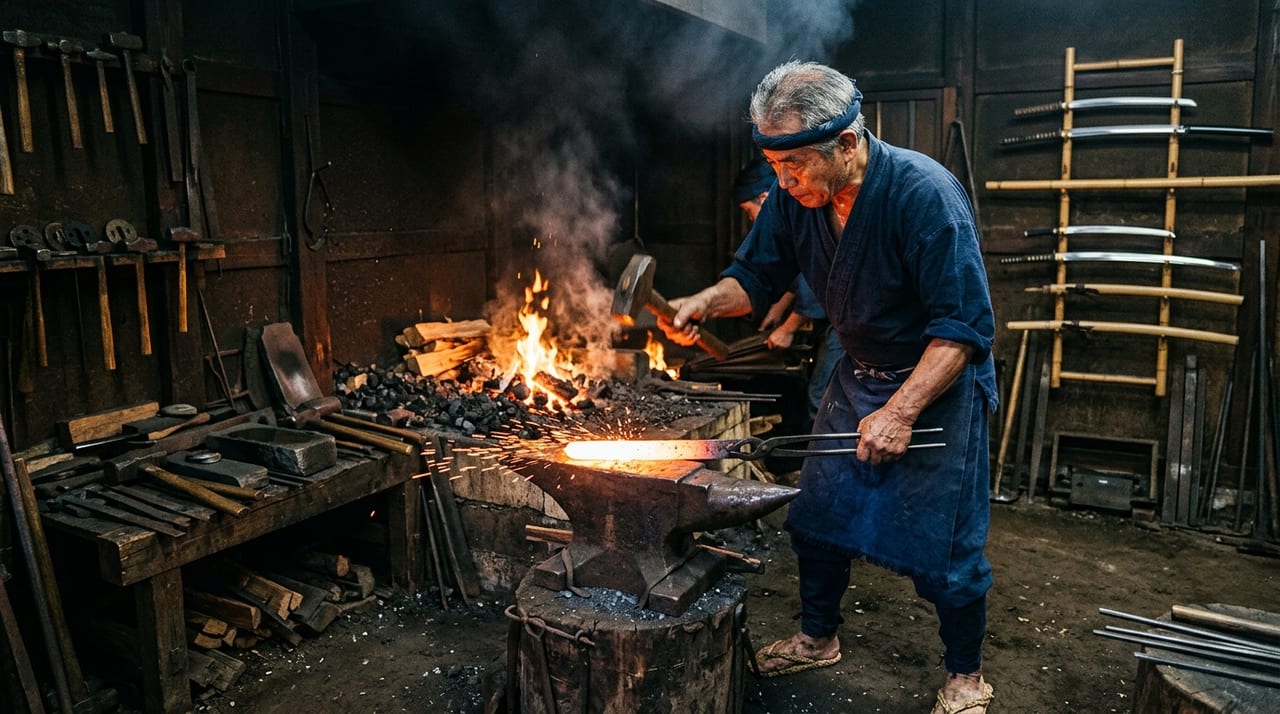
 * Image is for illustrative purposes only.
Hankei
繁慶
Description
A Heterodox Smith: From Gunsmith to Master Swordsmith
Hankei (also read Shigeyoshi) was a shintō-period smith active from the Momoyama period into the early Edo period, and he is an extremely unusual figure in the history of Japanese swords in both his origins and his style. He is said to have been a gunsmith from Mikawa Province, and his career began with making weapons as an artisan before he later moved into forging Japanese swords. As a gunsmith he used the name Kiyotaka; as a gunsmith in the service of Tokugawa Ieyasu and Hidetada, he made matchlock guns at Sunpu, and later he switched to sword-smithing and changed his name to Hankei.
Much about Hankei's birth and death years and his detailed career remains unknown, but a matchlock gun made by Kiyotaka and dated Keichō 16 (1611) survives at the Tokugawa Art Museum. After Ieyasu's death in Genna 2 (1616), he moved to Edo and mainly made swords. His original surname was Ono and his common name was Noda Zenshirō; he signed his swords "Hankei." As a shintō-period smith, he is said to have studied the Sōshū tradition (Norishige of Etchū), but in fact he developed an original style that does not fit within any single school, and in this respect too he is a figure worthy of the label "heterodox."
A Style Inspired by Norishige
Hankei's style is said to have been modeled on that of Norishige of Etchū. The sword at the Tokyo National Museum, designated an Important Cultural Property, is a typical work of Hankei and is considered the finest among his works. The forging shows ō-itame skin that flows, with ji-nie and frequent chikei; the hamon is notare mixed with gunome, with sunagashi and kinsuji appearing, deep nioi, and abundant ko-nie. The bōshi is irregular, turning back and sweeping vigorously.
Bold Form: Swords of Presence
Hankei's swords stand out for their boldness not only in the hamon but in the overall form of the blade. Many of his works have a sense of mass, emphasizing even further the bold form of the so-called Keichō shintō, which is based on a broad mihaba (blade width) and thick kasane (blade thickness).
The jigane (base steel) shows a distinctive skin pattern of flowing ō-itame, with abundant ji-nie, and a rough, lively energy covers the whole. His mastery of handling iron, characteristic of a former gunsmith, brings a distinctive momentum to the forging of the jigane.
Gunsmith Knowledge: Innovation Born from Another Field
To understand the source of the innovation in Hankei's sword-making, his origin as a gunsmith cannot be ignored. In making matchlock guns, smiths are required to manage a different kind of precision and strength than in making swords. The techniques of quenching and tempering the barrel (iron tube), the technique of combining irons of different hardness, and a deep understanding of iron's properties in withstanding the explosive pressure of gunpowder — it is highly likely that these experiences were put to use in Hankei's sword-making.
The matchlock gun held by the Tokugawa Art Museum, made under the name Kiyotaka and dated Keichō 16 (1611), is a barrel forged by layering Shisō iron from Harima in three layers, and it was passed down to Tokugawa Yoshinao, the first head of the Owari Tokugawa family, as one of the items from Ieyasu's estate distributed at Sunpu (Sunpu o-wakemono). In terms of innovation brought about by knowledge from another field, Hankei is also an intriguing figure in the history of Japanese craftsmanship.
Hankei's Reputation: Synonym for Bold Beauty
Hankei's surviving swords are not especially numerous, but his distinctive style earns him high popularity among sword enthusiasts. Where the swords of ordinary master craftsmen are valued for "dignity," "precision," and "balance," Hankei's swords are described with "boldness," "distinctiveness," and "force." This difference in evaluation clearly shows the difference in the direction of beauty that Hankei's swords aim for, and in understanding the diversity of beauty in Japanese swords, Hankei is indispensable.
Works by Hankei designated as Important Cultural Properties include one sword at the Tokyo National Museum and two swords at Kongō Sanmai-in on Mount Kōya. The signatures on the tang (nakago) are mostly large and vigorous in script, and the style of the blade and the script of the signature match, giving a bold impression.
Hankei's Spirit and Toukenza
The beauty of the "heterodox" that Hankei embodies is an important testament to the richness of the world of Japanese swords. Being born into a family of orthodox smiths and becoming a master through formal training is not the only path in the history of Japanese swords. Hankei's life — mastering iron in an entirely different world, bringing the knowledge he cultivated there into the world of swords, and creating a new beauty — embodies a spirit of innovation unbound by preconceptions.
Among the Japanese swords sold by Toukenza as well, bold swords like Hankei's works have a special presence. Hankei's spirit of creating beauty that transcends convention from outside convention offers many lessons even for sword enthusiasts today.
Famous Works
- katana, signed Hankei (Important Cultural Property, Tokyo National Museum)
- katana, signed Hankei (Important Cultural Property, Kongōsammai-in, 2 blades)