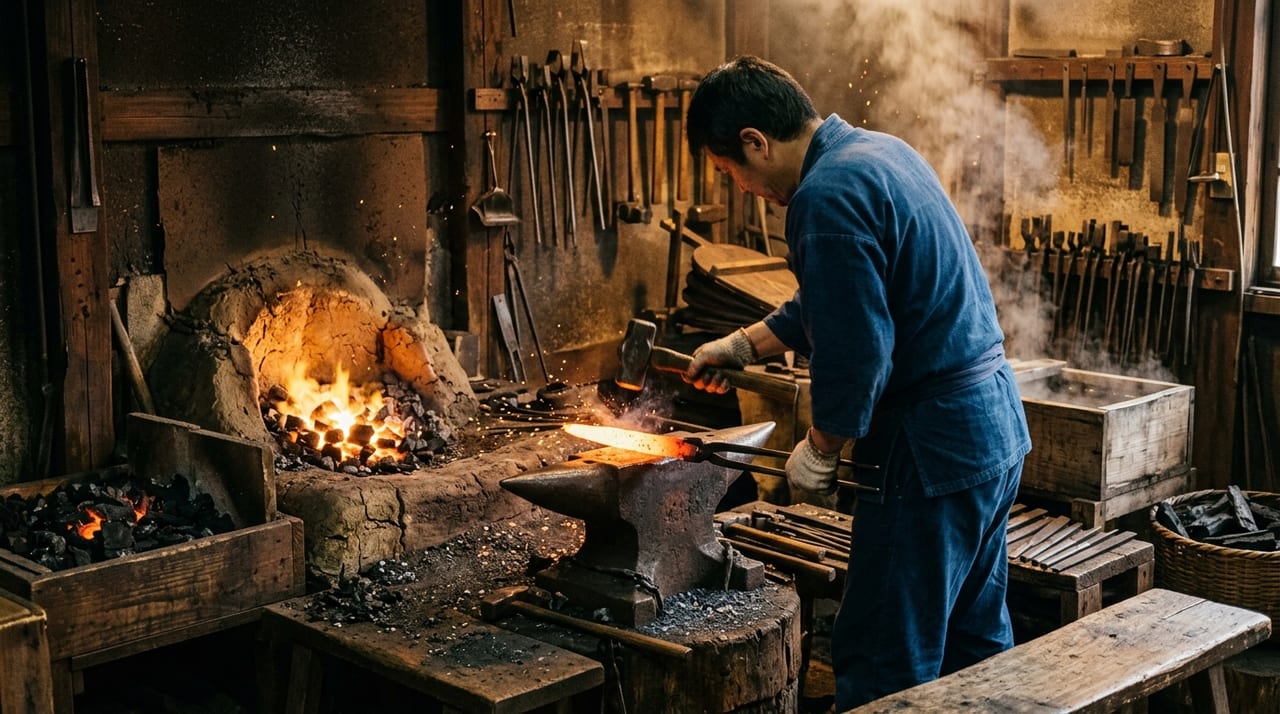
 * Image is for illustrative purposes only.
Hosokawa Masayoshi
細川正義
Description
Hosokawa Masayoshi was one of the representative smiths of the late Edo period's Shinshintō era, and is known as a leading disciple of Suishinshi Masahide. His common name is also transmitted as Chikara-no-suke Masayoshi. As a central figure in his teacher's fukkotō-ron, the movement to return to the style of the Kamakura-period kotō and to correct the ostentatious tendencies of the shintō, he had a major influence on the sword world of the late Edo period.
The greatest feature of Masayoshi's work is his high skill in faithfully inheriting his teacher Masahide's principles while using his own ingenuity to freely recreate classical styles such as the Sōshū-den and Bizen-den. His jigane has a tight ko-itame with good ji-nie, and his blades show a bright, clear finish with an antique, refined quality in the forging surface. His hamon is mainly gunome and notare. His works include rich examples aimed at a Sōshū-den-style nie-deki and splendid examples reproducing the Bizen-den-style chōji-midare. He is regarded as a representative example of the fukkotō-ron ideal embodied in the blade itself.
His works also clearly show the high technical standard characteristic of the Shinshintō period. As the age moved toward the end of the Edo period, demand for swords regained practical importance, and there was a need to mass-produce strong, beautiful blades that met the requirements of samurai. Masayoshi was known for meeting this demand while also producing high-quality pieces of great artistic merit. His eldest son, Hosokawa Masamori, later succeeded to the Tsuyama domain smith post.
In Bunka 14 (1817), he became a domain-retained smith of the Tsuyama Domain in Mimasaka Province. Inscriptions such as "Sakuyō Bakka-shi Hosokawa Masayoshi" are confirmed, and many examples survive in katana, wakizashi, and tantō. His taihai (overall form) is often archaistic, imitating the classical sword forms of the Kamakura to Nanboku-chō periods, which was characteristic of the Shinshintō period. Many examples are also transmitted in which he reconstructed sword forms after thoroughly studying old works, such as katana with the deep sori of a tachi and the imposing ō-kissaki.
At present, a tachi dated Tenpō 9 (1838) is designated a Tochigi Prefecture-designated cultural property, and a katana dated Tenpō 10 (1839) is designated a Kanuma City-designated cultural property. In the turning point of sword history that was the late Edo period, Hosokawa Masayoshi is a smith who gave technical substance to Suishinshi Masahide's archaistic ideals, and his name remains an important point of reference in Shinshintō research today.
Famous Works
- tachi signed Sakuyō bakkashi Hosokawa Masayoshi (Tenpō 9, Tochigi prefectural cultural property)
- katana signed Sakuyō bakkashi Hosokawa Masayoshi (Tenpō 10, Kanuma municipal cultural property)