Sashikomi-togi and Sashi-togi: The Staged Use of Whetstones and the Togishi's Philosophy of "Letting the Blade Live"
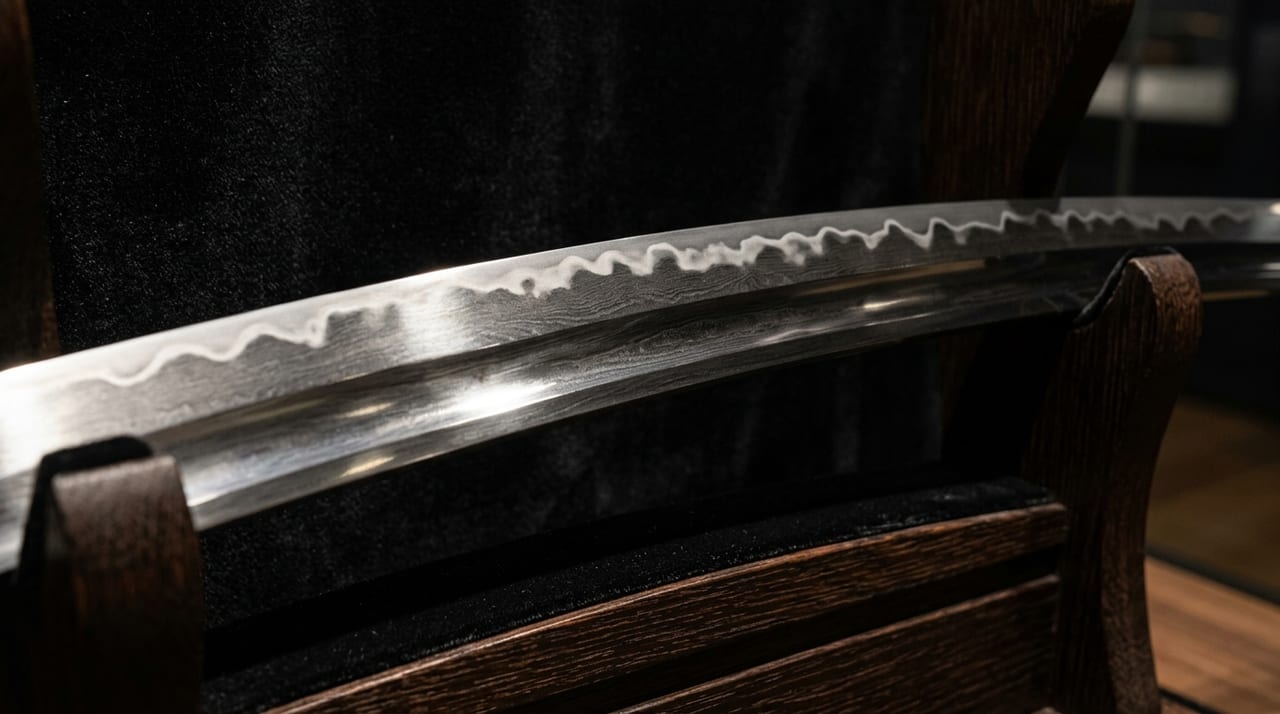 * Image is for illustrative purposes only.
Table of Contents
The Two-Phase Structure of Nihontō Polishing: Shitaji-togi and Shiage-togi
The polishing of a nihontō is broadly divided into two phases: "shitaji-togi" (foundation polishing) and "shiage-togi" (finish polishing). Shitaji-togi is rough work that shapes the blade, removes scratches, and prepares the foundation for polishing; shiage-togi is the delicate final stage that draws out the sword's "beauty" to the fullest.
The "sashikomi-togi" and "sashi-togi" explained in this article form the core of this shiage-togi. They are a technical system for bringing out to the maximum the two most important elements in the appreciation of a nihontō — "the brilliance of the hamon" and "the hada (surface texture) of the jigane" — and are also the stage where the skill and philosophy of the togishi are most clearly manifested.
What Is Sashikomi-togi?
Sashikomi-togi is a technique in which an extremely fine whetstone is applied to the blade at a very shallow angle — "inserted" (sashikomu) — to draw out the brilliance of the hamon. The whetstones used are natural stones such as "uchigumori-to" and "hatori-to," and among these, "Kyoto-produced uchigumori-to" is considered the finest quality.
The defining feature of sashikomi-togi is that it "intentionally finishes the jigane and the hamon with different polishing methods." The hamon (the boundary of the martensite structure formed by yaki-ire) and the jigane (the pearlite and ferrite structure) are fundamentally different in steel structure, and so even when polished with the same whetstone and the same pressure, they respond differently. Sashikomi-togi exploits this difference to make only the hamon area shine selectively and brightly.
In practice, the uchigumori-to is shaved thin and flat into "a small piece about the size of a little fingernail," which is then applied to the blade at a very shallow angle (approximately 10 to 15 degrees). The "hataraki (activity)" of the hamon — the fine structural variations such as nie, nioi, kinsuji, and sunagashi — are visually emphasized by this polishing.
Sashi-togi: The Technique of Bringing Out the Hada of the Jigane
If sashikomi-togi is the technique for drawing out "the beauty of the hamon," then sashi-togi is the technique for drawing out "the beauty of the jigane." In sashi-togi, the togishi attaches a thin piece of whetstone to the fingertip, or controls the whetstone with the fingertip, to finish the surface of the jigane with extreme delicacy.
The jigane has distinctive surface patterns produced by the method of forging: itame-hada, mokume-hada, masame-hada, ayasugi-hada, and others. These are the crystalline structures of the steel formed through tanren that appear on the surface through polishing.
The mechanism by which sashi-togi brings out the hada of the jigane lies in the minute differences in hardness between the metallic structures. The "flows" of itame and mokume and so on differ subtly in structural density, so when the same polishing is applied, microscopic peaks and valleys are created. These microscopic irregularities scatter light, turning the hada into a visible, expressive surface.
Sashikomi-togi and sashi-togi differ in their targets and methods of application. The foregoing can be summarized as follows.
| Technique | Target | Method of Application | Effect |
|---|---|---|---|
| Sashikomi-togi | Brilliance of the hamon | The uchigumori-to or hatori-to is applied at a very shallow angle (approximately 10–15 degrees), inserted into the blade | Visually emphasizes the hataraki such as nie, nioi, kinsuji, and sunagashi |
| Sashi-togi | Hada of the jigane | Finished with extreme delicacy using a thin piece of whetstone attached to the fingertip, or a whetstone controlled by the fingertip | Minute peaks and valleys arising from differences in structural density scatter light, turning the hada into a visible, expressive surface |
The Staged Use of Whetstones: A Systematic Approach from Coarse to Fine
The whetstones used in nihontō polishing are applied in stages according to coarseness (grit). The general flow of polishing is:
- Arato: Scratch removal and shape forming. The whetstone is coarse and removes a large amount of metal.
- Nakato: An intermediate stage that eliminates the scratches left by the arato.
- Uchigumori-to: The core of the finish polishing. Natural whetstones from Kameoka, Kyoto, are highly prized (the characteristics of whetstones by production region are summarized in this article).
- Hatori-to: A small whetstone for polishing the edge area specifically.
The polishing process using whetstones is complete at this point. The subsequent "nugui" (wiping) is a finishing treatment distinct from polishing with whetstones. Fine iron oxide powder (kin-hada, tetsu-hada) is mixed with chōji oil or camellia oil and wiped over the hamon, giving the jigane a deep luster. Nugui involves no cutting action, and is positioned as an independent technique separate from sashikomi-togi.
The uchigumori-to, in particular, is a special whetstone that satisfies the contradictory requirements of evening the polishing surface uniformly with consistent fine particles while giving brilliance without damaging the surface expression of the jigane. The reason Kyoto-produced stones are superior is said to be that the whetstones from this region have the right degree of "water retention" and "uniformity of abrasive particles," but geological research into the underlying mechanism is still ongoing.
The Togishi's Philosophy: Not "Polishing" but "Drawing Out"
To discuss the techniques of sashikomi-togi and sashi-togi, it is important to understand the togishi's philosophy — "not to polish the sword, but to draw out the sword's inherent beauty."
The meaning of this philosophy is profound. It is not that the sword's "appearance improves" as the togishi applies polishing, but rather that the essential beauty of the sword — the hamon, the jigane, the sori — is expressed in a form visible to the human eye. Excessive polishing crushes the hada of the jigane and flattens the minute hataraki of the hamon. True skill is revealed not in "how much to polish" but in "where to stop."
This philosophy also resonates with the Buddhist aesthetic sensibility of "wabi" and "sabi." The sensibility that finds beauty in the incomplete, the empty space, and natural change also flows through the togishi's aesthetic of self-restraint — "not over-polishing."
The Difficult Problem of Rust Removal: The Ethics of Polishing
In the ethics of the togishi, a particularly difficult problem is "how to remove rust (sabi)." Kotō often develop rust from long years in storage conditions. Superficial rust can be removed by polishing, but deep rust has penetrated the jigane, and removing it by polishing risks losing the very structure of the jigane.
The rule that modern togishi share as "the ethics of polishing" is: "For swords with cultural heritage value, preserve as much of the iron (kurogane) material as possible." Rather than removing all rust to produce a perfect brilliance, it is considered correct in the preservation of swords as cultural heritage to respect the kotō's inherent "ko-mi (antique patina)" — the deep tonal quality arising from rust (this criterion is discussed in further detail in this article).
Technical Challenges for Modern Togishi: The Depletion of Traditional Whetstones
The uchigumori-to that determines the quality of sashikomi-togi and sashi-togi is a natural whetstone and therefore limited in the amount that can be quarried. The finest veins of uchigumori-to in Kameoka, Kyoto, were substantially quarried in the latter half of the 20th century, making it increasingly difficult to obtain high-quality stones year by year.
In response to this challenge, improvements to synthetic whetstones (industrial products) have progressed, but completely reproducing the polishing characteristics of natural whetstones remains difficult to this day. Among togishi, "inventory management" of high-quality uchigumori-to has become a matter of survival, and securing whetstones is intertwined with the issue of togishi retiring and their successors.
The two techniques of sashikomi-togi and sashi-togi go beyond mere craft skill — they are also a philosophical practice for passing on the nihontō as a cultural heritage to the next generation "in visible form." If the beauty of the sword is "the result of the tōkō's work," then making it visually manifest is "the essence of the togishi's work."