How to Tell nie from nioi — A Practical Guide to Appreciating the Hamon of Japanese Swords
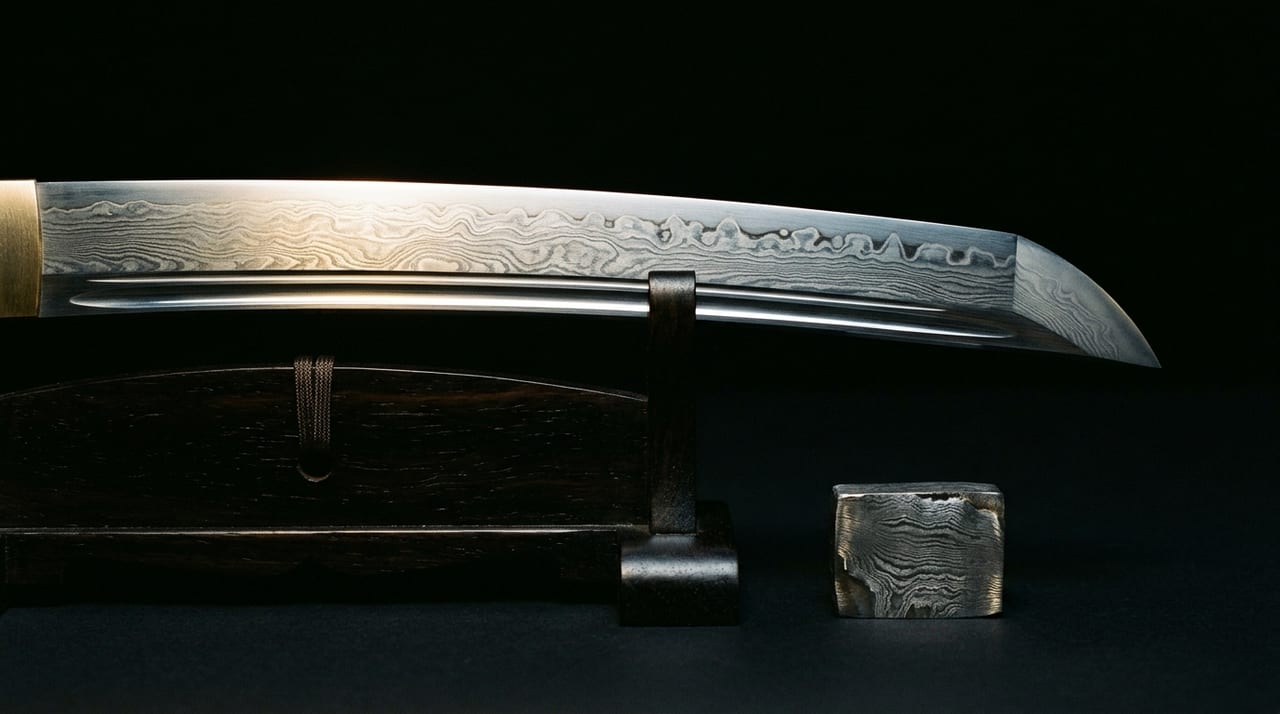 * Image is for illustrative purposes only.
Table of Contents
nie and nioi — The Greatest Challenge in Japanese Sword Appreciation
When discussing the hamon (temper line) of a Japanese sword, the two technical terms nie and nioi are unavoidable. Yet these two words are also the concepts that cause the most confusion for those new to the world of swords.
"What is the difference between nie and nioi?" is one of the questions that sword appraisers, togi (polishing) artists, and enthusiasts most often receive from beginners. This article explains these two concepts step by step, from their scientific metallurgical background to practical identification methods.
Defining nie and nioi — Understanding Them Through Metallurgy
To accurately understand the difference between nie and nioi, one must first know the mechanism of yaki-ire (quenching) in Japanese swords.
The basics of yaki-ire (quenching): Yakiba-tsuchi (clay coating) is applied to the blade body, which is then heated in a furnace and rapidly cooled in water. This rapid cooling causes a martensitic transformation (hardening) at the cutting edge, producing the hard yakiba (hardened edge). The hamon is visualized as the boundary line between this hardened portion and the softer portion.
What nie actually is: Nie is the granular white sparkle that appears near the boundary of the hamon. Metallurgically, it is the phenomenon in which martensite particles reflect light and become visible, the particles being large enough to identify with the naked eye (ranging from tens to hundreds of micrometers). Descriptions such as "like scattered sand" or "like frost settling" are commonly used.
What nioi actually is: Nioi is what appears when the nie particles become even finer and more densely packed, manifesting as a hazy, spreading boundary. The individual particles are too small to identify, and the entire boundary zone appears to smoke with whiteness. Expressions such as "haze," "mist," and "smoke" are applied to it. The mechanism by which the state of particle aggregation determines the texture of the hamon edge is explored further in nie-deki and nioi-deki.
Comparing nie and nioi — A Summary in Table Form
| Comparison item | nie | nioi |
|---|---|---|
| Particle size | Large (identifiable with the naked eye) | Small (difficult to identify with the naked eye) |
| Appearance | Sandy, sparkling | Hazy, spreading white blur |
| Representative schools | Sōshū-den, Yamato-den, Yamashiro-den | Bizen-den, Mino-den |
| Cooling speed | Rapid cooling (lower water temperature) | Somewhat gradual cooling |
| Aesthetic impression | Powerful, intense | Delicate, elegant |
Hamon Rich in nie — The "Strong nie" of Sōshū-den
The hamon of Masamune and Sadamune, the most representative tōkō (swordsmiths) of Sōshū-den, are known for their "strong nie."
In the hitatsura seen in the work of Hiromitsu and Akihiro and other Sōshū-den tōkō of the Nanbokuchō period, nie spreads even into the jigane (steel of the blade surface) on the mune (back of the blade) side, causing the entire blade to sparkle. This is also called nie-kuzure, a phenomenon in which nie crosses the hamon boundary and invades the jigane.
The tōkō of Yamato-den (Nara) also work primarily in nie-deki, but their nie is less wild than that of Sōshū-den, tending instead to give an impression of "orderly nie."
Hamon Rich in nioi — The "nioi-deki" of Bizen-den
The hamon of the Fukuoka Ichimonji and Osafune schools, the most representative of Bizen-den (Okayama), are fundamentally nioi-deki. The outline of each chōji in the chōji hamon spreads in a hazy way, and there is an elegance well described as "like chōji flowers in bloom."
By contrast, the tōkō of Yamashiro-den (Kyoto) — including the Awataguchi family and the Rai School — primarily work in ko-nie-deki, with fine, evenly distributed nie particles. The "fine, uniform ko-nie" seen in tantō by Yoshimitsu is achieved through precise control of the hamon boundary, and the high level of skill manifests as "the beauty of refined nie." For a school-by-school comparison of the stylistic differences between Sōshū-den and Bizen-den, Sōshū-den vs Bizen-den is a useful reference.
Intermediate Forms — The Concepts of "ara-nie / ko-nie" and "nioi-kuzure"
Nie and nioi are not a binary opposition but a continuous gradient. Knowing the following intermediate concepts broadens the depth of one's appreciation.
ara-nie: Nie whose particles are especially large and rough. Seen in the powerful hamon of Sōshū-den.
ko-nie: Nie whose particles are small and uniform. The texture is close to nioi, but the particles can be confirmed when a strong light is applied.
nie-ashi: A phenomenon in which nie particles extend from the hamon boundary toward the cutting edge. One of the aesthetic expressions of the sword.
nioi-kuzure: A phenomenon in which nioi breaks down in places and becomes uneven. Technical evaluations differ, but it is sometimes appreciated as an intentional expression.
How to Actually Tell Them Apart — Steps for Appreciation
The steps for actually distinguishing nie from nioi are explained below.
Step 1: Fix the light source and move the sword. Prepare a point-source incandescent bulb or spotlight, and alternately "lay the blade down" (tilting it toward the shinogi (ridge line)) and "raise it up" (tilting it toward the cutting edge).
Step 2: Observe the "texture" of the hamon boundary. If the boundary "sparkles with a grainy, rough texture" → nie-deki If the boundary "spreads in a hazy, blurring way" → nioi-deki
Step 3: Confirm with a loupe. Use a 10× to 20× loupe and observe the hamon boundary under magnification. If individual particles are visible → nie. If the particles are too fine to identify → nioi.
Step 4: Look at the "width" of the boundary. The hamon of nie-deki has a relatively clear, sharp boundary width. Nioi-deki tends to have a wide boundary that gives the impression of a gradual transition.
Impact on Authentication — How the Evaluation Changes Depending on nie or nioi
The identification of nie and nioi is an important piece of evidence that bears directly on authenticating a sword's place of origin, school, and period.
- "Strong nie + large irregular hamon" → high likelihood of Sōshū-den
- "Nioi-deki + chōji hamon" → high likelihood of Bizen-den
- "Ko-nie + suguha (straight temper line)" → possibility of Yamashiro-den or Yamato-den
These are tendencies only, however, and there are many exceptions. In the shintō and shinshintō of the Edo period and later, blending of multiple traditions is common, and it is difficult to determine place of origin from nie and nioi identification alone. Comprehensive assessment of jigane, blade shape, bōshi (temper line in the point), nakago mei (signature on the tang), and other factors is the foundation of authentication.
Summary — "Moving Sand Grains" or "Spreading Haze"?
To express the difference between nie and nioi in a word:
- nie is "a sparkle like moving sand grains"
- nioi is "a blur like spreading haze"
These two forms of beauty embody the differences in aesthetic sensibility across regions, schools, and periods of Japanese swords. The raw power of Sōshū-den's wild nie and the elegance of Bizen-den's delicate nioi — it is not a question of which is superior; each is the crystallization of a different technical approach and aesthetic philosophy.
When looking at a hamon, keeping the question "is this nie, nioi, or both?" in mind as you observe will deepen your appreciation of Japanese swords by another level.