A Practical Guide for Inbound Foreign Visitors Purchasing Swords at Japanese Sword Dealers — Procedures, Bringing Swords Home, and Choosing Reliable Shops
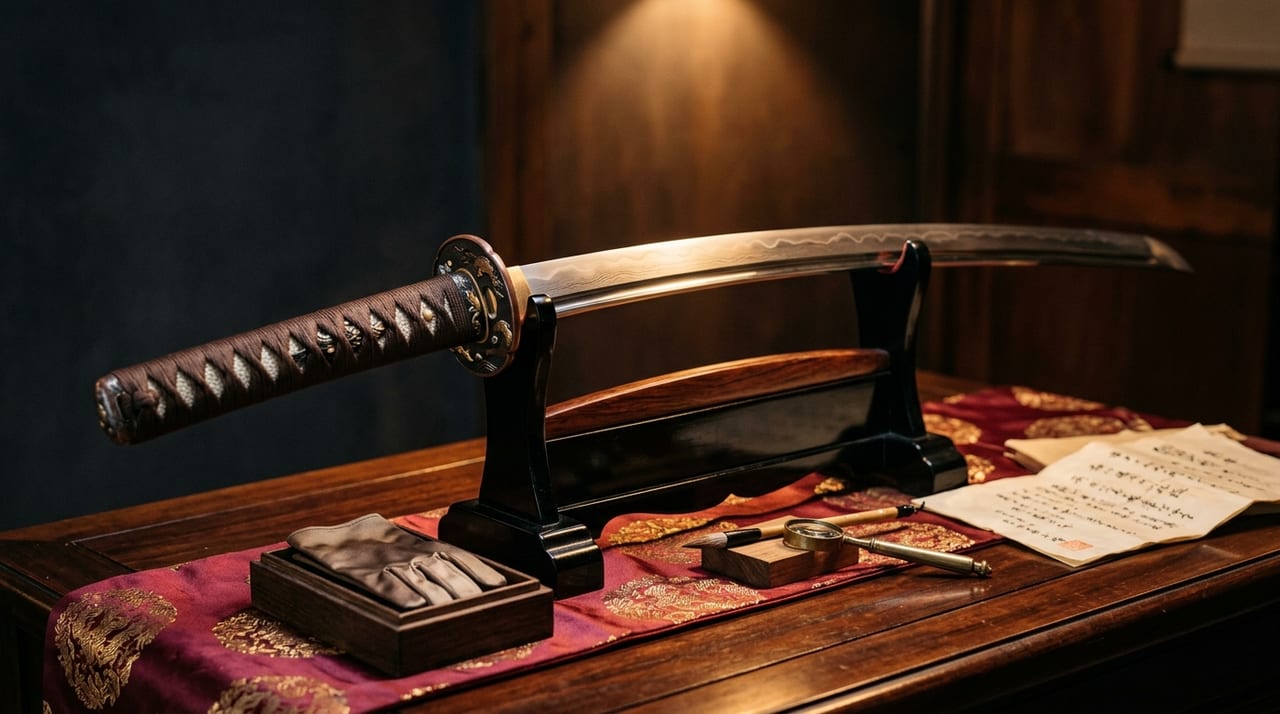 * Image is for illustrative purposes only.
Table of Contents
What Foreign Visitors Wanting to Buy a Nihontō in Japan Need to Know First
When a foreign collector visiting Japan thinks "I want to buy a real nihontō here in Japan," there is one important fact they need to know first.
Purchasing a nihontō is legal even for foreigners — however, the proper procedures must be followed. Conversely, ignoring the procedures carries the risk of having the sword confiscated upon returning home.
This article explains in detail everything from the legal requirements for inbound foreign visitors purchasing a nihontō at a domestic sword dealer in Japan to a practical shopping guide and the procedures for bringing the sword home.
The Legal Status of Nihontō — What Is a Registration Certificate?
In Japan, under the Act for Controlling the Possession of Firearms or Swords and Other Such Weapons (Jūtōhō), possessing a nihontō requires a "registration certificate (torokusho)."
What is a registration certificate: A document issued by the Board of Education of each prefecture (Article 14 of the Jūtōhō; Act for Controlling the Possession of Firearms or Swords and Other Such Weapons (e-Gov Law Search)) that certifies that a specific sword "has been properly registered as a work of art." Swords with a registration certificate may be legally possessed and bought or sold.
Foreign collectors and registration certificates:
- Even foreign tourists may legally purchase a sword with a registration certificate within Japan
- After purchase, possessing the sword within Japan (including keeping it at a hotel) is not a problem as long as the registration certificate is present
- When returning home, a separate "export procedure" is required (described later)
Note: Swords that have not been registered (unregistered swords) may not in principle be purchased or possessed (Article 3, Paragraph 1 of the Jūtōhō). Trustworthy sword dealers always sell swords with a registration certificate.
How to Identify a Reliable Sword Dealer — An Area Guide for Tokyo, Osaka, and Kyoto
When an inbound foreign visitor purchases a nihontō, the most important thing is "choosing a reliable shop."
How to identify a reliable shop:
- Member shops of the All Japan Tosho Association and the National Sword Dealers Cooperative: membership in industry organizations is one measure of trustworthiness
- Track record with NBTHK: shops that handle swords with kanteisho issued by NBTHK (Society for the Preservation of Japanese Art Swords)
- Availability of English support: shops that have English-speaking staff or English materials for inbound foreign visitors have experience with foreign customers
- Shop history and location: sword dealers with a long-established physical storefront (50 years or more) have a high degree of trustworthiness
- Issuance of receipts and certificates: shops that provide proper receipts and support for export procedures have high transparency
Major sword dealer districts by area:
- Tokyo — Kanda to Okachimachi area: a traditional area where sword dealers and antique dealers are concentrated
- Tokyo — Ginza to Nihonbashi area: many long-established shops handling high-end swords
- Kyoto — Teramachi-dori and Shinmonzen-dori area: antique and sword dealers line the streets
- Osaka — Namba to Shinsaibashi area: several sword specialty shops are present
A Guide to Price Ranges — How Much to Budget Depending on What You Buy
The following shows approximate price ranges for inbound foreign visitors actually considering a purchase.
| Category / Quality | Price Range (approximate) | Features |
|---|---|---|
| Entry class (Hozon Tōken, gendaitō) | 50,000–300,000 yen | With NBTHK Hozon kanteisho; mass-produced to unsigned swords in good condition |
| Mid-range class (Tokubetsu Hozon, renowned Edo-period smiths) | 300,000–1,500,000 yen | Authentic works by well-known tōkō or notable Edo-period signed pieces |
| High-end class (Jūyō Tōken and above) | 1,500,000–over 10,000,000 yen | Pieces designated Jūyō Tōken or Tokubetsu Jūyō Tōken |
| Kokuhō, jūyō bunkazai | Tens of millions to hundreds of millions of yen | Do not in principle come onto the market |
For a foreigner making their first purchase, the 50,000–300,000 yen "Hozon Tōken" class is a realistic option that keeps risks low while still acquiring a genuine sword with a kanteisho.
The In-Store Purchase Procedure — How It Actually Works
The following describes how the process actually unfolds from visiting a sword shop to completing a purchase.
Step 1: Entering the shop and viewing
- Many sword shops can be entered without a reservation, but for high-end shops it is advisable to contact them in advance
- Always obtain the staff's permission before "picking up" a sword (there is proper etiquette for handling swords)
- For a sword that interests you, telling the staff "Can I see this?" will allow you to view it
Step 2: Checking the registration certificate
- Before purchasing, check the original "registration certificate (torokusho)"
- The registration certificate states the sword's type, nagasa (blade length), mei (signature), and registration number
- Confirm that the sword you are purchasing matches the details on the registration certificate
Step 3: Price negotiation
- At Japanese sword shops, price negotiation may or may not be possible
- Many shops will agree to a discount for multiple purchases or cash payment
- Swords with high-tier NBTHK kanteisho (Jūyō or Tokubetsu Jūyō) often have a fixed price
Step 4: Purchase and documentation
- At the time of purchase, obtain a "sales contract (or receipt)" and a "copy of the registration certificate"
- A name-change procedure for the sword (notification to the prefectural Board of Education) may be required; in many cases the shop will handle this procedure on the buyer's behalf
Bringing the Sword Home — Everything About the Export Procedure
Several procedures are required to bring a purchased nihontō back to one's home country.
Procedure 1: Applying to the Agency for Cultural Affairs for an antique arts export inspection certificate When taking a nihontō registered as a work of art (an antique art object) overseas, an application to the Agency for Cultural Affairs is required under the Act on Protection of Cultural Properties. At the time of application, a copy of the registration certificate and other documents are submitted to obtain an "antique arts export inspection certificate." For standard export of art swords, the procedures of the Ministry of Economy, Trade and Industry (METI) and the Foreign Exchange and Foreign Trade Act do not apply.
Where to apply: Agency for Cultural Affairs (apply by mail; the address and forms can be confirmed on the Agency for Cultural Affairs website) Required documents: application form, photographs of the sword (both sides of the entire blade and the nakago), a copy of the front of the registration certificate, a return envelope for the certificate From application to issuance of the certificate: apply with ample time to spare
Procedure 2: Confirming that the sword is not a kokuhō, jūyō bunkazai, or jūyō bijutsuhin Swords designated as kokuhō (National Treasure) or jūyō bunkazai (Important Cultural Property), and swords recognized as jūyō bijutsuhin (Important Art Object), may not in principle be exported (Act on Protection of Cultural Properties, etc.). Whether a sword falls into these categories is verified by the Agency for Cultural Affairs through the antique arts export inspection certificate in Procedure 1 (Agency for Cultural Affairs, "Antique Arts Export Inspection Certificate"). An NBTHK kanteisho is a private appraisal and does not indicate a national designation or recognition.
Procedure 3: Customs declaration At customs upon departure, present the antique arts export inspection certificate (the original is submitted to customs), the registration certificate, and the sword to make an export declaration. Once the sword is taken out of Japan, the registration certificate becomes invalid at that point, and must be returned to the Board of Education of the prefecture where it was registered (Tokyo Metropolitan Board of Education, "When Exporting Firearms, Swords, and Similar Items").
Procedure 4: Procedures in the destination country When bringing the sword back home, the weapons import regulations of the destination country must be followed. Depending on the country, advance permission may be required (check requirements for the EU, the United States, Australia, and other countries).
Transportation Methods — Carry-On Is Not Permitted
An important note: nihontō may absolutely not be brought onto an aircraft as carry-on baggage.
Recommended transportation methods:
- International shipping by a specialist carrier (most recommended): use a carrier specializing in sword transportation or an art shipping specialist. Comes with insurance for peace of mind
- Sending by post or courier: Japan Post does not list swords among items prohibited worldwide, but items such as blades with an edge of 15 cm or more placed in international airmail must have an "international mail dangerous-items label" attached and may be returned without being loaded onto an aircraft (Japan Post, "Items That Cannot Be Sent as International Mail"). Whether courier services accept swords differs by carrier. In all cases, it is necessary to check the regulations of the destination country
- Air cargo: can be loaded if declared as proper cargo
Reliable sword shops often have a network of shipping carriers and can be asked for transportation support at the time of purchase.
Useful English Phrases for Buying Swords
The following useful English expressions will help with communication at a sword shop.
- "Can I see this sword?" — Can I see this sword?
- "Does it have a registration certificate?" — Does it have a registration certificate?
- "Do you have an NBTHK appraisal certificate?" — Do you have an NBTHK appraisal certificate?
- "Can you help with the export procedure?" — Can you help with the export procedure?
- "What is your best price?" — What is your best price?
- "Can you ship it to my country?" — Can you ship it to my country?
Summary — Keys to a Successful Sword Purchase During Your Visit to Japan
Here is a summary of the key points for inbound foreign visitors to purchase a nihontō safely, legally, and with satisfaction.
- Purchase only swords with a registration certificate (unregistered swords are illegal)
- Choose a reliable long-established shop or a shop that is a member of an industry organization
- Allow time before departure to submit the export inspection certificate application to the Agency for Cultural Affairs
- Entrust sword transportation to a specialist carrier (carry-on is not permitted)
- Check the import regulations of the destination country in advance
By following the correct procedures, foreigners too can legally purchase a genuine nihontō in Japan and bring it home. Preparation in advance and choosing a reliable shop are the surest paths to the best possible sword-buying experience.