Ōsumi Toshihira's Straight-Edge Technique — The Pinnacle of "Suguha" Pursued by a Contemporary Mukansa Swordsmith
 * Image is for illustrative purposes only.
Table of Contents
Ōsumi Toshihira and Straight-Edge — The Most Difficult Blade Pattern Chosen by a Master
Ōsumi Toshihira (大隅俊平, b. 1941) holds the highest position among contemporary Japanese swordsmiths: the title of "Mukansa" (無鑑査). Mukansa is the highest-ranking qualification recognized by the Japanese Sword and Art Sword Preservation Society (NBTHK), literally meaning a status that allows one to exhibit and display works "without examination." Very few active swordsmiths hold this position.
Ōsumi Toshihira's signature is the straight-edge blade (直刃, suguha) — a blade pattern that appears deceptively simple at first glance, with the edge running in a straight line. In modern Japanese sword circles where ornate patterns like notched blades (丁子), wavy patterns (互の目), and all-over hardened edges (皆焼) attract attention, why does the master choose straight-edge continuously? The answer lies in both the technical difficulty and the aesthetics of this pattern.
Why Straight-Edge Is "The Most Difficult Blade Pattern"
Straight-edge appears simple on the surface. Yet its degree of control is among the highest in Japanese sword blade patterns.
Reason 1: No room for error or concealment Notched and wavy patterns, due to their complex shapes, allow slight irregularities and unevenness to be absorbed into the overall beauty. But straight-edge is a single line extending unbroken, so even minor waviness becomes immediately visible as a "flaw." The examiner's eye catches every deviation in a straight-edge.
Reason 2: Extreme uniformity in clay application required Blade patterns are created by the application of hardening clay (焼刃土, yakiba-tsuchi). To finish a beautiful straight-edge, clay must be applied uniformly just a few millimeters from the edge, and upon quenching (rapid cooling) it must harden precisely as applied. Even a 0.1mm variance in clay thickness will compromise the uniformity of the straight-edge.
Reason 3: Uniform nioe appearance is extremely challenging A quality straight-edge displays fine granular patterns (沸, nie) spreading evenly along the edge boundary — called "small nie appearance" (小沸出来, ko-nie deki). Achieving this uniformity requires precise control of water temperature during quenching, the angle at which the blade is immersed, and the speed of withdrawal.
Reason 4: The tip pattern reveals everything The blade pattern at the tip, called the "hat" (帽子, boushi), demonstrates the overall quality of the finished blade. With straight-edge, the shape and depth of the hat's return stand out as isolated focal points, so any crudeness in execution becomes obvious.
Ōsumi Toshihira's Straight-Edge — Technical Analysis
Among experts, Ōsumi Toshihira's straight-edge works are sometimes praised as "the most highly refined straight-edge seen in contemporary times." Technical characteristics:
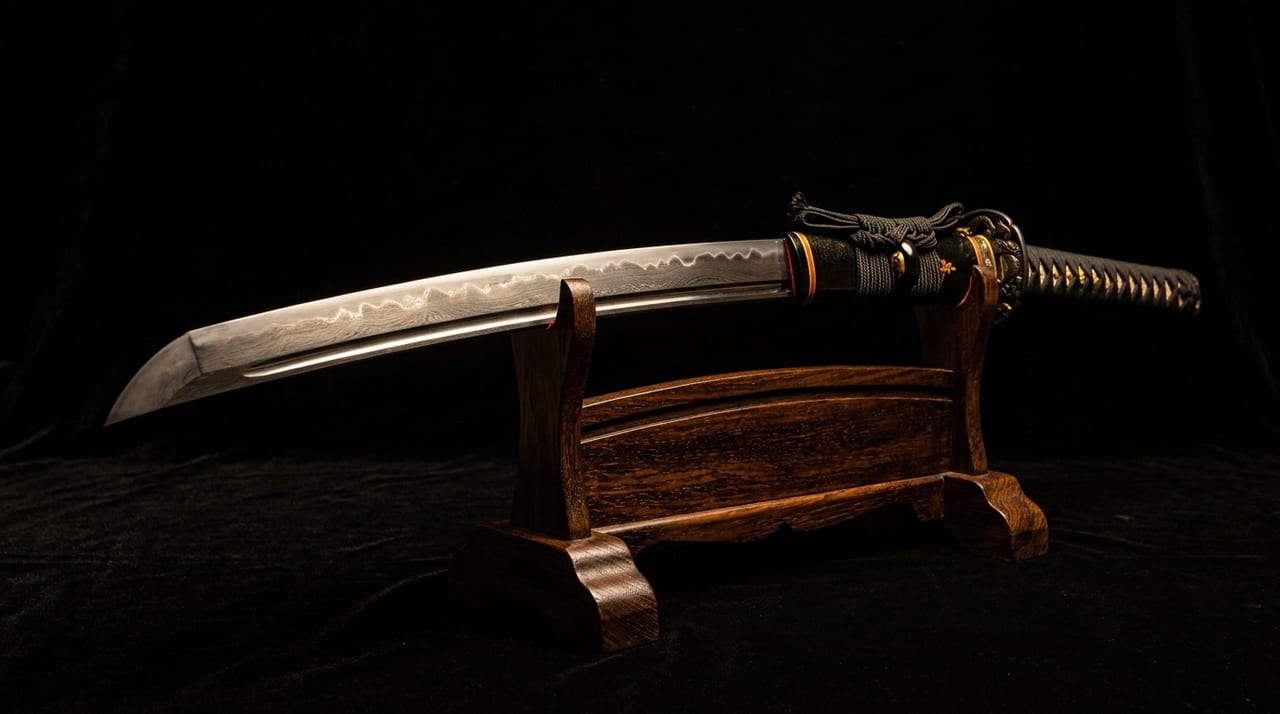
Clarity of edge boundary and quality of fine granulation: Ōsumi's straight-edge demonstrates an exceptionally clear edge boundary, giving the impression of a "sharply cut" line. Simultaneously, fine granules spread uniformly along the boundary, so the line appears not as a rigid boundary but as a "living edge."
Nioe-ashi (granule extensions): Ōsumi's straight-edge shows appropriate presence of "nioe-ashi" — fine granules extending from the boundary toward the edge. Neither excessive nor deficient, the quantity and length of these granule extensions impart movement and vitality to the straight-edge.
Unity with the steel body: Ōsumi Toshihira is highly regarded for the craftsmanship of the steel body (地鉄, jigane) itself, and his works are characterized by "unity" where the beauty of the straight-edge and the quality of the steel enhance each other. The uniform tightness of the board-grain pattern combined with the linearity of the straight-edge creates a "serene beauty."
Why Straight-Edge — Ōsumi Toshihira's Aesthetics
Sword experts point to multiple reasons why Ōsumi Toshihira centers his work around straight-edge.
Devotion to Yamashiro and Yamato traditions: Ōsumi Toshihira's style is strongly influenced by the Yamashiro and Yamato schools. These traditions take the straight-edge as their primary form, pursuing the "beauty of stillness" rather than the notched patterns of Bizen or the wild variations of Soshu tradition. Ōsumi can be understood as embodying this aesthetic in contemporary times.
The craftsman's logic: "Difficulty holds value": Master craftsmen often embrace the stance of "engaging with that which allows no concealment." Straight-edge exemplifies this, and Ōsumi Toshihira's continued pursuit of this pattern as a Mukansa swordsmith can be interpreted as an expression of craftsman's pride.
Differentiation in the contemporary market: While many modern swordsmiths work with ornate notched or all-over hardened patterns, Ōsumi Toshihira's straight-edge has established a unique brand as "the pinnacle of stillness."
Appreciating Straight-Edge Works — How to Properly View Ōsumi's Creations
Points to observe when appreciating an Ōsumi Toshihira straight-edge work:
- Uniformity of edge boundary: Does the straight-edge run consistently in width from edge to back?
- Density of fine granules: Are fine granules spread uniformly along the edge boundary, without sparse sections?
- Quality of the tip pattern: How refined is the hat pattern at the tip? Is it small or medium rounded? What is the depth of the return?
- Harmony with the steel body: Does the beauty of the straight-edge harmonize with the quality of the steel?
- Blade curvature (sori): Ōsumi's curve follows traditional forms, and the overall proportions of the blade are also objects of appreciation.
The Meaning of Mukansa — Ōsumi Toshihira's Position
In the world of Japanese swords, swordsmiths submit works to NBTHK's "New Swords Meritorious Works Exhibition" and receive certifications in stages based on examination results. "Mukansa" represents the highest rank, a status that exempts one from examination requirements for exhibition.
This status is judged not only on technical evaluation but comprehensively, including contribution to the broader sword-collecting world, mentorship of successors, and commitment to the transmission of traditional techniques. Ōsumi Toshihira's achievement of this status means that the contemporary Japanese sword world recognizes his technical skill, aesthetic sensibility, and approach to craftsmanship as the highest standard.
Collecting and Appreciating Ōsumi Toshihira's Works
Ōsumi Toshihira's works, centered around award-winning pieces from the Meritorious Works Exhibition, can be viewed at the Japanese Sword Museum (Ryogoku, Tokyo) and at various sword exhibitions throughout Japan. They are also often held in private collections and appear at sword dealers and auctions.
Price ranges for new swords vary from several million to over 10 million yen, differing greatly depending on the blade's quality, length, and exhibition history. As works by a living Mukansa swordsmith, they receive the highest market evaluation, and collectors have strong interest from the perspective of long-term value retention.
Conclusion — The Craftsman's Way Embodied by Unwavering Dedication to Straight-Edge
Analysis of Ōsumi Toshihira's straight-edge technique reveals the core of Japanese craftsmanship: "The deepest technique dwells in that which appears most simple."
Straight-edge lacks the ornate beauty of notched patterns and the dramatic intensity of all-over hardened edges. Yet the technical difficulty and aesthetic sensibility contained in that single line represent the crystallization of a beauty aesthetic perfected over more than 700 years of Japanese sword history. As the contemporary master continues to walk this path, the "serene beauty" of straight-edge is assuredly transmitted to the next generation.